C1.11; E1.11 - Simplifying and sharing ratios
A ratio compares quantities by equal-sized parts. You will put quantities into common units, simplify ratios with two or three terms, and divide a total fairly according to a stated ratio.
Ratios and common units
A mix uses of flour and of sugar. Is there really less flour because is smaller than ? The units tell a different story. You must compare the same kind of quantity in the same units.
Ratio
A ratio compares the relative sizes of quantities in a stated order. Flour : sugar means four equal parts of flour for each one equal part of sugar. The parts have the same size, but that size is not fixed by the ratio alone.
Order matters: flour : sugar is the same comparison as sugar : flour . It is not the same recipe as flour : sugar .
Worked example 1: kilograms and grams
Question. Write the ratio of of flour to of sugar in its simplest form.
Plan. Convert kilograms to grams, then divide both terms by the same number.
Answer. .
Check. . There is four times as much flour as sugar.
Now increase only the sugar mass by a factor of ten. That changes the ratio, even though the unit conversion stays the same.
Worked example 2: the same units, a different comparison
Question. Write the ratio of of flour to of sugar in its simplest form.
Plan. Compare both masses in grams, then find a common factor.
Answer. .
Check. Two parts of give ; five give . Flour is now the smaller quantity, as the answer shows.
Watch out
does not compare these masses correctly: the first number counts kilograms and the second counts grams. Convert first. You may use either common unit, provided both quantities use it.
Simplifying ratios
Equivalent ratios describe the same comparison using differently sized parts. For example, and have the same meaning because every term has been divided by . Dividing only one term would change the comparison.
Simplest form of a ratio
A ratio is in simplest form when its terms are whole numbers with no common factor greater than . For a three-term ratio, consider factors common to all three terms.
Decimal terms can be cleared by multiplying every term by , , or another suitable power of ten. Fractional terms can be cleared by multiplying every term by a common denominator. For instance, becomes after multiplying both terms by . Then simplify the whole-number ratio if needed.
Worked example 3: removing decimals
Question. Simplify .
Plan. Make both terms whole numbers before removing their common factor.
Answer. .
Check. Multiplying both answer terms by gives , recovering the original comparison.
Add a third quantity while retaining the first two. Every operation must now affect all three terms.
Worked example 4: three quantities
Question. Simplify .
Plan. Clear the decimals in all three terms and divide by their highest common factor.
Answer. .
Check. Multiplying all three terms by recovers . No integer greater than divides all of .
Watch out
Subtracting a fixed number does not preserve a ratio: does not simplify to . The first comparison has value , while the second has value . Use multiplication or division by the same non-zero factor.
Sharing a quantity in a ratio
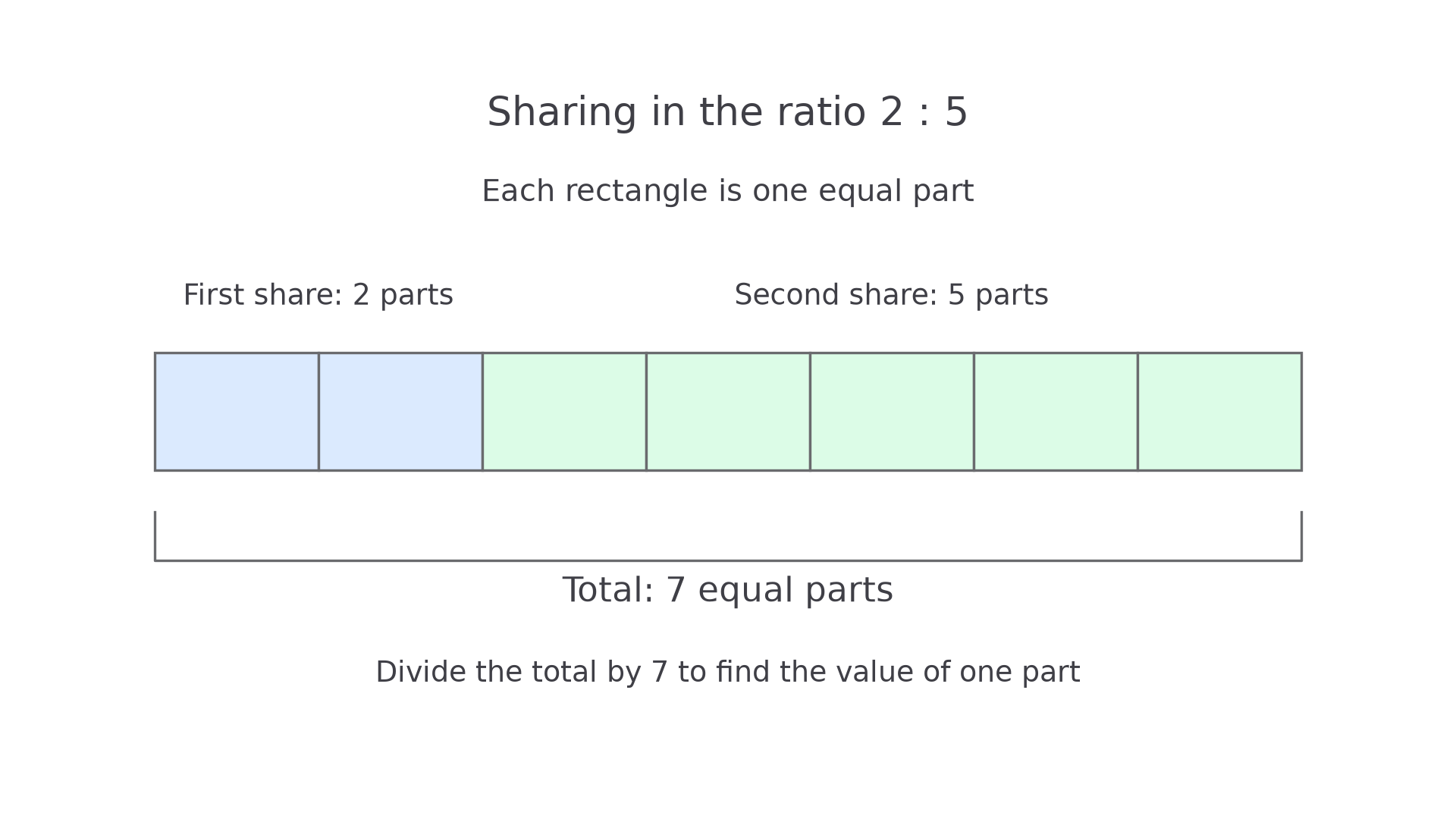
When a total is shared in a ratio, add the ratio terms to find how many equal parts make the whole total. Divide the total by that number, then multiply by the number of parts each person receives.
For , the first share is of the total, not : the total consists of both shares together. This is the link between ratios and fractions.
[DIAGRAM: asset_name: Seven equal ratio parts; asset_slug: ratio_equal_parts; caption: A 2 to 5 share contains seven equal parts altogether.; description: Seven equal adjacent rectangles form one bar. The first two are pale blue and labelled first share, 2 parts. The last five are pale green and labelled second share, 5 parts. A bracket beneath the whole bar is labelled total, 7 equal parts.]
Worked example 5: two shares
Question. Divide \84=2:5$.
Plan. Find the value of one of the seven equal parts.
Answer. Ana receives \24$60$.
Check. , and . Check both the total and the ratio.
Keep the total and the first two ratio terms, but introduce a third recipient. The total number of parts changes, so the old part value cannot be reused.
Worked example 6: three shares
Question. Divide \842:5:7$.
Plan. Share the total among fourteen equal parts.
Answer. Ana receives \12$30$42$.
Check. , and dividing the shares by gives .
The value of one part need not be a whole number. Keep it exact until the shares are found. If a problem involves indivisible objects, such as people, check that the proposed shares are whole numbers before accepting the model.
Watch out
The number you divide by is the sum of the ratio terms. Dividing by in the first example treats the second share as if it were the whole total.
Quick Recap
- Compare like quantities in common units and preserve the stated order.
- Multiply or divide every ratio term by the same non-zero factor.
- Simplest form has whole-number terms with no common factor greater than .
- To share a total, find the total number of equal parts, then the value of one part.
The opening mixture contains four times as much flour as sugar: .