E7.4 - Parallel vectors and collinear points
Vector algebra can prove a geometric relationship even when a drawing is not to scale. You will recognise scalar multiples, justify collinearity using a common point, and connect ratio paths to similar triangles. These are geometric reasoning applications of E7.4.
Parallel vectors as scalar multiples
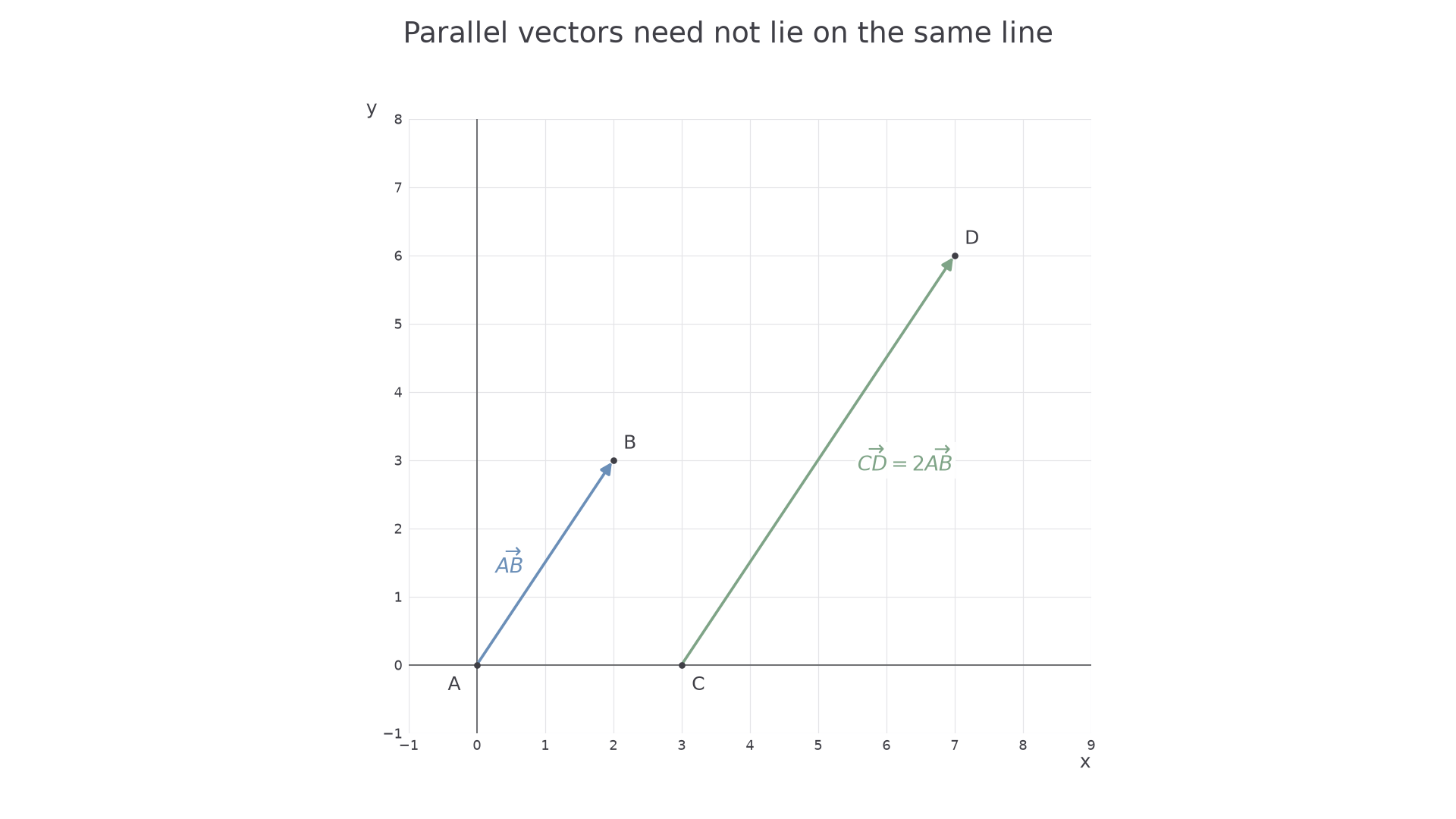
If two arrows are parallel, must all four endpoints lie on one straight line? No: the arrows can lie on separate parallel lines. We need to distinguish a relationship between directions from a claim about points.
Parallel vectors
Two nonzero vectors are parallel when one is a nonzero scalar multiple of the other. A positive multiple points in the same direction; a negative multiple points in the opposite direction. Their drawn segments can lie on the same line or on separate parallel lines.
Multiplying both components by the same scalar changes length without introducing a new direction. To show parallelism, state the actual scalar relationship. For expressions in two vectors, collect the coefficients and factor a common expression. The zero vector has no direction, so do not use it to establish a parallel direction.
[DIAGRAM: asset_name: Parallel vectors on separate lines; asset_slug: parallel_vectors; caption: Equal direction does not force the endpoints onto the same line.; description: Equal-scale grid shows arrow A zero zero to B two three, and C three zero to D seven six. AB has components two three and CD has components four six. The arrows lie on distinct parallel lines and CD is twice AB.]
Worked example 1: a positive multiple
Question. and . Show that they are parallel and compare their directions and magnitudes.
Plan. Look for one scalar multiplying both components.
Answer. The vectors are parallel in the same direction, and .
Check. and , confirming the length factor independently.
Keep and change only the sign of the other vector.
Worked example 2: an opposite direction
Question. and . Show that they are parallel and compare their directions and magnitudes.
Plan. Find a scalar that accounts for both signs as well as both sizes.
Answer. The vectors are parallel in opposite directions, with .
Check. Two displacements followed by one displacement sum to , so the reversed displacement has the required size and direction.
By contrast, is not parallel to : its horizontal component requires multiplier , while its vertical component requires . One scalar must work for both. Symbolically, and give , proving parallel directions provided .
Watch out
“Both components are larger” is not a parallelism proof. State the same multiplier for the complete vectors, and check that the vectors are nonzero.
Showing points are collinear
To show three distinct points lie on one straight line, find parallel vectors with a common endpoint. If , both arrows start at , so and lie on the line through in that direction.
Collinear points
Points are collinear when they lie on one straight line. For distinct and , a point is on line if for some scalar . The common point is what turns the direction relationship into a statement about one line.
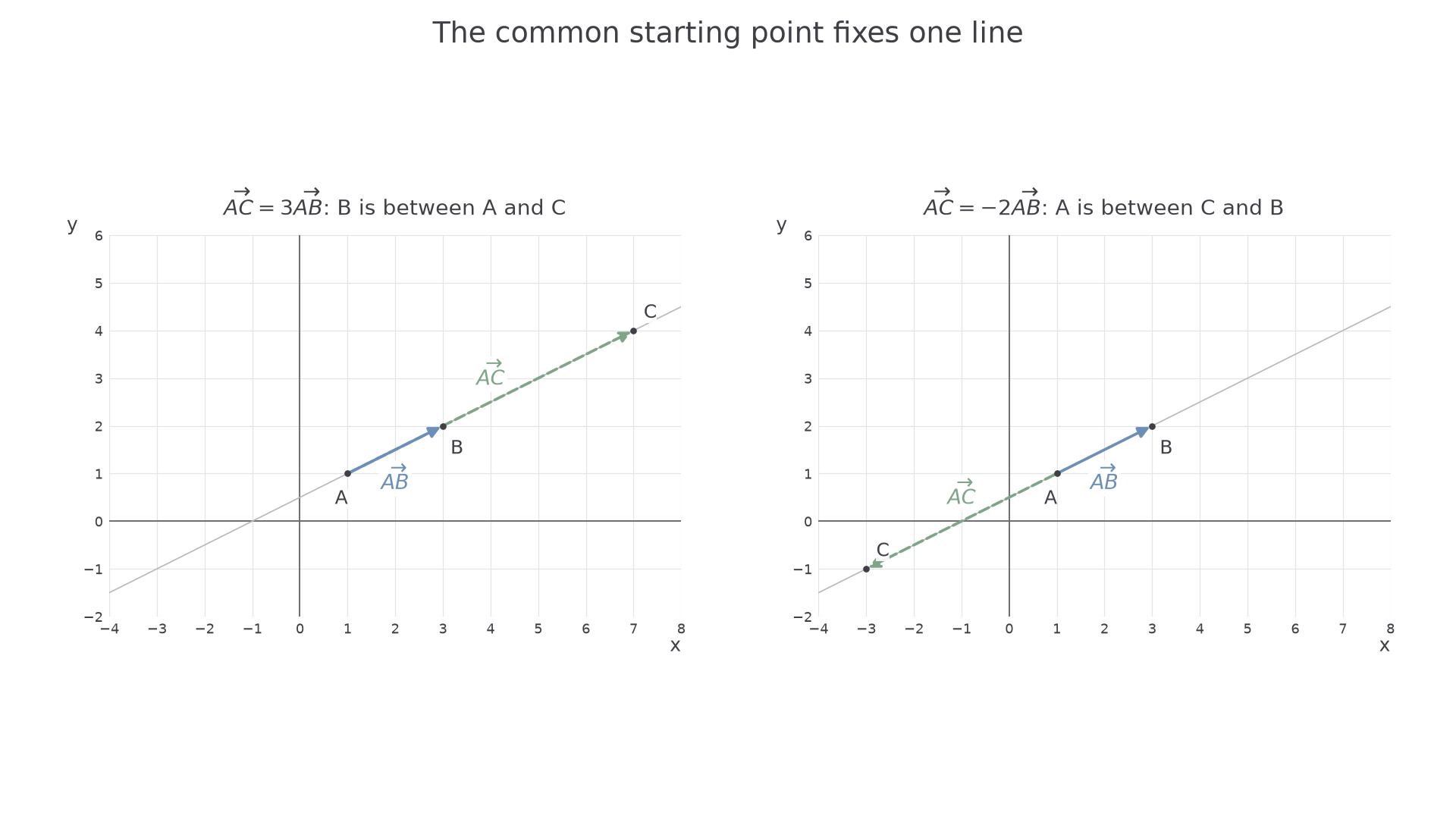
When the three points are distinct, . If , lies between and ; if , lies between and ; if , lies between and . These positions follow from the directed distance from .
[DIAGRAM: asset_name: Collinear vectors with a common start; asset_slug: collinear_common_point; caption: Multiples of AB starting at A lie on the same line, on either side of A.; description: Two panels show A at one one and B at three two on a straight line. Left C at seven four has AC equal to three AB, with B between A and C. Right C at negative three negative one has AC equal to negative two AB, with A between C and B. Directed arrows start at A.]
Worked example 3: a point beyond B
Question. Distinct and have position vectors and . Point has position vector . Show that are collinear and state which lies between the other two.
Plan. Compare and , which have the same start.
Answer. The vectors are parallel and share , so are collinear. The positive factor puts between and .
Check. . Thus the path continues in the same direction, with lengths in ratio .
Continue this lesson.
You’re previewing NovaLearn without an account. Create a free account to read the rest.
Create free account