E1.2 - Three sets and set relationships
Set notation can describe one element, a whole collection, or a relationship between collections. This Extended lesson develops E1.2 through membership and subset symbols, three-set Venn regions and sets defined by conditions, including coordinate pairs. You will distinguish these meanings before using them to organise more involved information.
Membership, subsets and the empty set
Is “ belongs to ” the same kind of statement as “every element of belongs to ”? The first talks about one object; the second compares two complete collections. Their symbols need to preserve that distinction.
Let and . The number is an element of . Both elements of are in , so the entire set fits inside .
Membership and subsets
means “ is an element of ”; means it is not. For example, and .
means “ is a subset of ”: every element of is in . Equality is allowed. means at least one element of is not in .
To disprove a subset claim, one counterexample suffices. For , the element shows ; the fact that is shared cannot rescue the claim. To prove a finite subset claim, check every element of the proposed subset.
[DIAGRAM: asset_name: Subsets and disjoint sets; asset_slug: extended_sets_relationships; caption: Containment and separation represent different relationships.; description: Two panels show universal rectangles. On the left, circle B lies entirely inside larger circle A, with elements 2 and 4 in B and 1 and 3 in A outside B. On the right, separate circles P and Q contain 1 and 3, and 2 and 4 respectively, with no overlap.]
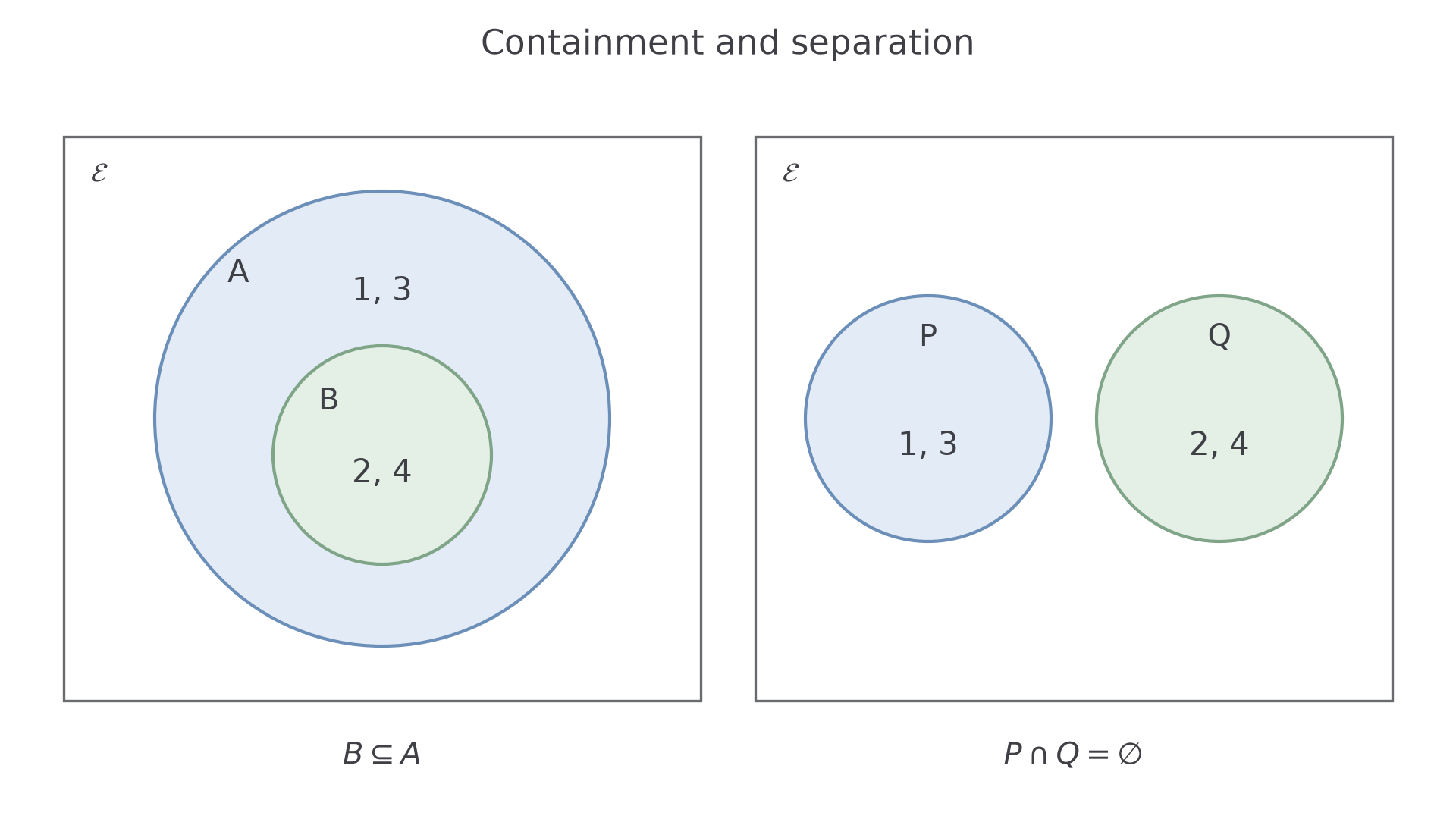
The right-hand sets are disjoint: they have no common elements. Their intersection is the empty set, written , so and . The set is different: it contains one element, zero. Empty braces also represent the empty set.
Every set is a subset of itself. The empty set is a subset of every set, because it has no element that could violate the condition “every element is in the other set”. That does not make it an element of every set: , since the two elements are the numbers and .
Key idea
Membership compares an object with a set. A subset statement checks whether an entire set fits inside another. For a set of numbers, and express related facts using different kinds of object.
Check the kind of object on each side of the symbol in this question.
Three-set Venn regions
Three circles arranged with every kind of overlap produce eight separate regions, including the region outside all three. An element in all three belongs in the central overlap once. Begin there when totals include it, then move out to regions in exactly two sets and finally regions in only one.
Suppose a group has students. Sets contain students respectively. The counts in the pairwise intersections are , and , and students belong to all three. Each given pairwise count includes the central three.
[DIAGRAM: asset_name: Eight regions of a three-set Venn diagram; asset_slug: extended_sets_three_regions; caption: Pairwise intersections include the central region unless “only” excludes it.; description: Three overlapping circles A, B and C lie in a universal rectangle of 40 students. Region counts are A only 8, B only 7, C only 7, A and B only 5, A and C only 4, B and C only 3, all three 3, and outside all three 3.]
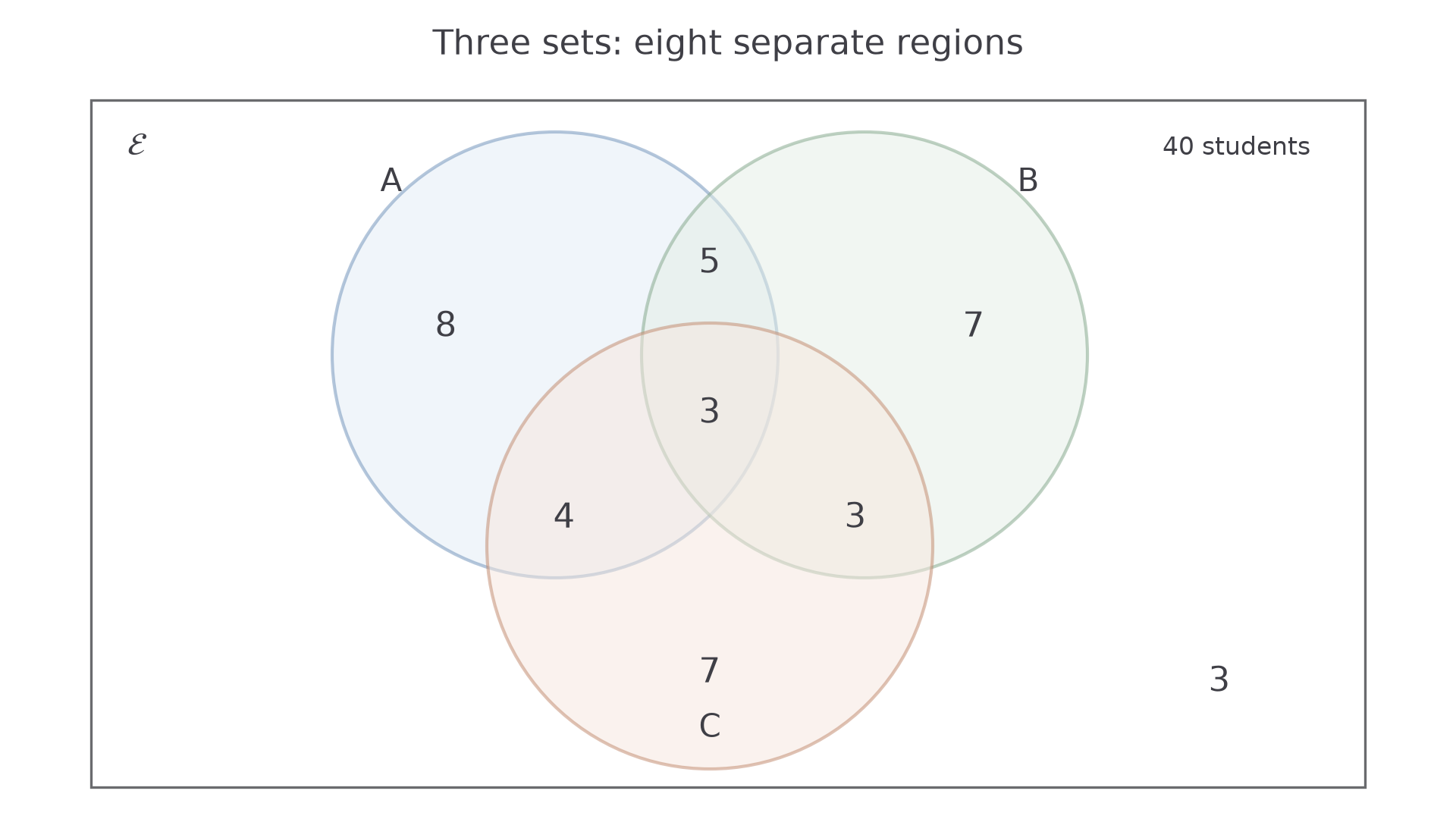
Worked example 1: separating inclusive pair counts
Question. For these students, find the number in but not , and the number in only.
Plan. Subtract the central count from each needed pairwise total, then remove all other regions of from its total.
Answer. belong to and only; belong to only.
Check. , recovering the total for ; , recovering the given count.
Keep all counts and change the target to students outside every set. This requires the remaining regions, each counted once.
Continue this lesson.
You’re previewing NovaLearn without an account. Create a free account to read the rest.
Create free account