C7.1; E7.1 - Reflections and rotations
A shape can move without changing its size. You will draw reflections and rotations on a grid, then describe each movement precisely enough for someone else to reproduce it. C7.1 and E7.1 use the mirror line or the centre and turn to fix the image.
Reflections in horizontal and vertical lines
Can two triangles have the same side lengths but face different ways? Reflect a triangle in a mirror line and they do: the image keeps its lengths and angles, but its orientation reverses.
Reflection
A reflection maps each point to the opposite side of a mirror line, at the same perpendicular distance from the line. A point on the mirror line stays fixed.
For a vertical mirror line, move horizontally to reach the image; the height stays the same. For a horizontal line, move vertically; the horizontal coordinate stays the same. Count from the mirror line, not automatically from an axis. Plot every image vertex and join corresponding vertices in the original order with a ruler. A prime labels an image: means the image of .
[DIAGRAM: asset_name: Reflections in vertical and horizontal lines; asset_slug: reflections_axis_parallel; caption: Each vertex and its image are equally far from the mirror line.; description: Two equal-scale coordinate grids show the triangle with vertices A at one one B at three one and C at one three. The left reflects it in x equals zero and the right in y equals zero. Dashed joining segments cross each mirror line at right angles and the image vertices have prime labels.]
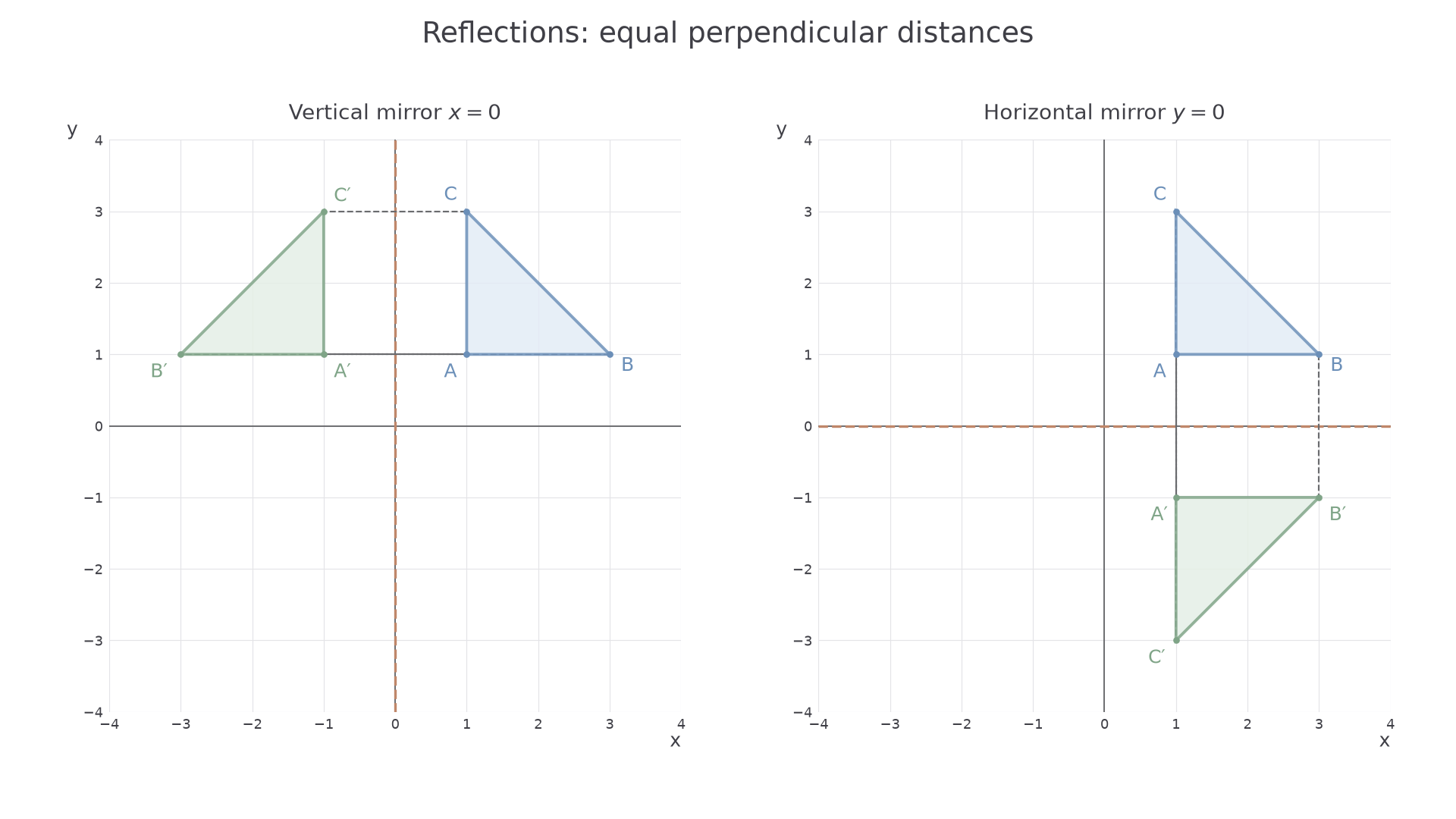
Worked example 1: a vertical mirror
Question. Reflect triangle in . Give its image vertices.
Plan. Keep every height and place each vertex the same horizontal distance on the other side of the line.
Answer. Plot and rule the three sides.
Check. The midpoints of all have , and these joining segments are horizontal, perpendicular to the vertical mirror.
Change only the mirror from vertical to horizontal. Now the other coordinate changes.
Worked example 2: a horizontal mirror
Question. Reflect the same triangle in .
Plan. Keep each horizontal coordinate and reverse the vertical distance from the mirror.
Answer. Join with ruled sides.
Check. Reflecting each image back in restores the original coordinates. Each joining segment is vertical and bisected by the mirror.
Watch out
For reflection in , “change the sign of ” is wrong. A point at height is three units above this mirror, so its image has height , three units below .
Rotations about a stated centre
A rotation turns the whole shape around one fixed point. Unlike a reflection, it keeps the order in which the labelled vertices run around the shape.
Rotation
A rotation turns every point through the same angle and direction about a fixed centre. Each point stays the same distance from that centre. Clockwise follows a clock's hands; anticlockwise goes the other way.
A quarter-turn is , a half-turn is , and three quarter-turns are . A clockwise turn gives the same image as anticlockwise. For , either direction gives the same image.
Use tracing paper if allowed: trace the shape and centre, hold the centre fixed, turn, then transfer the vertices. On a grid, turn the horizontal and vertical offsets from the centre. A anticlockwise turn sends “right” to “up” and “up” to “left”. The centre can be the origin, a vertex or the midpoint of an edge; it need not lie inside the shape.
[DIAGRAM: asset_name: Quarter-turn and half-turn; asset_slug: rotations_core_centres; caption: Turning happens about the marked centre; the centre itself stays fixed.; description: Two equal-scale coordinate grids show triangle A at two zero B at four zero C at two two. Left is a ninety degree anticlockwise rotation about the origin giving zero two zero four and negative two two. Right is a half-turn about vertex A giving A fixed B prime zero zero and C prime two negative two. Dashed radii identify the centres.]
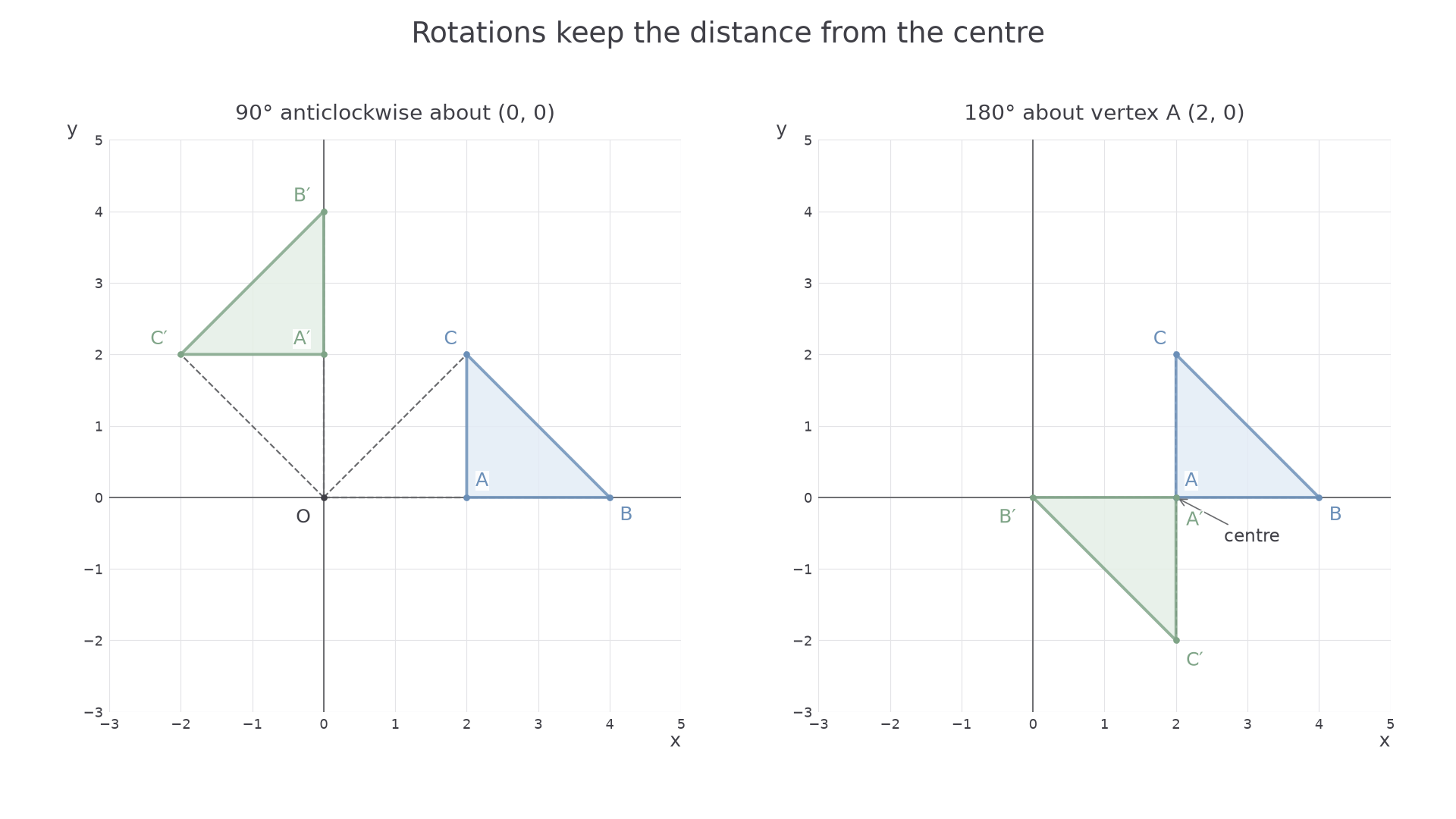
Worked example 3: a quarter-turn
Question. Rotate triangle through anticlockwise about .
Plan. Turn each offset from the origin a quarter-turn anticlockwise.
Answer. Rule the triangle with vertices .
Check. Its two perpendicular sides still have lengths and . A clockwise quarter-turn about the origin returns all three vertices.
Continue this lesson.
You’re previewing NovaLearn without an account. Create a free account to read the rest.
Create free account