E6.5 - Triangle area using sine
Two sides and the angle between them can determine a triangle's area even when its height is hidden. You will derive the sine-area formula, preserve exact answers, and work backwards from an area while checking possible angle branches. This lesson is for Extended.
Area from two sides and the included angle
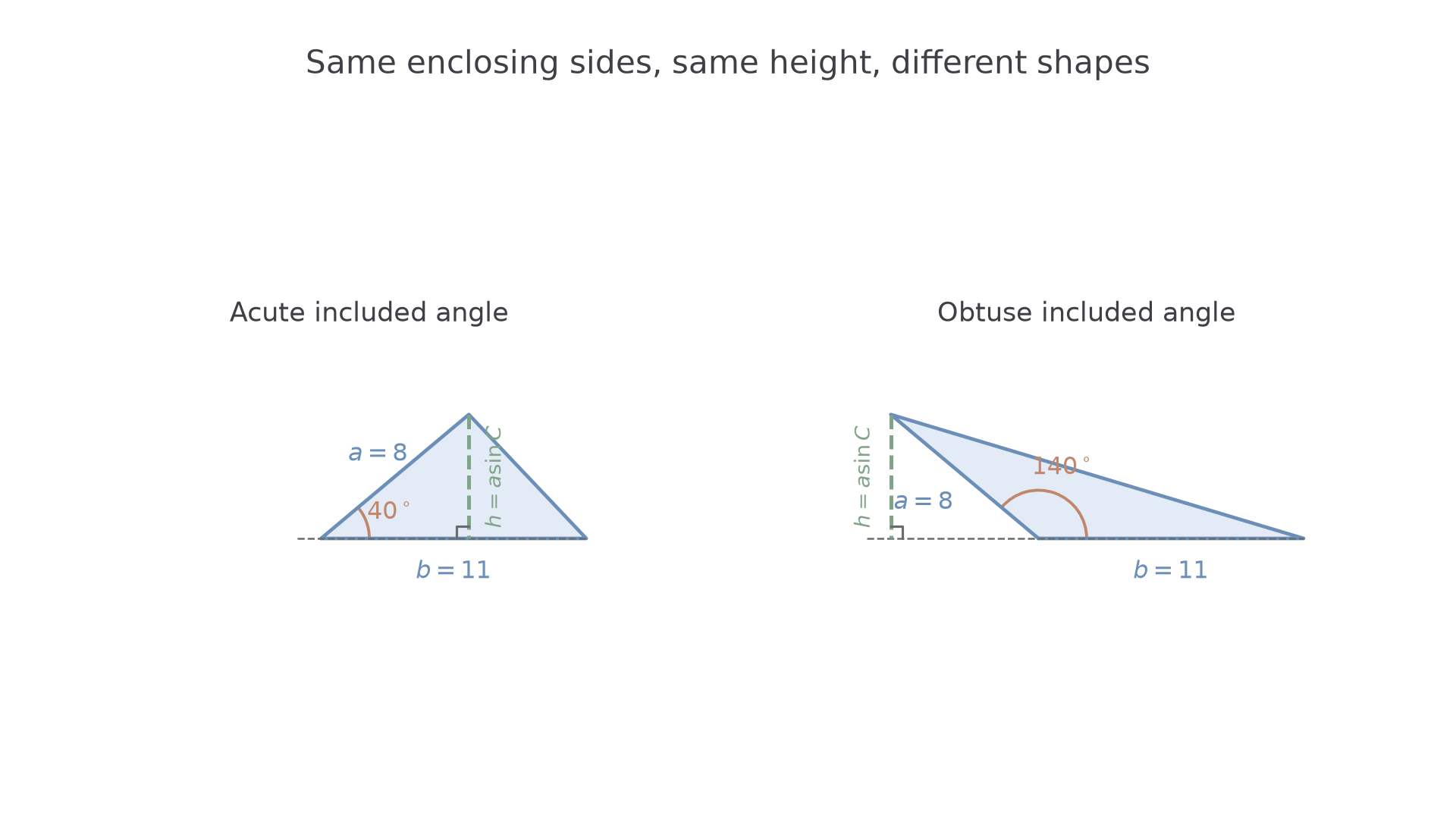
Can two triangles with the same two side lengths have the same area but very different shapes? Keep two sides fixed and compare an included angle of with one of . Their perpendicular heights are equal, even though one triangle leans outwards.
Take side as the base. The other known side makes included angle with it. Dropping a perpendicular gives height , so the familiar area becomes .
For obtuse , the foot lies on the extended base. The height is , using the supplementary-angle relationship already established. The height remains positive.
[DIAGRAM: asset_name: The height behind the sine-area formula; asset_slug: area_height; caption: Supplementary included angles give equal perpendicular heights and equal areas.; description: Two exact triangles have adjacent sides a and b and included angles 40 and 140 degrees. In each the perpendicular height from the endpoint of a is a sine C. The obtuse triangle has its perpendicular foot on the extension of base b. Right-angle squares mark the feet, and equal heights are highlighted.]
Area from two sides and their included angle
is the area, are positive side lengths, and is the angle between them, with . Use consistent length units; the area has their square unit.
Given in the List of formulas.
The letter choices can change, but “included” cannot. The required angle touches both chosen sides.
Worked example 1: an acute included angle
Question. A triangle has sides and enclosing an angle of . Calculate its area.
Plan. Substitute the two enclosing sides and their included angle. Use degree mode.
Answer. , to significant figures.
Check. Taking as base gives perpendicular height . Then .
Change only the included angle to its supplement. This deliberately tests whether the formula still works for an obtuse triangle.
Worked example 2: an obtuse included angle
Question. A triangle has sides and enclosing an angle of . Calculate its area.
Plan. Use the same enclosing sides; sine handles the positive perpendicular height.
Answer. .
Check. Reflecting the sloping side across the perpendicular leaves its height unchanged. The base is still , so equal base and height must give equal area.
Watch out
If and are the chosen sides, the formula needs the angle where those two sides meet. Substituting some other angle of the triangle may look tidy but does not give the correct perpendicular height.
Exact and numerical triangle areas
The same area formula can produce an exact surd or a decimal approximation. Decide which form the question requests before rounding anything.
You already know
, , and . Substitute these values exactly on a non-calculator question.
Even on a calculator paper, retain exact values or full calculator precision during working. Round the final area once. If the angle is , the formula becomes , as it should for two perpendicular sides.
Worked example 3: an exact surd area
Question. A triangle has sides and enclosing . Find its exact area.
Plan. Replace sine by its exact value and simplify.
Answer. .
Check. The height on base is , so . Also, , so the area lies between and .
Change only the angle to . It no longer has one of the required exact special values, so a numerical answer is appropriate here.
Continue this lesson.
You’re previewing NovaLearn without an account. Create a free account to read the rest.
Create free account