C1.4, C1.5; E1.4, E1.5 - Fractions as numbers
A fraction is a number, even when it is written in several different ways. You will move between improper fractions and mixed numbers, simplify equivalent fractions, and compare their sizes using equal-sized parts. This lesson covers the shared Core and Extended fraction skills.
Proper fractions and mixed numbers
Two identical bars are shaded: one shows , the other . Does the first contain more because both its numbers are larger? Keep that question in mind while we work out what the numbers in a fraction actually count.
In , the denominator says that one whole is divided into four equal parts. The numerator counts three of those parts. The bar also means division: . Parts must be equal, and comparisons must refer to the same-sized whole.
Proper fraction, improper fraction and mixed number
For a non-negative fraction with a positive denominator, a proper fraction has numerator smaller than denominator: . An improper fraction has numerator at least as large as denominator: , and is included.
A mixed number writes a whole number plus a proper fractional part: . It does not mean multiplication. A denominator cannot be zero because a fraction means division.
Zero is allowed as a numerator: . The non-negative proper fractions lie from zero up to, but not including, one. We will use negative fractions in the later calculation lessons; here the pictures count positive parts of wholes.
[DIAGRAM: asset_name: Eleven quarters as a mixed number; asset_slug: eleven_quarters; caption: Eleven quarters fill two whole bars and three quarters of a third bar.; description: Three equal horizontal bars each divided into four equal parts. The first two bars are fully shaded blue, and three parts of the third are shaded blue. Labels show four quarters, four quarters and three quarters, totalling eleven quarters or two and three quarters.]
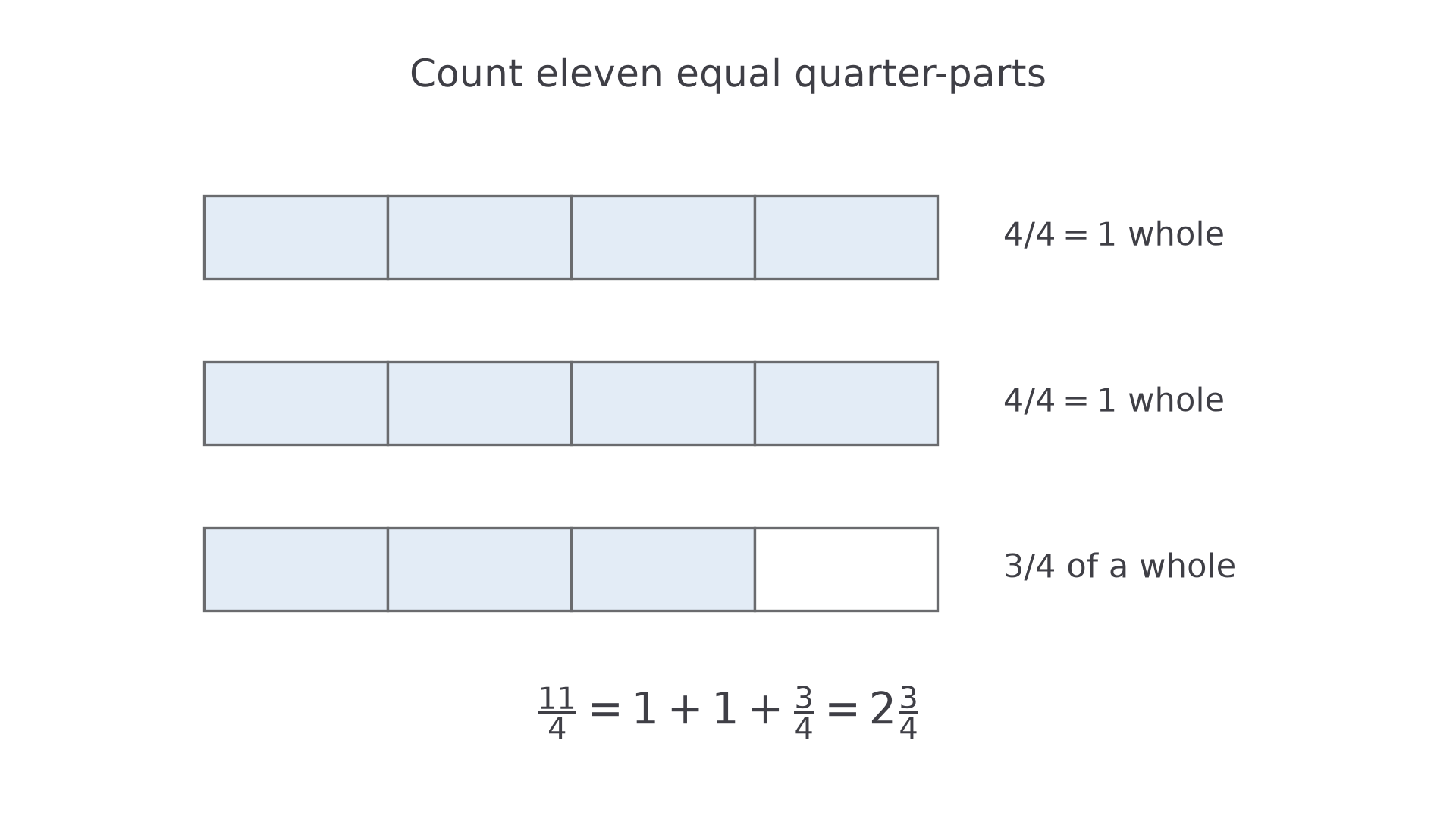
Worked example 1: improper fraction to mixed number
Question. Write as a mixed number.
Plan. Find how many groups of four quarters make complete wholes, then keep the remaining quarters.
Answer. .
Check. The value must lie between and , because . The answer does.
Now reverse the conversion. The whole-number part must be counted in quarters before you combine it with the fractional part.
Worked example 2: mixed number to improper fraction
Question. Write as an improper fraction.
Plan. Count the quarters in two wholes and add the three remaining quarters.
Answer. .
Check. Dividing by gives remainder , recovering the original mixed number.
You can use exactly the same reasoning for any positive denominator: divide the numerator by the denominator to find the whole-number part and remainder, or multiply the whole-number part by the denominator before adding the numerator.
Watch out
adds the visible and without converting units. Two wholes contain eight quarters, so the correct numerator is .
Equivalent fractions and simplest form
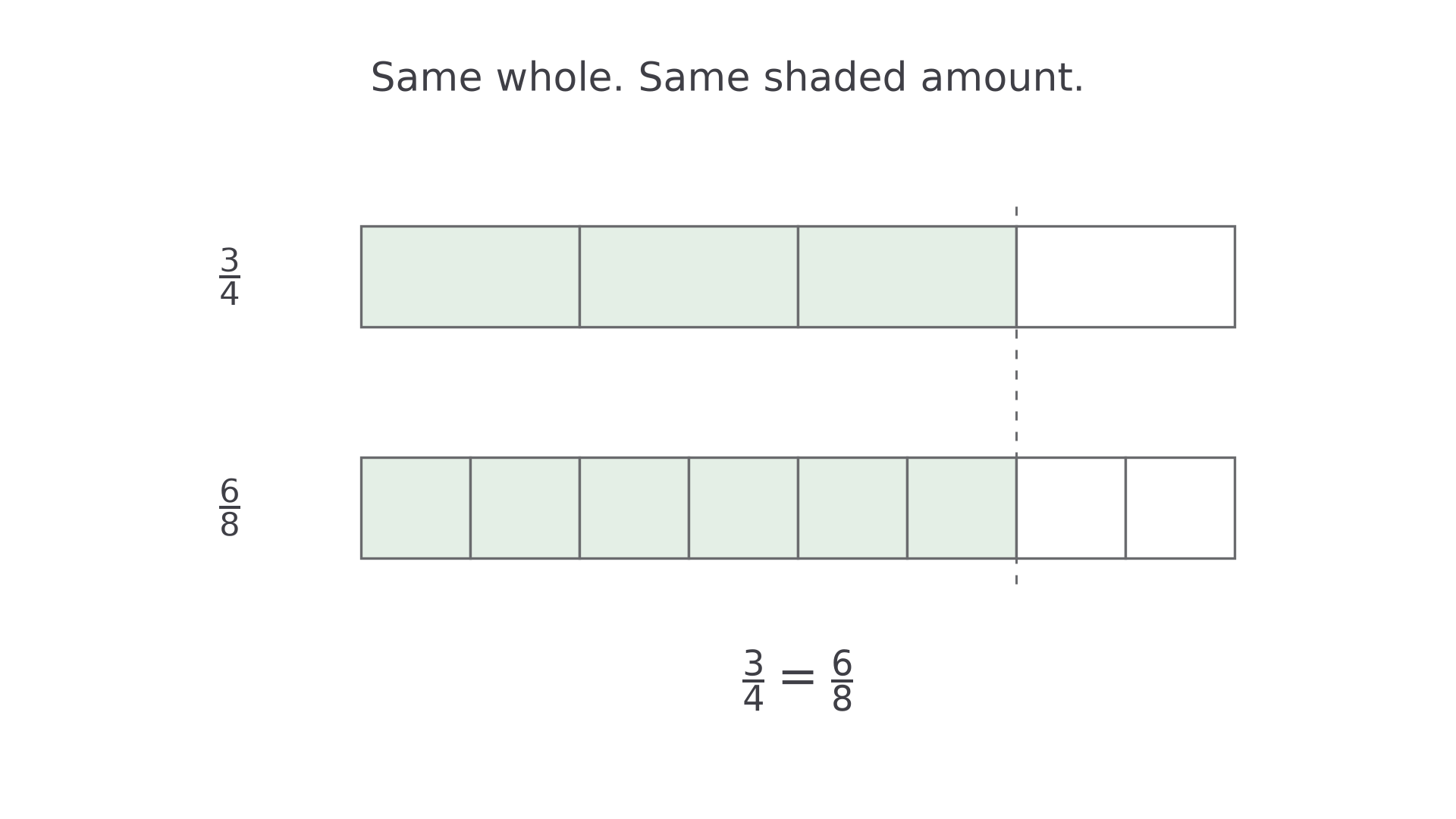
Cutting each quarter of a bar into two equal pieces changes the counting unit from quarters to eighths. Three shaded quarters become six shaded eighths. The shaded length stays the same, so .
[DIAGRAM: asset_name: The same amount in quarters and eighths; asset_slug: equivalent_fraction_bars; caption: Three quarters and six eighths shade the same length of equal-sized wholes.; description: Two equal-length bars aligned vertically. The upper bar is divided into four equal parts with three shaded sage. The lower is divided into eight equal parts with six shaded sage. A dotted vertical guide marks their common shaded endpoint, and labels state three quarters equals six eighths.]
Equivalent fractions and simplest form
Equivalent fractions have the same value. Multiplying or dividing both numerator and denominator by the same non-zero number preserves the fraction's value.
A fraction is in simplest form when its integer numerator and positive integer denominator have no common factor greater than . For example, is simplest, while is not.
Why must you change both? Multiplying both by cuts each part into two while doubling the number of parts counted. Changing only the numerator doubles the amount instead. To simplify in one step, use the highest common factor (HCF): the largest positive integer that divides both numbers exactly.
Worked example 3: simplifying with the HCF
Question. Write in its simplest form.
Plan. Divide the numerator and denominator by their HCF.
Answer. .
Check. Multiply both numbers by : . Also, and have no common factor above .
Change the fraction but keep the final value. This time the equal-sized groups contain seven parts rather than six.
Worked example 4: a different common factor
Question. Write in its simplest form.
Plan. Find the HCF and divide both numbers by it.
Answer. .
Check. Five equal groups of make ; three of those groups make . The fraction therefore counts three fifths.
You may simplify in several steps instead. Dividing by any common factor preserves the value; continue until the only common factor is . For zero, ; there is no need to keep a fraction bar in the final answer.
Watch out
divides only the numerator and halves the value. To simplify by , divide both: . That is equivalent, but not yet simplest; dividing both by gives .
Comparing fractions
To compare fractions, first make their parts the same size. With the same denominator, the larger numerator counts more of those equal parts: . With the same positive numerator, a larger denominator makes each part smaller: .
When neither number matches, use equivalent fractions with a common denominator. A common multiple of all the denominators works; the lowest common multiple (LCM) keeps the numbers small. This compares exact values without rounding.
Worked example 5: ordering three fractions
Question. Write these fractions in order of size, starting with the smallest:
Plan. Express all three in twelfths, then compare their numerators.
Answer. .
Check. is twelfths below one; is only twelfths below one, so should be larger.
Now replace by . The common denominator stays , but the order changes.
Worked example 6: one fraction changes position
Question. Write these fractions in order of size, starting with the smallest:
Plan. Convert to twelfths again and read the numerators in increasing order.
Answer. .
Check. The gaps are each , so the middle fraction sits exactly halfway between the other two.
The symbols keep their usual meanings: is “less than”, is “greater than”, and is “equal to”. Equivalent fractions, such as the opening and , use , even though their numerators and denominators look different. The symbols and also allow equality; means “not equal to”.
Watch out
because compares the counts but ignores the sizes of the parts. Convert first: .
Quick Recap
- A denominator names the size of equal parts; a numerator counts them. A denominator cannot be zero.
- Improper fractions and mixed numbers can express the same value above or equal to one; count the fractional units in each whole.
- Change both numerator and denominator by the same non-zero factor to preserve a fraction's value. Use the HCF to simplify fully.
- Compare fractions by writing them with a common denominator and comparing the numerators.
The opening bars contain the same amount: . Larger written numbers do not necessarily mean a larger fraction.