E1.4 - Recurring decimals as fractions
A decimal can continue forever and still represent an exact fraction. You will read Cambridge recurring-dot notation, use division to find recurring decimals and convert them back to fractions with algebra. The repeating digits provide the structure that makes the algebra work.
Recurring-dot notation
A calculator shows only a finite row of digits. How could you record exactly, and how could infinitely many decimal places ever give a fraction?
The block repeats forever after the initial . Cambridge uses dots above the first and last digits of the repeating block:
The undotted occurs before the repeating part starts. The dots tell you which digits to keep copying; they are not decimal points or rounding instructions.
Recurring-dot notation
For a one-digit repeating block, put a dot over that digit: . For a longer block, put dots over its first and last digits. For example, , with the zero included in each block.
The location of the first dot matters as much as the last. These two expansions begin with the same three digits but then separate.
Worked example 1: a two-digit block after a prefix
Question. Write the first six digits after the decimal point of .
Plan. Keep the undotted prefix once, then repeat the block between the dots.
Answer. The first six digits are , giving . This is an expansion, not a rounded value.
Check. After removing the first digit, the remaining digits occur in pairs .
Move only the first dot from the to the . This makes the repeating block three digits long and removes the non-recurring prefix.
Worked example 2: a three-digit block
Question. Write the first six digits after the decimal point of .
Plan. Repeat every digit from the first dotted digit through the last dotted digit.
Answer. , with first six digits .
Check. Digits one to three and four to six are identical. That was not true in the previous example.
Watch out
Dots over the endpoints include the digits between them. Writing does not mean that only and repeat while the disappears.
Fractions that produce recurring decimals
Long division tells you both the digits and when they start repeating. At each decimal place, multiply the current remainder by , divide by the denominator and keep the new remainder.
For , start with remainder . Then , giving the first digit . Next , giving digit and remainder again. The same remainder creates the same next step, so the repeats:
[DIAGRAM: asset_name: A repeated remainder produces a repeating digit; asset_slug: repeated_remainder; caption: Once remainder two returns, the same division step produces another three.; description: A flow diagram for five divided by six. Initial remainder five gives fifty divided by six, digit eight and remainder two. Remainder two gives twenty divided by six, digit three and remainder two again. A loop returns to that same remainder-two state and the decimal reads zero point eight followed by repeating threes.]
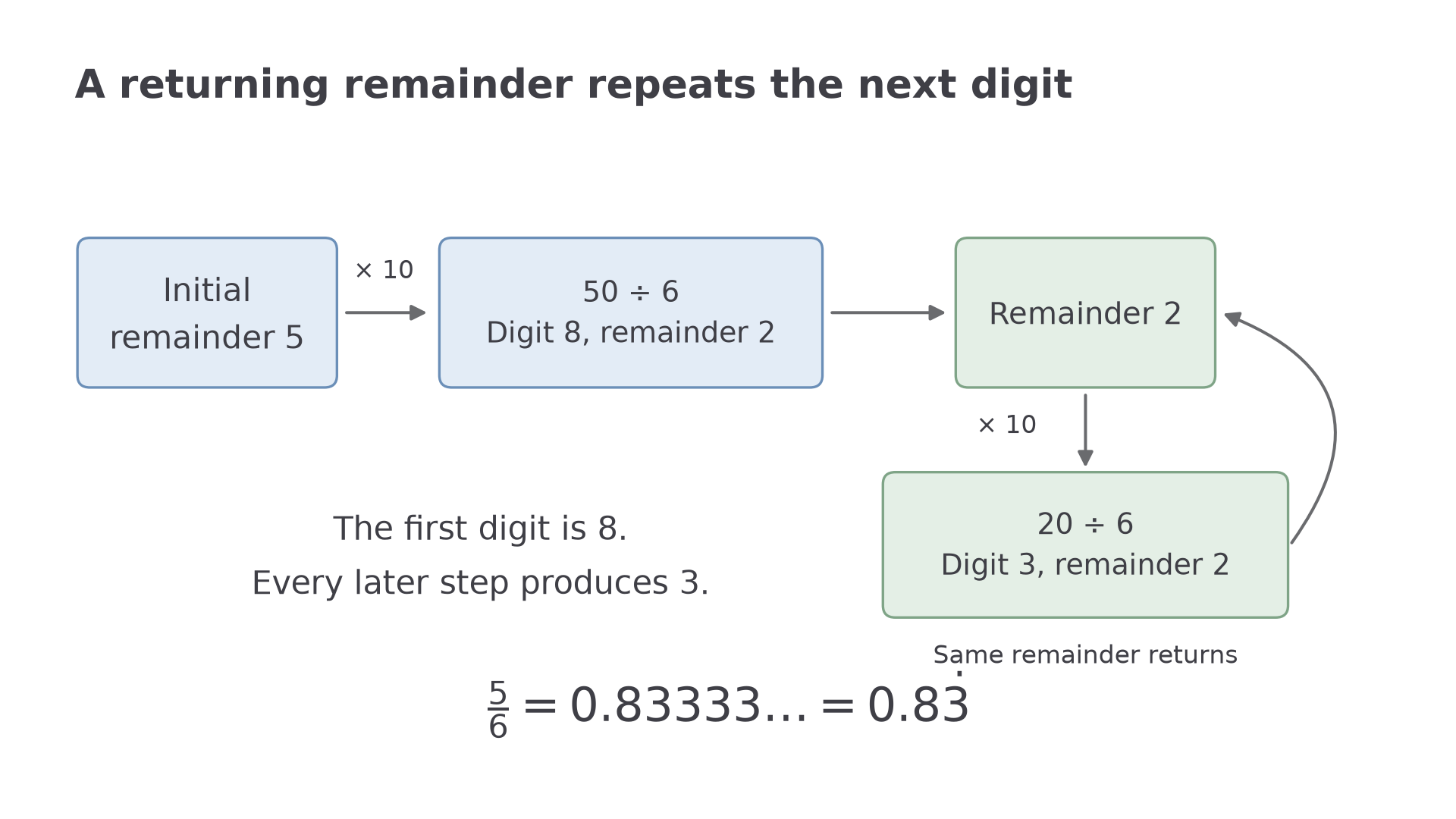
Why must rational decimals eventually terminate or recur? Dividing by a positive integer denominator can leave only remainders . Remainder zero ends the division. If it never reaches zero, eventually a non-zero remainder returns, and all the subsequent digits repeat from that point. A repeated digit alone is not the test: watch the remainder.
Worked example 3: a two-step remainder cycle
Question. Write as a recurring decimal, using dot notation.
Plan. Continue division until a remainder returns to one already used.
Answer. .
Check. Multiplying the expansion by gives .
Change only the numerator. The denominator is still , but the digits and remainder cycle change.
Continue this lesson.
You’re previewing NovaLearn without an account. Create a free account to read the rest.
Create free account