C1.8; E1.8 - Writing numbers in standard form
Standard form separates a number's digits from its size. You will write large and small positive numbers using powers of ten, convert them back, and compare their magnitudes. This lesson is for Core and Extended, including non-calculator work.
Powers of ten and scale
Which is larger, or ? The first has the larger front number, but the powers of ten tell a different story.
Recall that , while . A positive integer power of ten scales up; a negative integer power scales down. Index zero gives .
[DIAGRAM: asset_name: Powers of ten across zero; asset_slug: powers_ten_scale; caption: Each step right divides by ten, including the steps through one.; description: A sequence of nine equally spaced labelled boxes showing ten to the fourth equals 10000 down to ten to the negative fourth equals 0.0001. Each arrow between neighbouring boxes is labelled divide by ten. The diagram is an operation sequence, not a linear number line.]
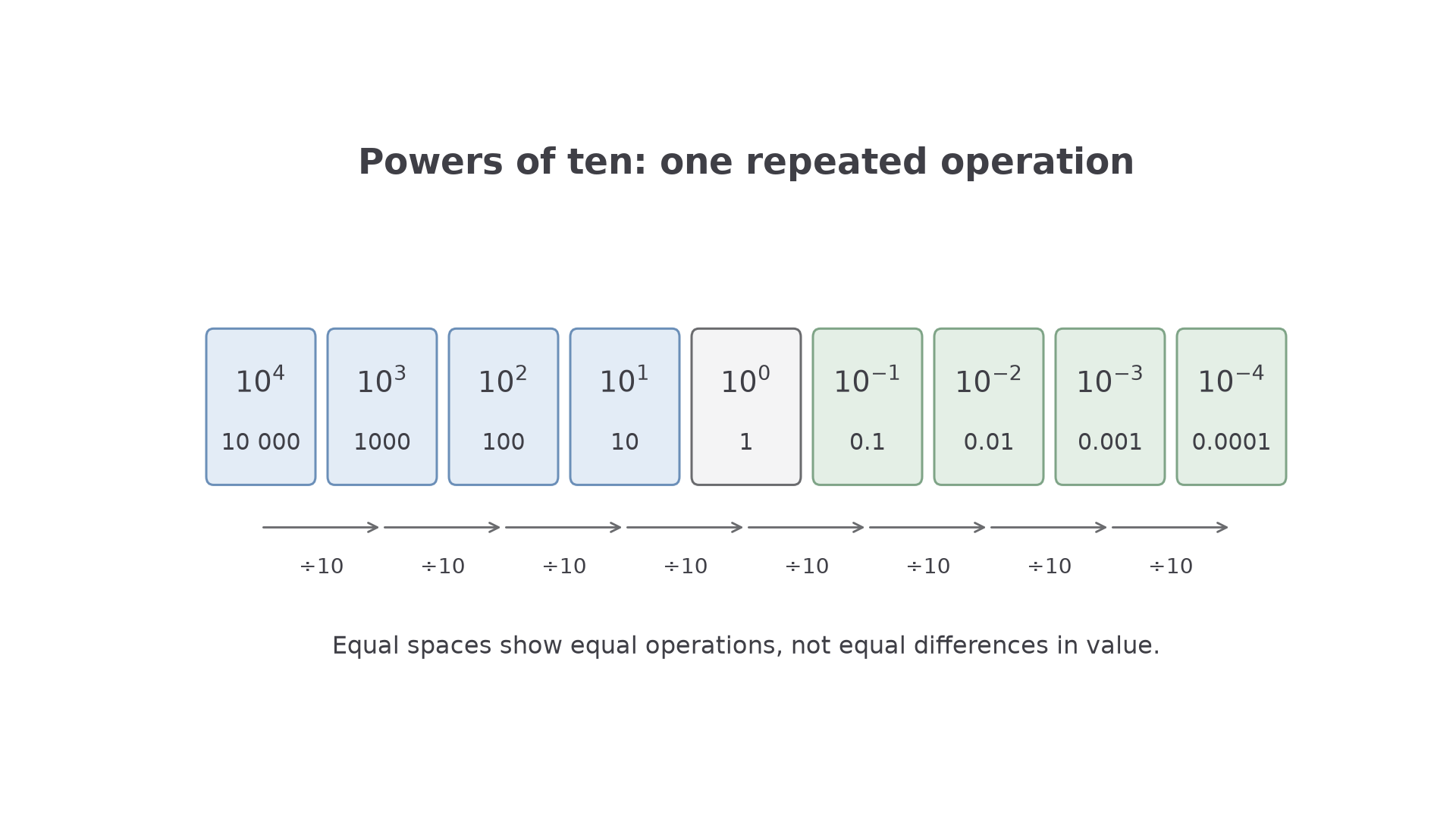
The equal spaces in this picture show the same operation each time, not equal differences between the values. Passing from to and then continues the same division pattern.
A power of ten
For a positive integer , is followed by zeros, and . Also, .
For example, and . A negative index does not make the value negative.
Counting the index is safer than counting only the zeros you can see after the decimal point.
Worked example 1: a positive power of ten
Question. Write as an ordinary number.
Plan. Use four factors of ten.
Answer. .
Check. Dividing by ten four times gives .
Change only the sign of the index. We need the reciprocal of the same power.
Worked example 2: a negative power of ten
Question. Write as an ordinary number.
Plan. Write a reciprocal, then use decimal place value.
Answer. .
Check. , as reciprocals must give.
Watch out
is one place too small. In , the is in the fourth place after the decimal point. There are only three zeros between the point and that .
Use the reciprocal and check the place.
Writing standard form
To describe , you can say “ lots of ten thousand”. The digits sit in , and the scale sits in . This is standard form.
Standard form
A positive number in standard form is written
where is an integer. The front number is called the coefficient.
For example, is in standard form. The equal expression is not, because is too large. The coefficient may equal , but it must be smaller than .
Choose the coefficient first: put its decimal point after the first nonzero digit. Then choose the power of ten that returns it to the original value. Large numbers need a positive scale; positive numbers below need a negative scale. A number such as can be written , since . Zero itself cannot meet the coefficient condition.
Worked example 3: writing a large number
Question. Write in standard form.
Plan. Use the coefficient , then find its scale.
Answer. .
Check. Multiplying by ten four times gives .
Keep the digits , but change the size of the original number. The coefficient stays the same.
Worked example 4: writing a small number
Question. Write in standard form.
Plan. Use , then count the divisions by ten needed to reach the original.
Answer. .
Check. Starting with , multiplying by gives . This reverses the scale.
Watch out
has the wrong sign of index: it would make . Before counting places, decide whether your power of ten must enlarge or reduce the coefficient.
Choose the coefficient before counting the scale.
Reading and comparing standard form
To read standard form, carry out the multiplication by its power of ten. For example, , while . Writing ordinary numbers is a reliable way to compare magnitudes.
When every positive number is already in standard form, compare the indices first. A larger index gives a larger number. If the indices match, compare the coefficients. This works because a standard-form coefficient is at least and smaller than : all numbers with one index fit below the numbers with the next index.
Worked example 5: ordering by scale then coefficient
Question. Write these numbers in order of size, starting with the smallest:
Plan. Read the powers as ordinary numbers, then order them.
Answer. .
Check. The index comes first. Of the two numbers with index , .
Change only the first number's index from to . Its position changes even though its coefficient does not.
Worked example 6: changing one index
Question. Write these numbers in order of size, starting with the smallest:
Plan. Compare the indices and check by converting back.
Answer. .
Check. The indices increase , matching the order of the positive standard-form numbers.
The opening comparison uses exactly the same idea: , so . In ordinary notation, .
Watch out
Comparing coefficients alone can reverse the order. Also, compare indices only after checking that every coefficient satisfies . An expression such as needs rewriting first.
Try three new small values.
Quick Recap
- Standard form is , with and an integer index.
- The coefficient carries the digits; the power of ten carries the scale.
- Positive indices enlarge the coefficient; negative indices reduce it; index zero leaves it unchanged.
- For positive numbers already in standard form, compare indices first, then coefficients if needed.
The opening larger number is , even though its coefficient is smaller.