C6.2; E6.2 - Finding angles in right triangles
Side lengths can reveal an angle when you reverse a trigonometric ratio. You will choose an inverse sine, cosine or tangent calculation, find the acute angle in degrees, and keep enough precision to round the final angle correctly.
Choosing sides for an inverse ratio
A right triangle has opposite side and adjacent side . If you double both lengths, will the angle change? The ratio stays , so the acute angle stays the same. To discover that angle, reverse the tangent calculation.
If , you need the acute angle whose tangent is . On a scientific calculator, the inverse tangent key is usually written , often accessed using SHIFT or a similar key. In degree mode it gives .
Inverse trigonometric functions
The inverse sine, inverse cosine and inverse tangent functions recover an angle from its ratio. For an acute angle in a right triangle,
Here mean opposite, adjacent and hypotenuse relative to . Use the one formula containing the two known sides.
Sine and cosine ratios lie strictly between and for an acute angle. Tangent is positive and can exceed : a steeper triangle can have opposite side longer than adjacent. These conditions help detect a reversed fraction.
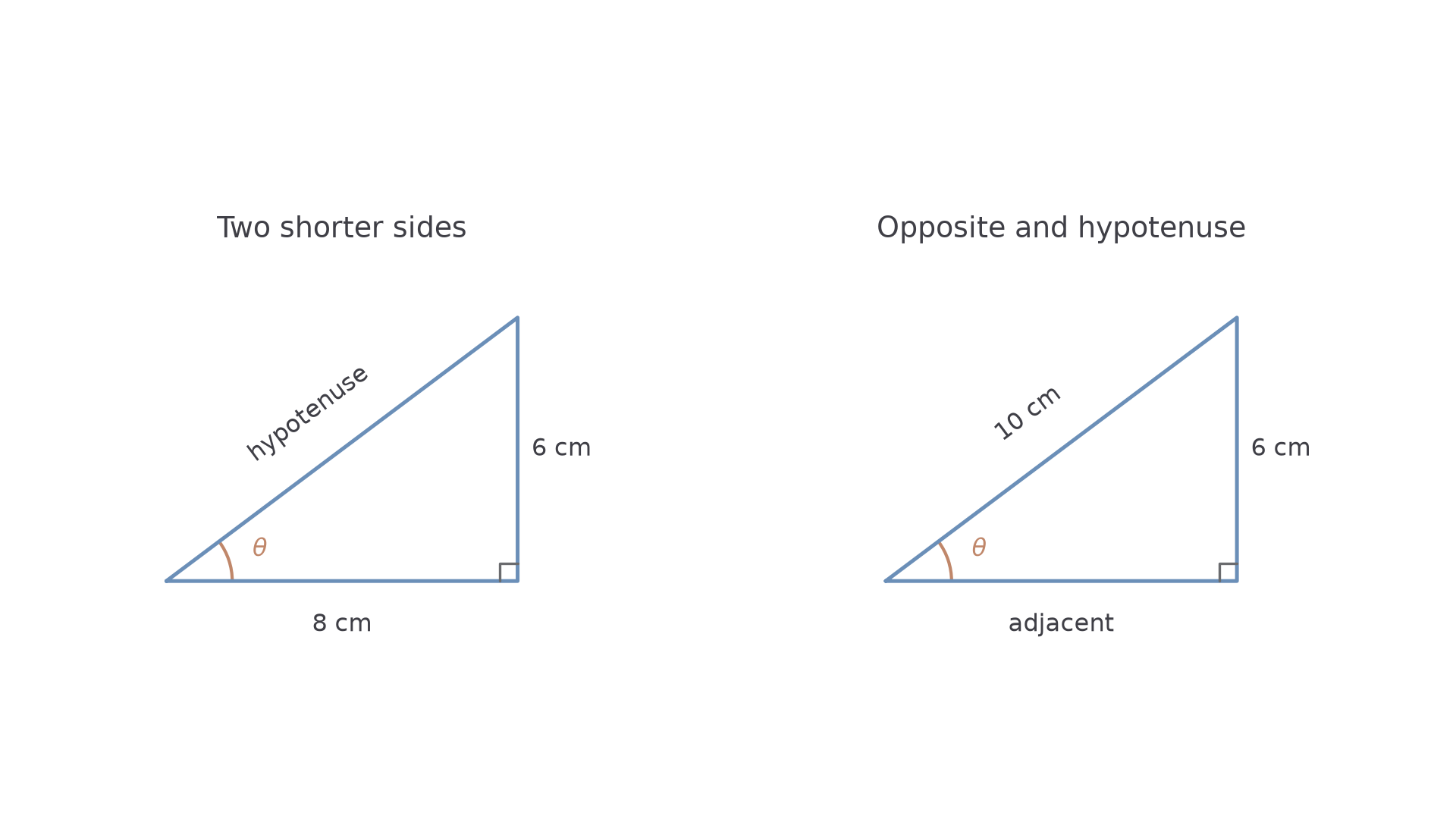
[DIAGRAM: asset_name: Choosing known sides for an inverse ratio; asset_slug: trig_inverse_known_pairs; caption: Choose the inverse ratio from the two known sides.; description: The same six-eight-ten right triangle is shown twice with the same target angle theta. The left copy supplies opposite six and adjacent eight; the right supplies opposite six and hypotenuse ten. This changes the available ratio while preserving the angle.]
Worked example 1: two shorter sides
Question. A right triangle has opposite side and adjacent side , relative to . Calculate , correct to decimal place.
Plan. Use tangent for opposite and adjacent, then its inverse in degree mode.
Answer. .
Check. Pythagoras gives hypotenuse . The alternative calculation also gives .
Keep the same target angle and opposite length, but supply the hypotenuse rather than the adjacent side. This changes the available ratio, not the angle.
Worked example 2: opposite and hypotenuse
Question. A right triangle has opposite side and hypotenuse , relative to . Calculate , correct to decimal place.
Plan. Use sine because the known denominator is now the hypotenuse.
Answer. .
Check. Pythagoras recovers adjacent side . Then , confirming the angle by a different ratio.
Watch out
does not mean . The superscript here names an inverse function, which returns an angle. It is not the reciprocal of a tangent value.
Choose a ratio from a fresh pair of lengths.
Finding an acute angle
The ratio must describe the angle asked for. If one shorter side is given with the hypotenuse, decide whether that shorter side is opposite or adjacent to the target. Its length alone cannot tell you which inverse key to press.
Write the ratio equation, apply the matching inverse function, and check that the result lies between and . Within this acute range, each of the three ratios identifies a single angle. The other acute angle is its complement: the two add to .
Worked example 3: the known side is adjacent
Question. A right triangle has hypotenuse . The side adjacent to is . Calculate , correct to decimal place.
Plan. Use inverse cosine for adjacent and hypotenuse.
Answer. .
Check. The opposite side is . Thus , agreeing with the cosine calculation.
Continue this lesson.
You’re previewing NovaLearn without an account. Create a free account to read the rest.
Create free account