C4.1; E4.1 - Parts of a circle
A circle has several different kinds of lines, curves and regions. You will distinguish them precisely, use the relationship between radius and diameter, and explain the difference between an arc, a sector and a segment.
Centre, radius, diameter and circumference
If you cut a circular pizza along a straight line, is the piece always a sector? The answer depends on where the cut goes. First locate the centre and the straight lengths that pass through it.
Circle, radius and diameter
A circle is the set of points at a fixed positive distance from a point called its centre. A radius joins the centre to any point on the circle; the plural is radii. All radii of the same circle have equal length.
A diameter is a straight segment joining two points on the circle and passing through the centre. Its length is twice the radius. The circumference is the curved boundary of the circle, and also the name for its total length.
[DIAGRAM: asset_name: Radius diameter and circumference; asset_slug: circle_radius_diameter; caption: A diameter passes through the centre and contains two radii.; description: An exact circle with centre O has a horizontal diameter AB through O and a non-horizontal radius OC. The curved circumference is highlighted separately from the straight segments. AO and OB have matching equal-length marks.]
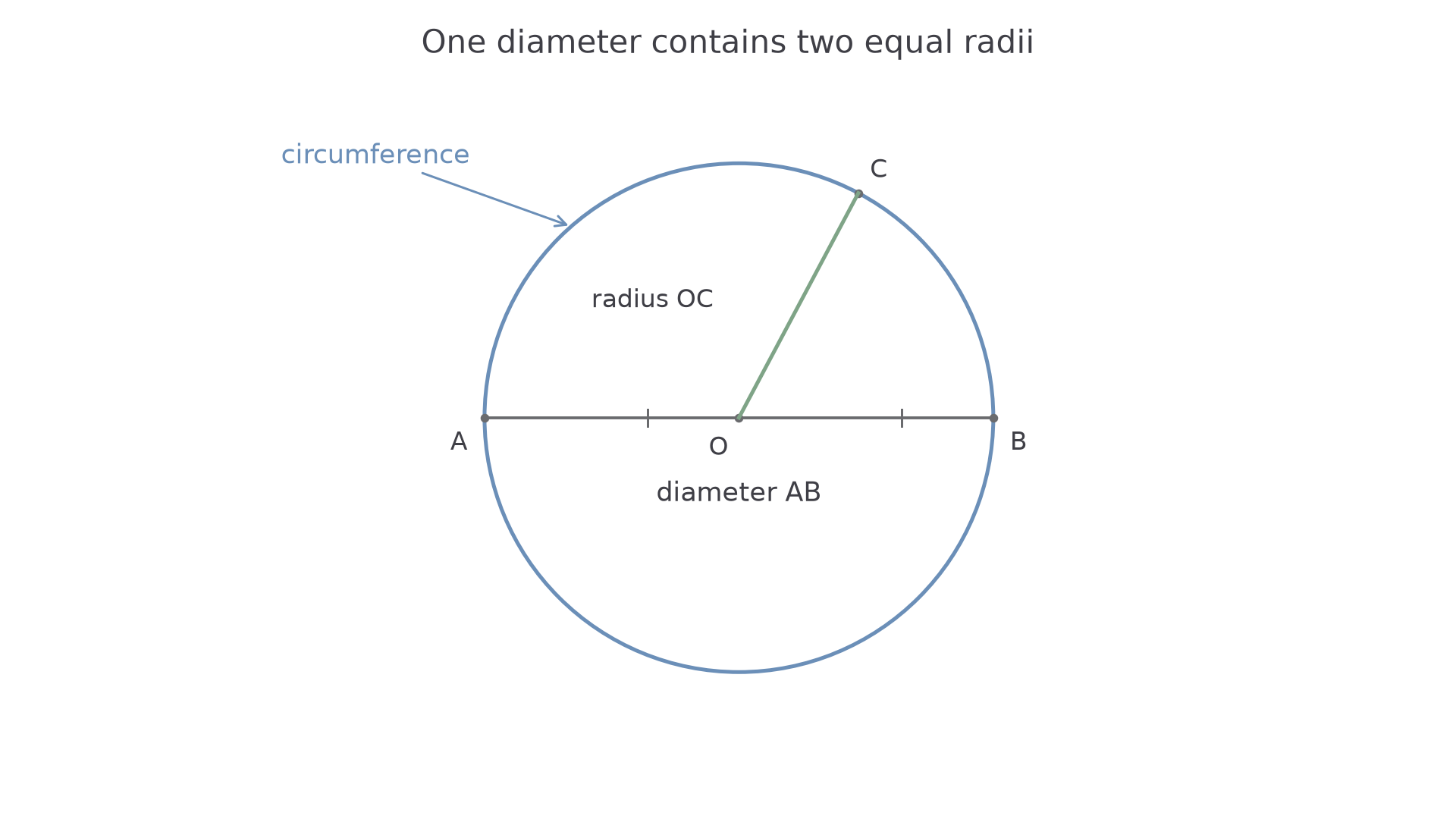
The diameter contains one radius on either side of the centre. That explains the relationship without needing a formula for the circumference.
Radius and diameter
For any circle with radius and diameter ,
Not given in the List of formulas: learn this relationship.
Keep the units of the given measurement when doubling or halving.
Worked example 1: finding a diameter
Question. A circle has radius . Find its diameter.
Plan. Join two radii in a straight line through the centre.
Answer. .
Check. Half of is , the given radius.
Reverse the information: keep the same circle, but start from its diameter.
Worked example 2: finding a radius
Question. A circle has diameter . Find its radius.
Plan. The centre divides the diameter into two equal radii, so halve it.
Answer. .
Check. Two lengths of placed end to end give the full diameter.
Watch out
“The circumference is twice the radius” confuses a straight length with a curved one. Twice the radius is the diameter. Circumference calculations will use a different relationship later.
Distinguish the two straight measurements before calculating.
Chords, tangents and arcs
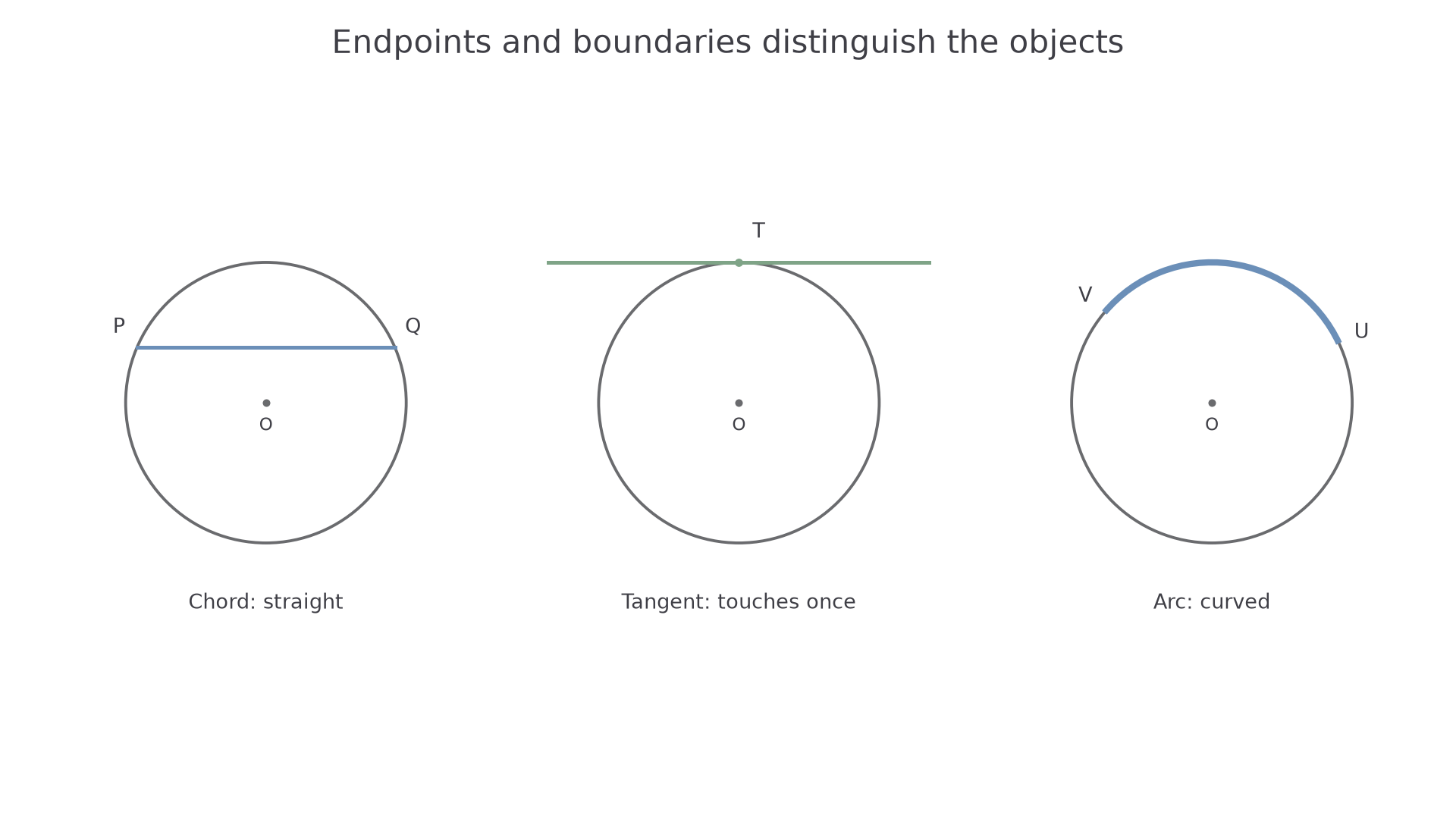
Two points on a circle can be joined by a straight segment or by following the curved boundary. These give different objects, even though their endpoints are the same.
Chord, tangent and arc
A chord is a straight segment with both endpoints on a circle. A diameter is a special chord through the centre.
A tangent is a straight line that touches a circle at exactly one point. An arc is a portion of the circle's circumference between two endpoints.
[DIAGRAM: asset_name: Chord tangent and arc; asset_slug: circle_chord_tangent_arc; caption: A chord is straight, an arc is curved, and a tangent touches once.; description: Three exact circles separately show a non-diameter chord PQ, a tangent line touching at T, and a highlighted curved arc UV. The chord does not pass through the marked centre and the tangent extends in both directions without cutting across the circle.]
Continue this lesson.
You’re previewing NovaLearn without an account. Create a free account to read the rest.
Create free account