C1.6; E1.6 - Adding and subtracting fractions
Adding fractions means combining counts of equal-sized parts. You will use common denominators to add and subtract, simplify the result, and handle improper fractions, mixed numbers and negative values. The methods are the same for Core and Extended.
Adding fractions with common denominators
If you pour half a litre and a third of a litre into a jug, why is the total not of a litre? The tempting calculation adds the numerators and denominators, but a half and a third are different-sized units. We will return to the jug once we can count matching units.
Begin with parts that already match. Three sevenths and two sevenths make five sevenths, just as three apples and two apples make five apples. The count changes; the unit stays “sevenths”.
You already know
In , the denominator tells you the size of each equal part of a whole. The numerator counts those parts. Fractions with the same positive denominator count the same-sized parts.
For addition with a common denominator, add the numerators and keep the denominator. For subtraction, subtract the numerators and keep the denominator. Simplify the result, converting to a mixed number if requested.
Worked example 1: combining sevenths
Question. Work out .
Plan. Count the total number of sevenths.
Answer. .
Check. Remove the second amount: , recovering the first.
Change the first numerator from to . The method stays the same even when the total crosses one whole.
Worked example 2: a total greater than one
Question. Work out . Give your answer as a mixed number.
Plan. Add the sevenths, then collect seven of them into a whole.
Answer. .
Check. The first fraction is one seventh below one; adding two sevenths must take you one seventh above one.
The same counting works for subtraction: . If both fractions are identical, the result is zero: . A zero numerator is allowed; a zero denominator is never allowed.
Watch out
is wrong: adding does not cut every seventh in half. Keep the denominator , giving . The wrong result is even smaller than the first positive amount.
Different denominators and subtraction
Different denominators need a common unit before you add or subtract. Replacing fractions by equivalent fractions changes how you count the amount, without changing the amount itself.
For the opening jug, divide each half into three sixths and each third into two sixths. You can now count the same-sized parts:
[DIAGRAM: asset_name: Halves and thirds become sixths; asset_slug: halves_thirds_sixths; caption: One half is three sixths and one third is two sixths. Together they make five sixths.; description: Three equal-length bars aligned vertically and divided into six equal parts. The first has three pale blue parts shaded and is labelled one half equals three sixths. The second has two sage parts shaded and is labelled one third equals two sixths. The third has three blue parts followed by two sage parts and one unshaded part, labelled total five sixths.]
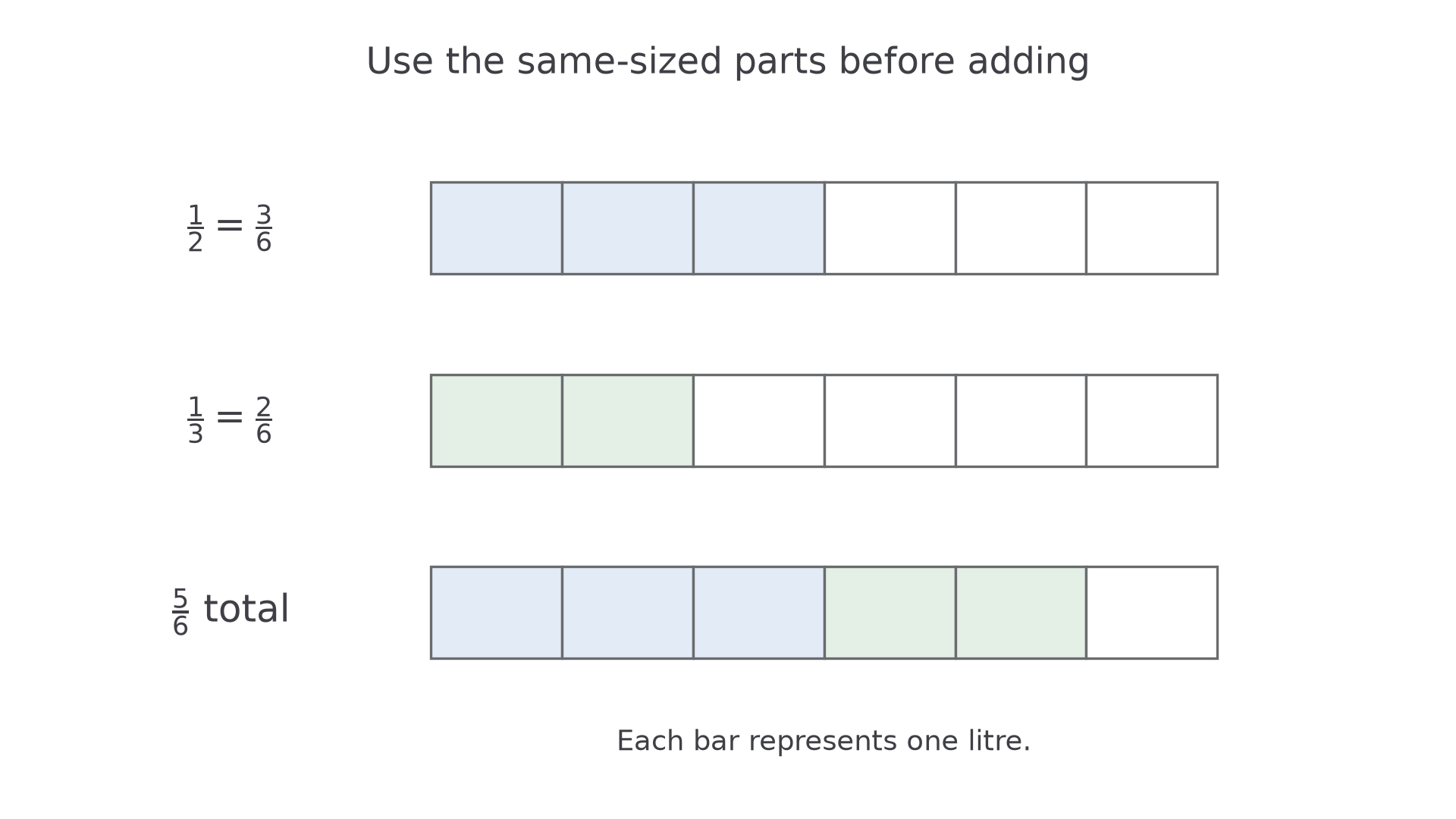
Choose a common denominator that is a multiple of both original denominators. Their lowest common multiple (LCM) usually keeps the arithmetic shortest. Dividing a part into smaller equal pieces multiplies its denominator and numerator by the same factor; do this separately for each fraction.
Worked example 3: adding quarters and sixths
Question. Work out .
Plan. Use twelfths, because is the LCM of and .
Answer. .
Check. Three quarters leaves a gap of to one. Adding leaves , so the total is .
Change only the operation to subtraction. Keep the same equivalent fractions, but subtract their counts.
Worked example 4: subtracting the same fractions
Question. Work out .
Plan. Express both fractions in twelfths, then subtract.
Answer. .
Check. Add the removed amount back: .
Using a larger common multiple is also valid. For instance, twenty-fourths would give . The extra simplification makes it less efficient, but it is still the same calculation.
Watch out
subtracts unlike numerators after multiplying only the denominators. Every equivalent fraction needs both numbers changed: , not .
Negative fractions and mixed numbers
Fractions use the signed-number rules you already know. Adding a negative fraction moves left on the number line. Subtracting a negative reverses that move: .
For a negative mixed number, the minus sign applies to its entire value: . It is not , which lies between and . Converting mixed numbers to improper fractions first gives one count of equal parts and keeps this sign clear.
Worked example 5: subtracting mixed numbers
Question. Work out . Give your answer in its simplest form.
Plan. Convert each mixed number to an improper fraction, then use twelfths.
Answer. .
Check. Add back : .
Now make only the first mixed number negative. The common denominator is unchanged, but both contributions to the final value are negative.
Worked example 6: a negative mixed number
Question. Work out . Give your answer as a mixed number in its simplest form.
Plan. Keep the minus sign on the entire first fraction, then combine the negative twelfths.
Answer. .
Check. Adding back gives . Also, subtracting a positive amount must move the answer below .
You can also obtain a negative result by subtracting a larger positive fraction from a smaller one. For example, . The denominator remains positive; put the negative sign in front of the fraction to make the direction easy to read.
Watch out
is wrong because it treats the expression as . Count the full magnitude first: two wholes and one third make seven thirds, so the negative mixed number is .
Quick Recap
- Add or subtract counts of equal-sized parts: keep the common denominator.
- With different denominators, write equivalent fractions with a common denominator before combining the numerators.
- Convert mixed numbers to improper fractions when that keeps the calculation clear. A minus before a mixed number applies to its whole value.
- Simplify at the end, give the requested form, and check subtraction by adding the removed amount back.
The opening jug contains of a litre, because a half is three sixths and a third is two sixths. Adding the denominators would change the units instead of combining the amounts.