E7.2, E7.3 - Calculating with vectors
A vector records both the size and direction of a displacement. You will connect column, arrow and bold notation, combine movements and calculate their magnitudes. E7.2 supplies the arithmetic; E7.3 connects the two components to Pythagoras' theorem.
Vector notation and components
Can two different vectors have the same length? A movement three right and four up, and a movement three left and four up, both have length five. Their directions still matter, so the vectors are different.
Vector and components
A vector has magnitude and direction. In two dimensions, gives its horizontal and vertical components. The directed segment means the displacement from to ; the arrow points towards . Bold , arrow notation and a column can represent the same vector.
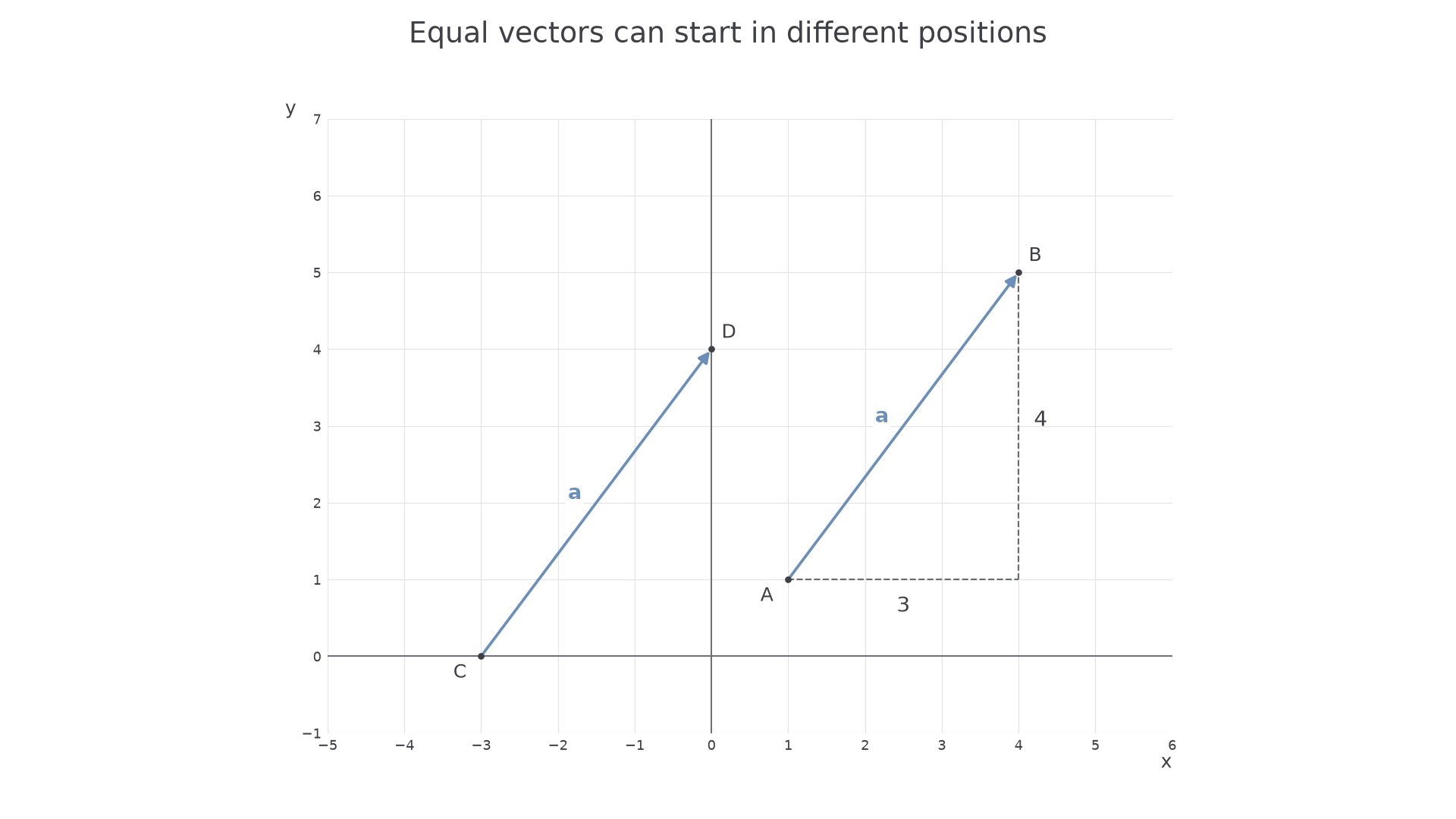
For a handwritten answer, use a clear arrow over the letters. The vector depends on the displacement, not on where the arrow is placed: equal parallel arrows pointing the same way represent equal vectors. Two points with different coordinates can begin equal displacements. Reversing an arrow reverses both components.
[DIAGRAM: asset_name: Equal vectors in different positions; asset_slug: equal_directed_vectors; caption: Both arrows move three units right and four units up, so they represent the same vector.; description: Equal-scale grid shows arrow A one one to B four five and arrow C negative three zero to D zero four. Both point upwards and right and are labelled a. A dashed horizontal and vertical step path for the first arrow labels its components three and four.]
Worked example 1: reading a directed displacement
Question. and . Write as a column vector.
Plan. Calculate finish minus start in each coordinate.
Answer. .
Check. Starting at , the displacement reaches , the required endpoint.
Keep the endpoints but reverse the arrow. The component signs must reverse too.
Worked example 2: reversing the displacement
Question. For the same points, write as a column vector.
Plan. Now start at and finish at .
Answer. .
Check. Following then returns to the start: the total components are and .
Watch out
and have equal lengths but are opposite vectors. Reversing only one component usually changes to a different direction altogether.
Addition, subtraction and scalar multiplication
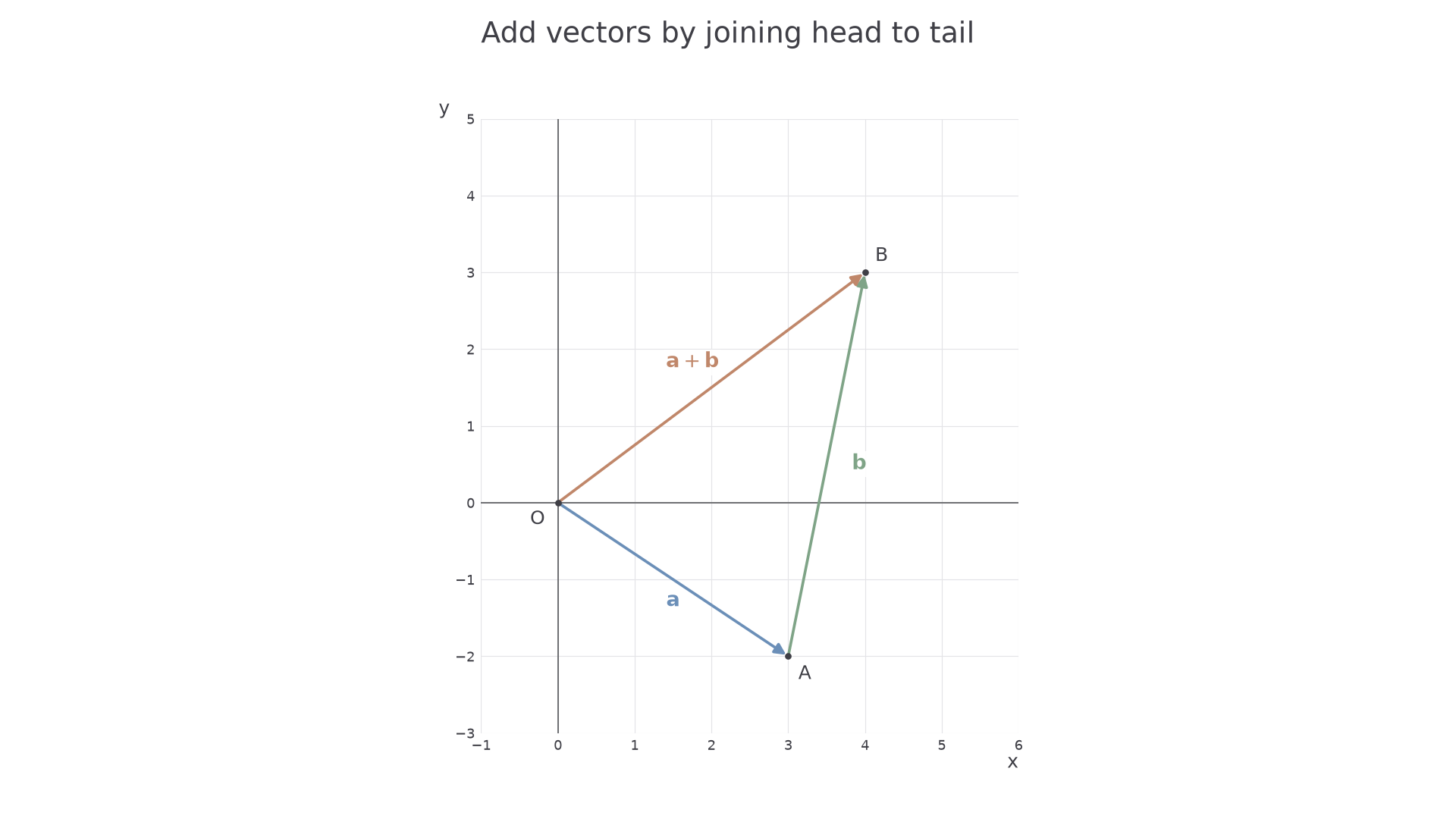
To add movements, follow one arrow and then the other, placing the tail of the second at the head of the first. The sum is the arrow from the original start to the final finish. Horizontal changes add separately from vertical changes.
Component arithmetic
For , and scalar ,
Subtract by adding the reverse vector: .
Not given in the List of formulas: learn these rules.
A scalar is an ordinary number multiplying a vector. Positive multiplication keeps a nonzero vector's direction; negative multiplication reverses it. Its magnitude is multiplied by . Multiplication by zero gives , the zero vector, which has no direction.
[DIAGRAM: asset_name: Adding arrows head to tail; asset_slug: vector_addition; caption: Three right and two down, followed by one right and five up, finishes four right and three up.; description: Equal-scale grid has O at zero zero, A at three negative two and B at four three. A blue arrow O to A is a, a sage arrow A to B is b and a clay arrow O to B is a plus b.]
Continue this lesson.
You’re previewing NovaLearn without an account. Create a free account to read the rest.
Create free account