E2.6 - Regions defined by inequalities
An equation draws a boundary; an inequality chooses a side of it. You will draw the correct boundary, shade unwanted points and recover the inequalities defining an unshaded region. This lesson is for Extended.
Boundary lines and strict inequalities
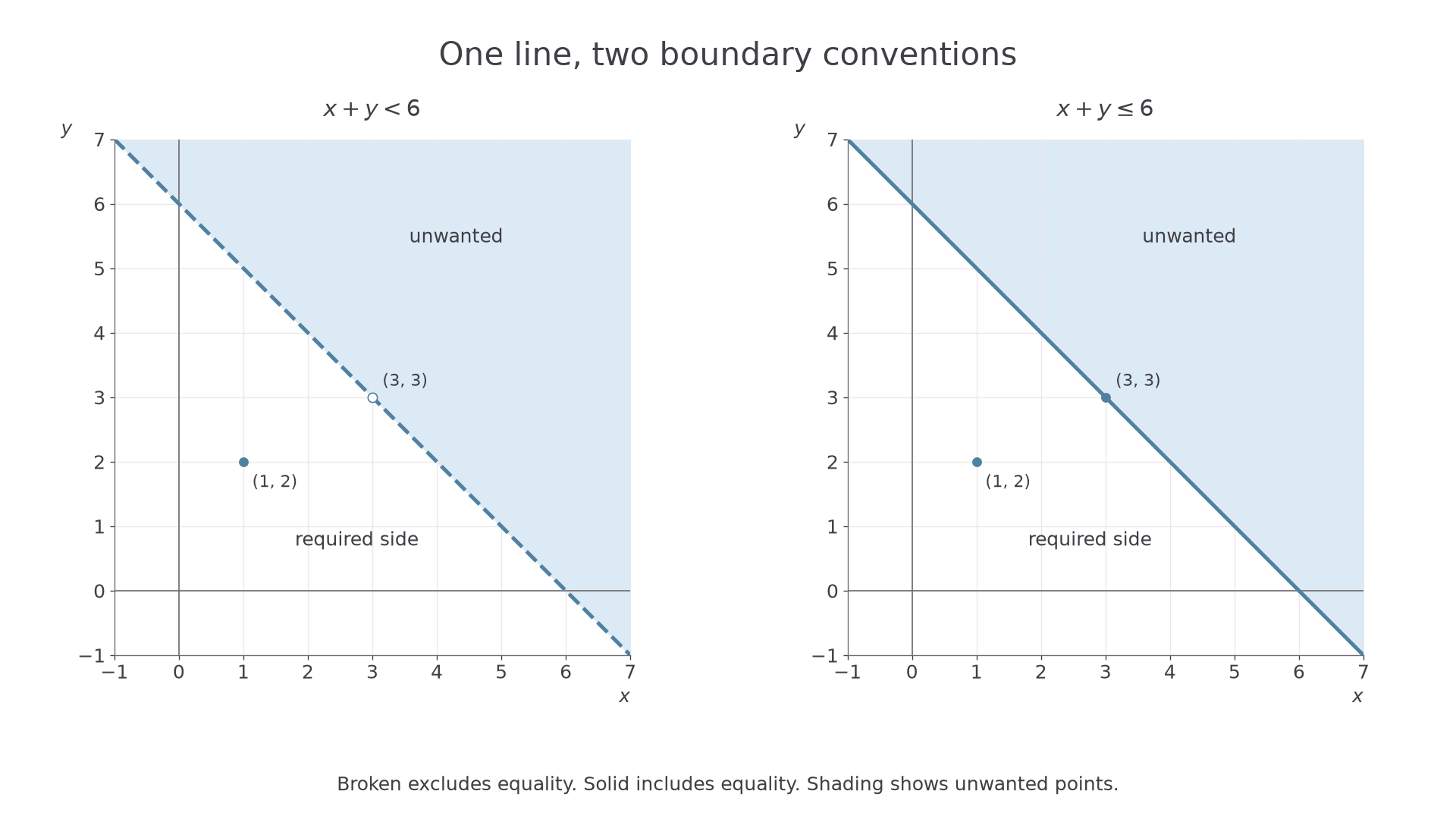
Can a graph represent infinitely many answers without marking each one? The condition accepts , since , but rejects . Its boundary is the straight line : every point on that line gives equality.
For a fixed input , the condition selects outputs below the line. Every point in that half of the plane works, not just points with integer coordinates. The boundary itself fails the strict inequality because equality is not allowed.
Boundary conventions
Draw the corresponding equation as a broken line for a strict inequality, or . Draw it as a solid line for an inclusive inequality, or , because equality is included. Unless directed otherwise, shade the unwanted side and leave the required side unshaded.
Use the same accurate plotting methods as for a line equation: label and number the axes, plot two distinct points and rule the boundary. For a broken boundary, make a straight sequence of dashes rather than a freehand curve. The dashes do not create allowed gaps; the whole boundary is excluded.
[DIAGRAM: asset_name: The same boundary with different inclusion; asset_slug: inequality_boundaries; caption: Both panels leave the lower half-plane unshaded; only the right panel includes its boundary.; description: Two equal-scale numbered grids show x plus y equals six through zero comma six and six comma zero. The left boundary is broken for x plus y less than six and the right is solid for x plus y less than or equal to six. The unwanted region above each line is shaded pale blue. The points one comma two and three comma three are marked.]
Worked example 1: a strict boundary
Question. Represent on a coordinate grid.
Plan. Draw the equality boundary, then use a test point to decide which side to keep.
Answer. Draw a broken line through and , extended across the grid. Shade above it, leaving the side containing the origin unshaded, as in the left panel.
Check. The unshaded point gives . The boundary point gives , false, agreeing with the broken line.
Change only to . The chosen side stays the same, but equality now works.
Worked example 2: including the boundary
Question. Represent on a coordinate grid.
Plan. Keep the same plotted points and test side, but include equality.
Answer. Use a solid line through and , and shade above it, as in the right panel.
Check. The unwanted point still gives , false. Changing inclusion has not moved the boundary or reversed the chosen side.
Vertical and horizontal boundaries work in the same way. For , use a broken vertical line at , shading to its left. For , use a solid horizontal line at , shading below it. “Above” is useful for a condition expressed in terms of ; it is not a description of the side of a vertical line.
Watch out
A test point must lie off the boundary. If the origin lies on your line, use a different point such as . Substituting a boundary point cannot distinguish the two sides.
Use the new boundary in this check.
Shading unwanted regions
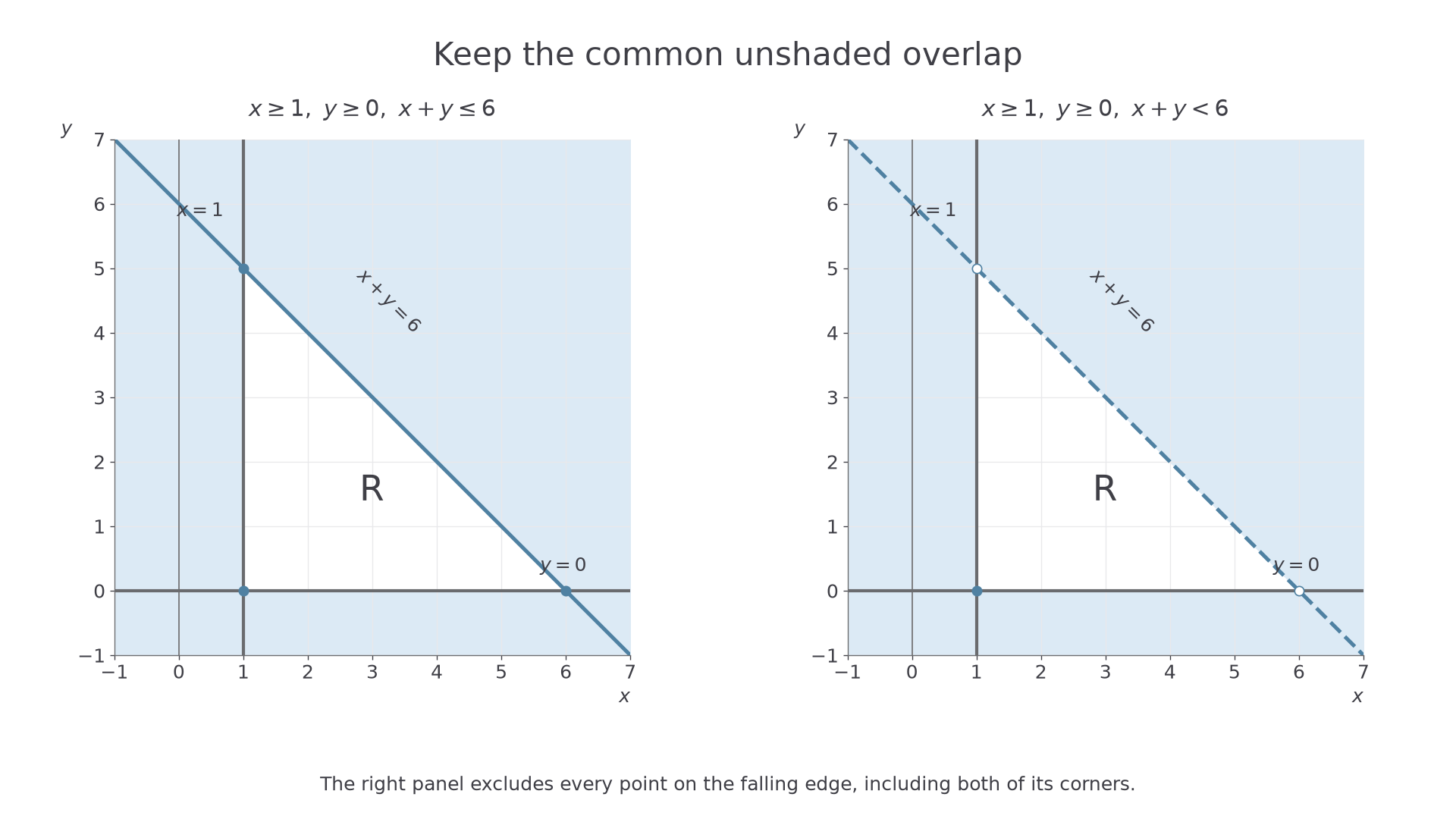
When several inequalities must hold together, a point must pass every condition. Shade each unwanted half-plane. The region left unshaded is their common solution; passing just one condition is not enough.
For example, keeps points on or right of a vertical line. The condition keeps points on or above the horizontal axis. Adding keeps only the part below a falling line. Their overlap is a triangle, although none of the individual conditions describes a triangle on its own.
[DIAGRAM: asset_name: Combining three half-planes; asset_slug: combined_inequalities; caption: The unshaded overlap satisfies all three inequalities; the broken edge in the right panel is excluded.; description: Two equal-scale numbered grids show the vertical line x equals one, the horizontal line y equals zero and the falling line x plus y equals six. The triangular overlap has vertices one comma zero, one comma five and six comma zero. The unwanted side of every boundary is shaded pale blue. All boundaries are solid in the left panel. Only the falling boundary is broken in the right panel. Each panel labels the unshaded region R.]
Worked example 3: three inclusive conditions
Question. Shade the unwanted regions for , and . Label the solution region .
Plan. Deal with each boundary separately, then keep the common unshaded part.
Answer. Draw all three boundaries solid. The remaining triangle, including its edges, is , shown on the left.
Check. The interior point gives , and . The point passes the last two conditions but fails the first and is shaded.
Continue this lesson.
You’re previewing NovaLearn without an account. Create a free account to read the rest.
Create free account