E4.7 - Angles in the same circle
The same chord can connect several angles in a circle. You will identify the arc or segment each angle uses, calculate centre and circumference angles, use cyclic quadrilaterals, and select the correct angle between a tangent and a chord.
Angles at the centre and circumference
Two people stand on different parts of a circular boundary and look towards the same two endpoints and . Must they see the same angle? It depends which side of the chord they stand on. Begin by identifying the arc that each angle sees.
An angle at the circumference subtends the arc from to that does not contain its vertex . Its arms end at and . To compare it with a centre angle, use the centre angle sweeping that same arc. This might be a reflex centre angle.
Centre and circumference angles
The angle at the centre is twice the angle at the circumference when both subtend the same arc:
The endpoints must match, and the selected centre angle must sweep the arc not containing the circumference vertex.
Not given in the List of formulas: learn this circle theorem.
Joining the centre to the three circumference points makes triangles with equal radii. Their equal base angles and triangle angle sums explain the factor of two. A diameter is a useful special case: its centre angle gives the familiar angle in a semicircle.
[DIAGRAM: asset_name: Choose the same intercepted arc; asset_slug: centre_circumference_angles; caption: Moving C to the other arc changes which centre angle must be doubled.; description: Three exact circles have centre O and chord AB. In the first C is on the major arc AB, angle ACB is 38 degrees, and the minor centre angle AOB is x. In the second C is on the minor arc AB, angle ACB is 142 degrees, and the reflex centre angle AOB is y, with its long arc marked. In the third C is on the minor arc, angle ACB is 127 degrees and the requested minor centre angle is z. The intercepted arc not containing C is highlighted in each.]
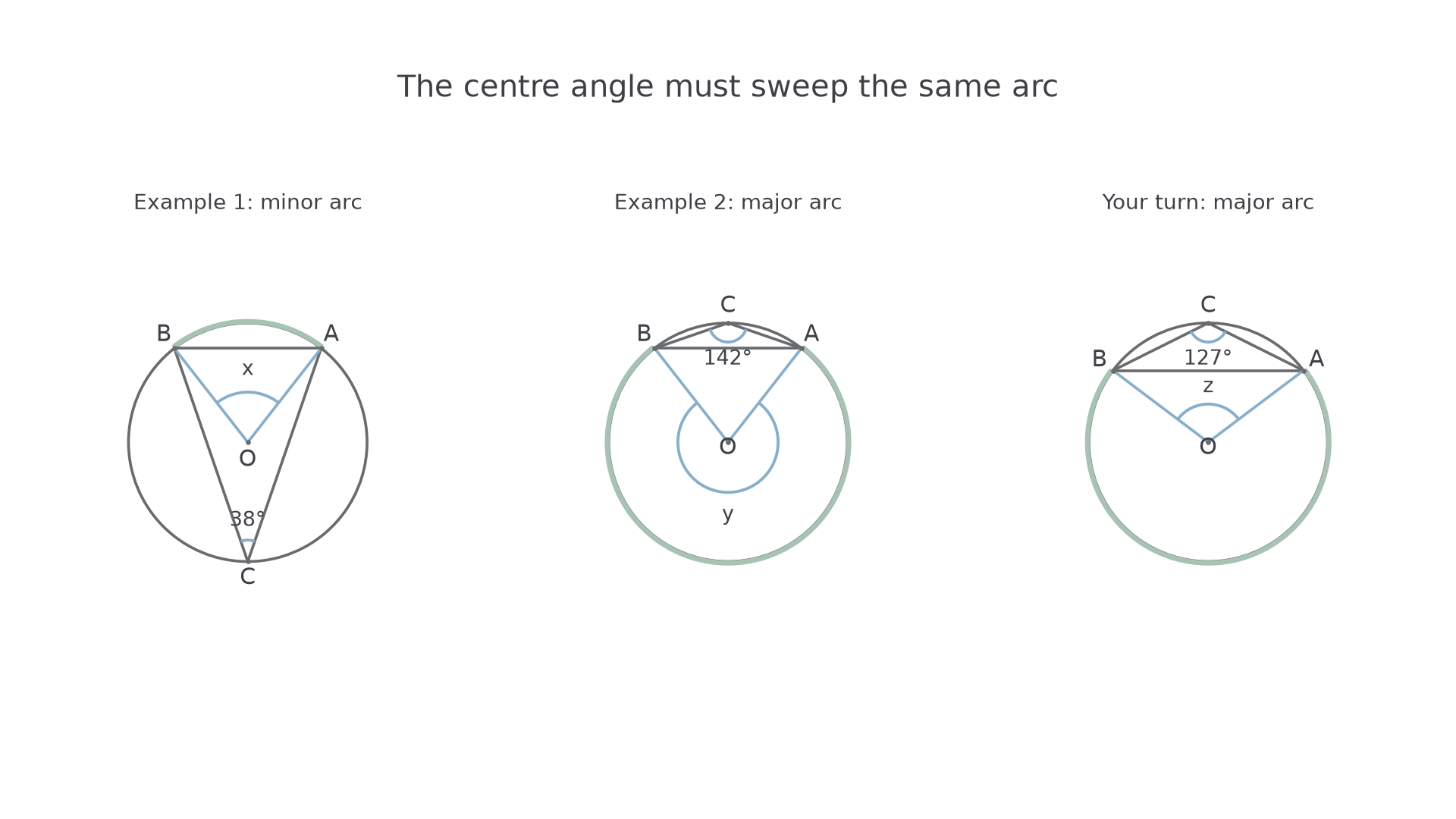
Worked example 1: a minor centre angle
Question. is the centre. lies on the major arc , and . Find the minor angle .
Plan. Both requested angles subtend the minor arc , so double the circumference angle.
Answer. The minor angle is .
Check. Half of is . The result is below , consistent with the specified minor arc.
Move only the circumference vertex to the other arc. The new angle sees the long arc, so doubling now gives a reflex angle.
Worked example 2: a reflex centre angle
Question. Keep the same chord, but put on the minor arc , with . Find the reflex angle , then its minor partner.
Plan. Double the angle seeing the major arc, then complete a full turn at .
Answer. Reflex ; minor .
Check. The two centre sectors total . The unchanged chord still has the same minor centre angle as before; only the chosen arc changed.
After doubling, classify the result as minor, straight or reflex before labelling its sector.
Watch out
“, so the minor centre angle is ” labels the wrong sector. Doubling is correct, but is reflex. Read the arc and the requested sector before finishing.
The fresh check asks for the minor angle even though the circumference vertex sees the major arc.
Angles in the same segment
Place two vertices and on the same side of chord , on the same circle. Both and see the arc on the other side. Each is half the same centre angle, so they are equal.
Angles in the same segment
If lie on one circle, with on the same side of chord , then
The angles must use the same chord endpoints and have their vertices in the same segment.
Not given in the List of formulas: learn this circle theorem.
A sloping or overlapping diagram does not change that relationship. Trace the two arms from each vertex back to the same endpoints. If the vertices are on opposite sides of the chord, do not use this equality.
[DIAGRAM: asset_name: Angles standing on the same chord; asset_slug: same_segment_chains; caption: C and D lie in the same segment, so their angles on AB match.; description: Three exact circles show chord AB near the bottom and vertices C and D on the same side above it, with chords AC, BC, AD and BD. The first marks ACB as 37 degrees and ADB as x. The second keeps ACB at 37 degrees, marks BAD as 41 degrees, and labels ABD as y. The third marks ACB 43 degrees, BAD 29 degrees and ABD z. All angle labels refer to the corresponding exact sectors.]
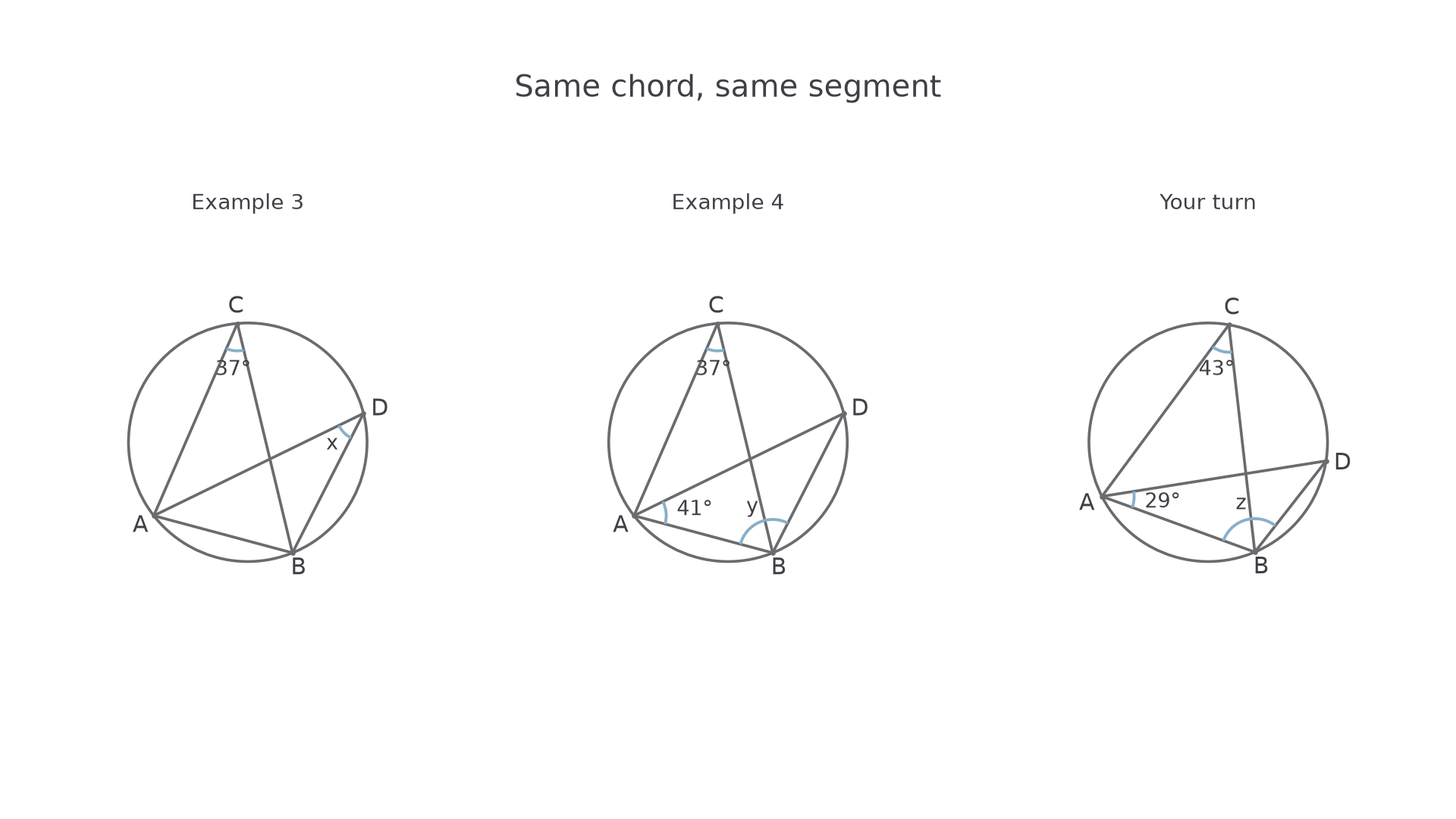
Worked example 3: transferring an angle
Question. lie on one circle. and are on the same side of chord , and . Find , giving a reason.
Plan. Check that both angles stand on chord in the same segment.
Answer. , angles in the same segment.
Check. Both angles see the same minor arc ; its centre angle is . Half of that gives either circumference angle.
Keep the same transfer, but carry it one step further into triangle .
Worked example 4: transferring before a triangle sum
Question. In the same configuration, and . Find , with reasons.
Plan. Find the angle at from the same segment, then complete triangle .
Answer. .
Check. . The target is obtuse, which is allowed even though the transferred angle is acute.
The equal angles may belong to different triangles. Transferring one angle can supply the information needed in the triangle you want to solve.
Watch out
“Angles in the same circle are equal” is too broad. You need the same chord and the same segment. Name the actual angle pair to show that both conditions hold.
Use fresh angles in the final panel.
Cyclic quadrilaterals
A cyclic quadrilateral has all four vertices on one circle. Take them in order around the circle to form the quadrilateral. Opposite angles now have their vertices on opposite sides of a chord, so they see the two complementary arcs.
Continue this lesson.
You’re previewing NovaLearn without an account. Create a free account to read the rest.
Create free account