E6.6 - Lengths and angles in three dimensions
A space diagonal belongs to a flat triangle even though the surrounding object is three-dimensional. You will locate useful right triangles in solids, calculate lengths in stages, and identify the angle between a line and a plane using a perpendicular projection. This lesson is for Extended.
Right triangles inside solids
A cuboid has edges , , and . Its longest diagonal goes through the interior. Which two lengths meet at a right angle and can reveal that diagonal?
Label its rectangular base , in order, with and . Put directly above , respectively, with vertical edges . A face diagonal joins opposite corners of one face; a space diagonal, such as , joins opposite vertices through the interior.
[DIAGRAM: asset_name: Face and space diagonals in a cuboid; asset_slug: cuboid_triangles; caption: Find a base diagonal first, then use it as one leg of a vertical triangle.; description: A labelled cuboid ABCD EFGH has base AB 8 centimetres, BC 6 centimetres and height CG 12 centimetres. Face diagonal AF and space diagonal AG are distinguished. Alongside, the flat right triangles ABF and ACG are redrawn, with the right angles at B and C respectively. AC is the base diagonal, length 10 centimetres.]
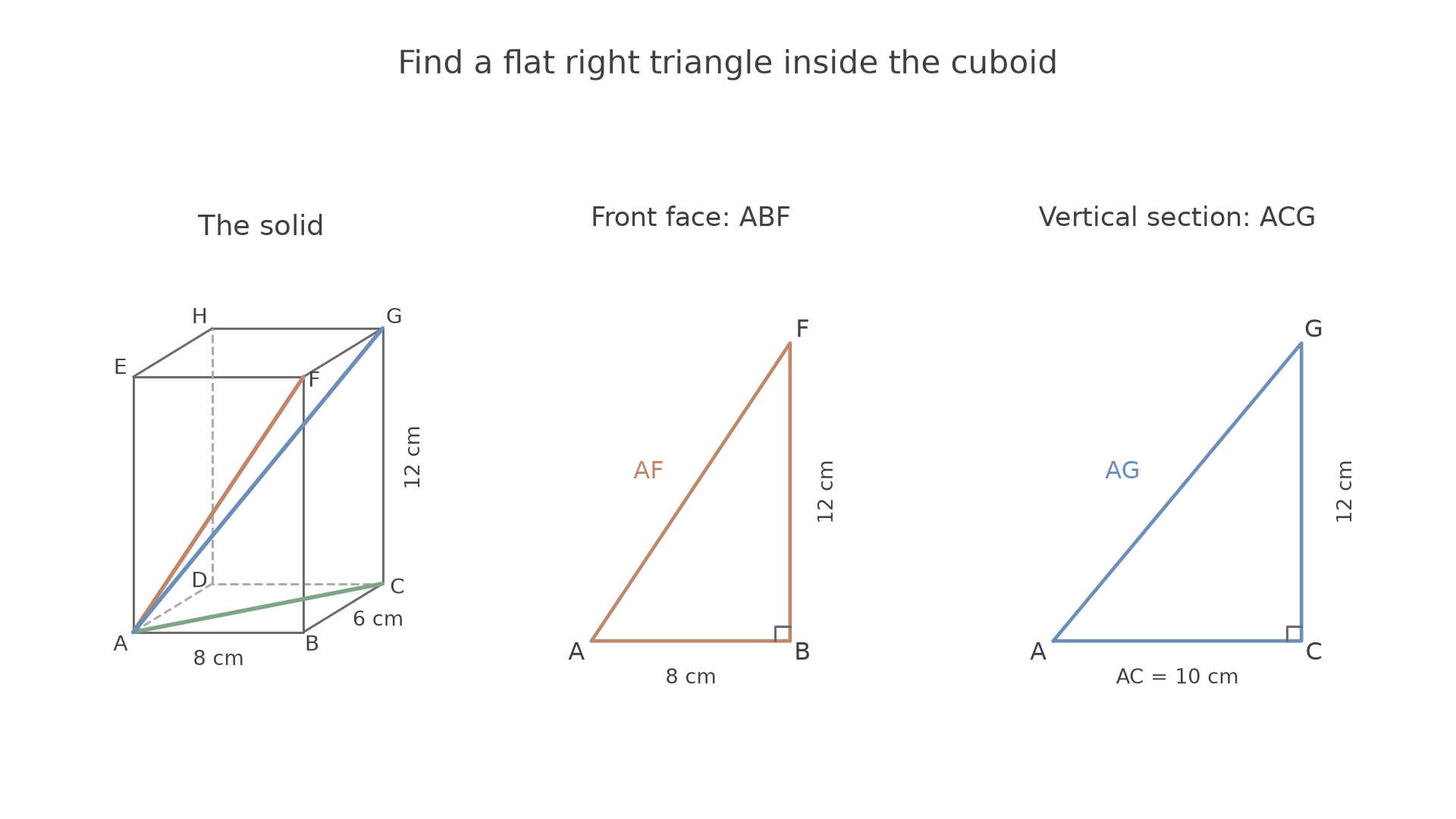
In a cuboid, a vertical edge is perpendicular to the whole horizontal base, so it is perpendicular to a base diagonal meeting its foot. This justifies the right angle at in triangle . Perspective on a page may distort that angle.
Worked example 1: a face diagonal
Question. In this cuboid, calculate the exact length of face diagonal .
Plan. Use triangle , which lies on the front rectangular face and is right-angled at .
Answer. .
Check. The value is about , greater than both and , but less than their sum . Its square is , agreeing with the sum of the two edge squares.
Now change the endpoint from to the opposite corner . The new diagonal leaves the front face, so a second triangle is needed.
Worked example 2: a space diagonal
Question. In the same cuboid, calculate the exact length of .
Plan. Find the base diagonal , then use the vertical triangle .
Answer. , approximately .
Check. A different route uses the front diagonal: . Also, the space diagonal is longer than the face diagonal.
Watch out
The line is not the hypotenuse of a triangle with just sides and : those lengths describe the front face and lead to . Name the three vertices of your triangle before substituting.
Lengths through several planes
A pyramid's sloping edge, face height and vertical height are different lengths. A useful cross-section passes through the apex and the point directly below it; that point establishes the right angle.
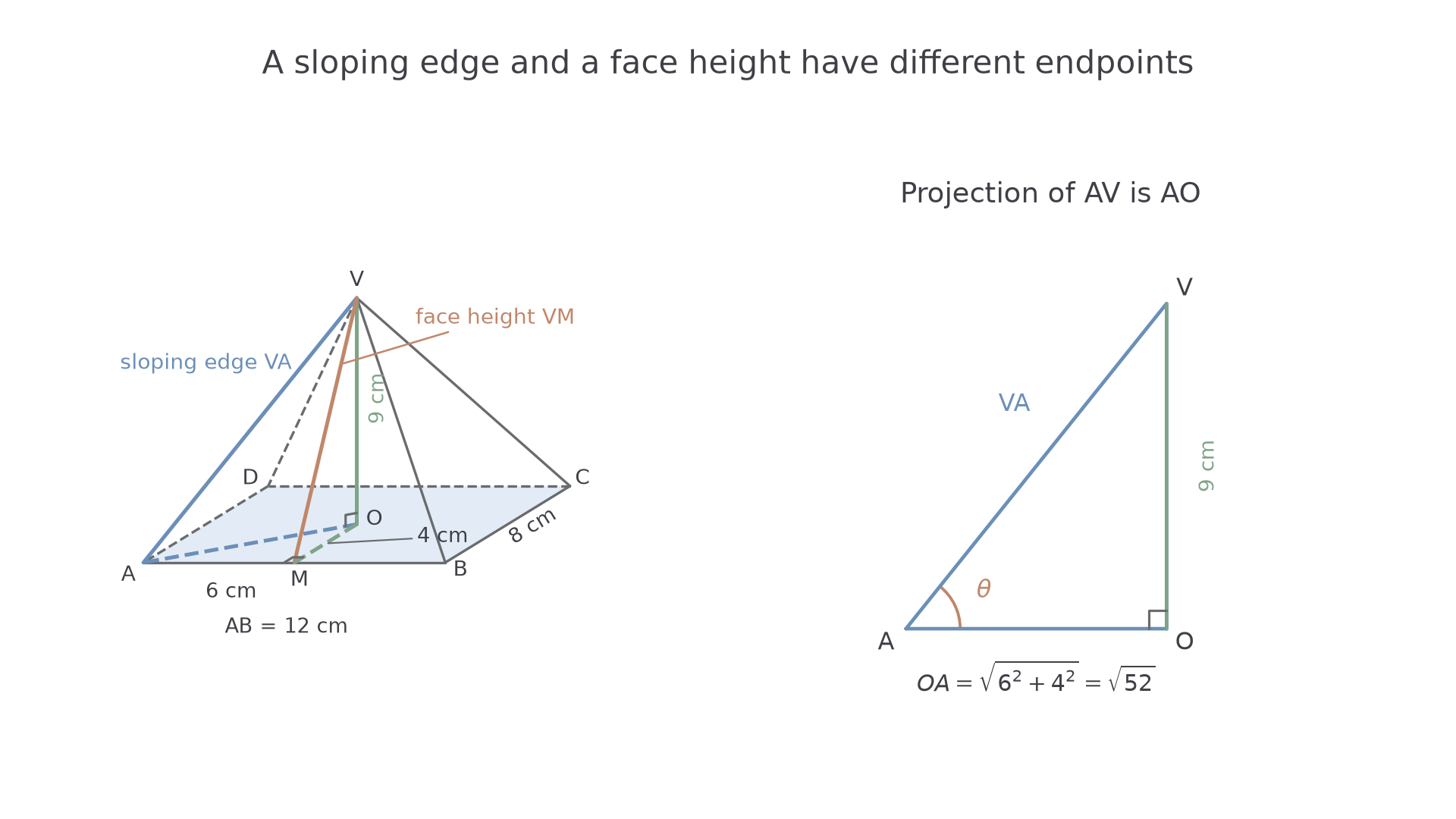
Take a pyramid with rectangular base . Its apex is directly above the base's centre . With base by , the centre-to-corner distance is half the base diagonal, not half either base edge:
This first triangle lies in the base plane. The next, , lies in a vertical plane and is right-angled at .
[DIAGRAM: asset_name: A pyramid and its perpendicular projection; asset_slug: pyramid_projection; caption: The sloping edge projects onto a centre-to-corner base segment.; description: A rectangular-base pyramid has apex V directly over centre O. Base sides are 12 and 8 centimetres, with half lengths 6 and 4 shown on a base triangle leading from O to corner A. The vertical height VO is perpendicular to the base. Sloping edge VA and the shorter face height VM to the midpoint M of AB are distinguished. A flat section VOA marks the line-plane angle at A between AV and AO.]
Worked example 3: vertical height to sloping edge
Question. This pyramid has vertical height . Find the exact length of a sloping edge .
Plan. Find the centre-to-corner distance in the base, then use the vertical cross-section.
Answer. , approximately .
Check. The base diagonal is ; half of it is , confirming . The sloping edge must exceed the vertical height .
Now the sloping edge is known instead of the vertical height. Keep the same base triangle, but subtract its square from the hypotenuse square.
Continue this lesson.
You’re previewing NovaLearn without an account. Create a free account to read the rest.
Create free account