E2.13 - Functions, domain and range
A function is a rule with specified allowed inputs, not just an expression on its own. You will use function notation and mappings, decide which inputs are permitted and find the outputs a function can actually produce. This lesson is for Extended.
Function notation and mappings
Can two different inputs give the same output without breaking a function? A machine that squares its input sends both and 2 to 4. That is allowed: each input still has exactly one output. Sending the single input 2 to both 4 and 7 would be different and would not define a function.
Function and notation
A function assigns exactly one output to each input in its domain, the set of allowed inputs. The range is the set of outputs actually obtained. In , names the function and , read “f of x”, names its output at input . The brackets do not mean multiplication by .
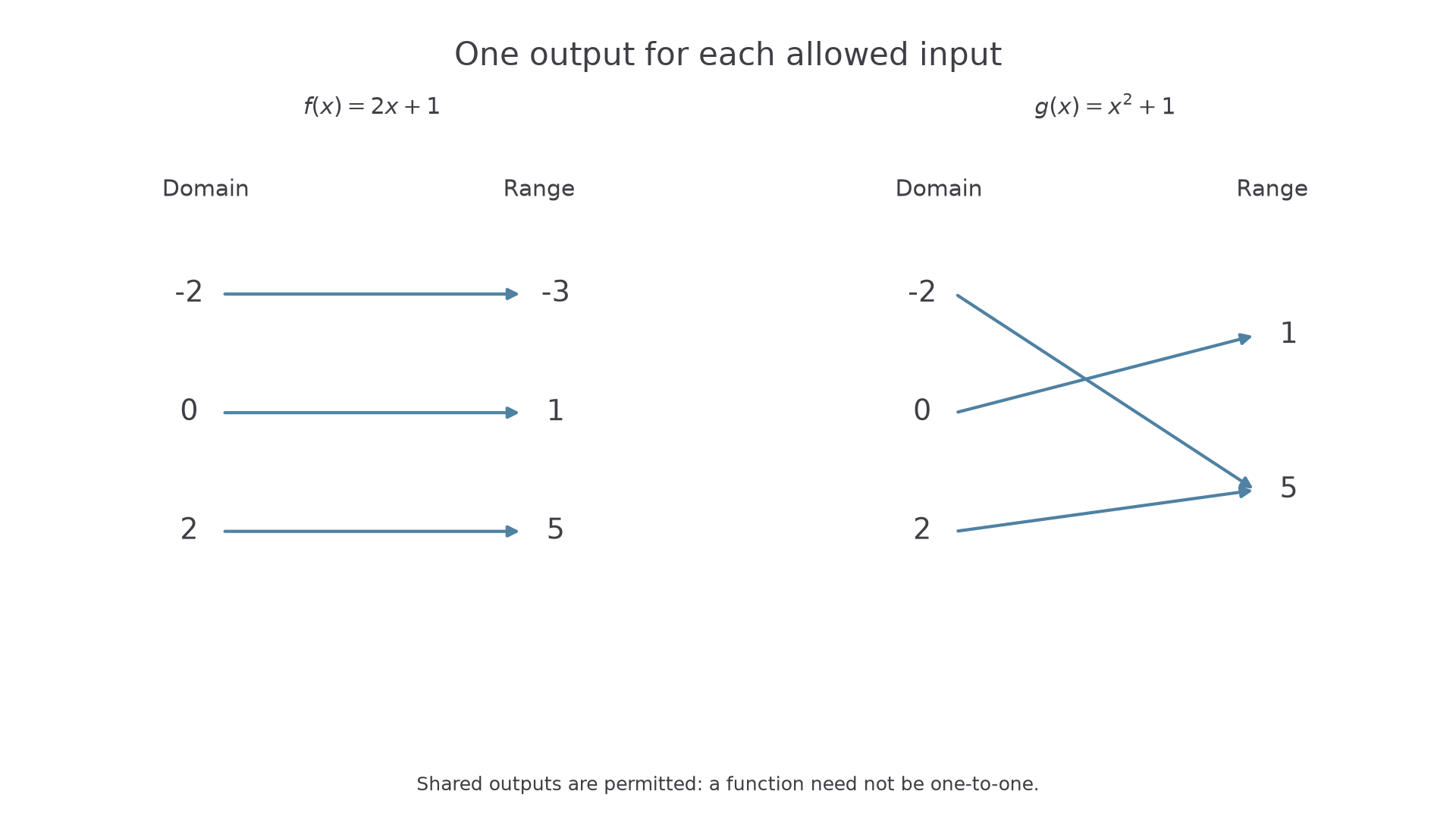
A mapping diagram lists allowed inputs on the left and outputs on the right, with one arrow from each input. Several arrows may arrive at the same output. Unused values in a larger right-hand set are not part of the range: only values reached by arrows belong to it.
[DIAGRAM: asset_name: Linear and many-to-one mappings; asset_slug: function_mappings; caption: Several inputs may share an output, but each input has just one arrow.; description: Two mapping diagrams use the domain negative two, zero, two. The left is labelled f of x equals two x plus one and maps to negative three, one, five. The right is labelled g of x equals x squared plus one and sends both negative two and two to five and zero to one. The right-hand range contains one and five only. All arrows have clear endpoints.]
Worked example 1: evaluating a positive input
Question. For , find .
Plan. Replace every occurrence of the input letter with 3, then follow the operations.
Answer. .
Check. Undo the two operations on 7: subtract 1 and divide by 2 to recover 3. This confirms the machine's input–output pair.
Change only the sign of the input. Brackets keep that sign attached to the substituted value.
Worked example 2: evaluating a negative input
Question. For the same function, find .
Plan. Substitute the whole signed input into the same rule.
Answer. .
Check. , so reversing the arithmetic recovers the new input. Also, moving the input down by 6 changes the output by : .
If a domain is finite, evaluate each allowed input. For on , the outputs are , so the range is . Sets do not list repeated values twice. The domain has three members and the range only two; that does not stop being a function.
Watch out
is an output, while “solve ” asks for an input. In the latter, solve , giving ; do not simply substitute 3.
Use this different rule and finite domain.
Domain restrictions
The written rule may forbid some real inputs, and a question may deliberately permit fewer inputs still. For example, cannot accept 4 because division by zero has no value. A model for time since a start may restrict an otherwise valid algebraic rule to .
Finding the real domain
If no smaller domain is stated, use all real inputs for which the rule is defined. A denominator must be non-zero. A square root needs a non-negative expression inside it; if that root is itself a denominator, it must be strictly positive. Apply all restrictions together.
The square-root convention matters: , a single non-negative output, rather than . The equation has two solutions, but that is a different statement. A function must assign one output to each permitted input.
Worked example 3: a shifted square root
Question. State the largest real domain of .
Plan. Require the expression inside the root to be non-negative.
Answer. All real .
Check. At 4, the output is , so equality is allowed. At 3, the rule would require , which has no real value.
Keep the same root but put it in a denominator. This one change now excludes the endpoint too.
Worked example 4: the root becomes a denominator
Question. State the largest real domain of .
Plan. Combine the real-root condition with the non-zero denominator condition.
Answer. All real .
Check. At 5, the output is 1, so a permitted input works. At 4, the expression becomes , confirming the strict boundary. Inputs below 4 still fail the real-root condition.
Continue this lesson.
You’re previewing NovaLearn without an account. Create a free account to read the rest.
Create free account