C4.1; E4.1 - Lines, angles and polygons
Geometry begins with descriptions you can trust. You will name lines, angles, triangles, quadrilaterals and polygons, and use their properties to decide what a shape really is even when it has been turned round.
Points, lines and angle types
Can a square become a different shape just by standing on one corner? Its appearance changes, but its lengths and angles do not. To recognise it reliably, start with the language that describes those properties.
A point marks an exact position; the dot we draw makes that position visible. A vertex is a corner where sides meet; the plural is vertices. A straight line continues indefinitely in both directions. A line segment has two endpoints, and a ray has one endpoint and continues in one direction. A triangle has three straight sides and three vertices; a rectangle has four of each.
Parallel and perpendicular
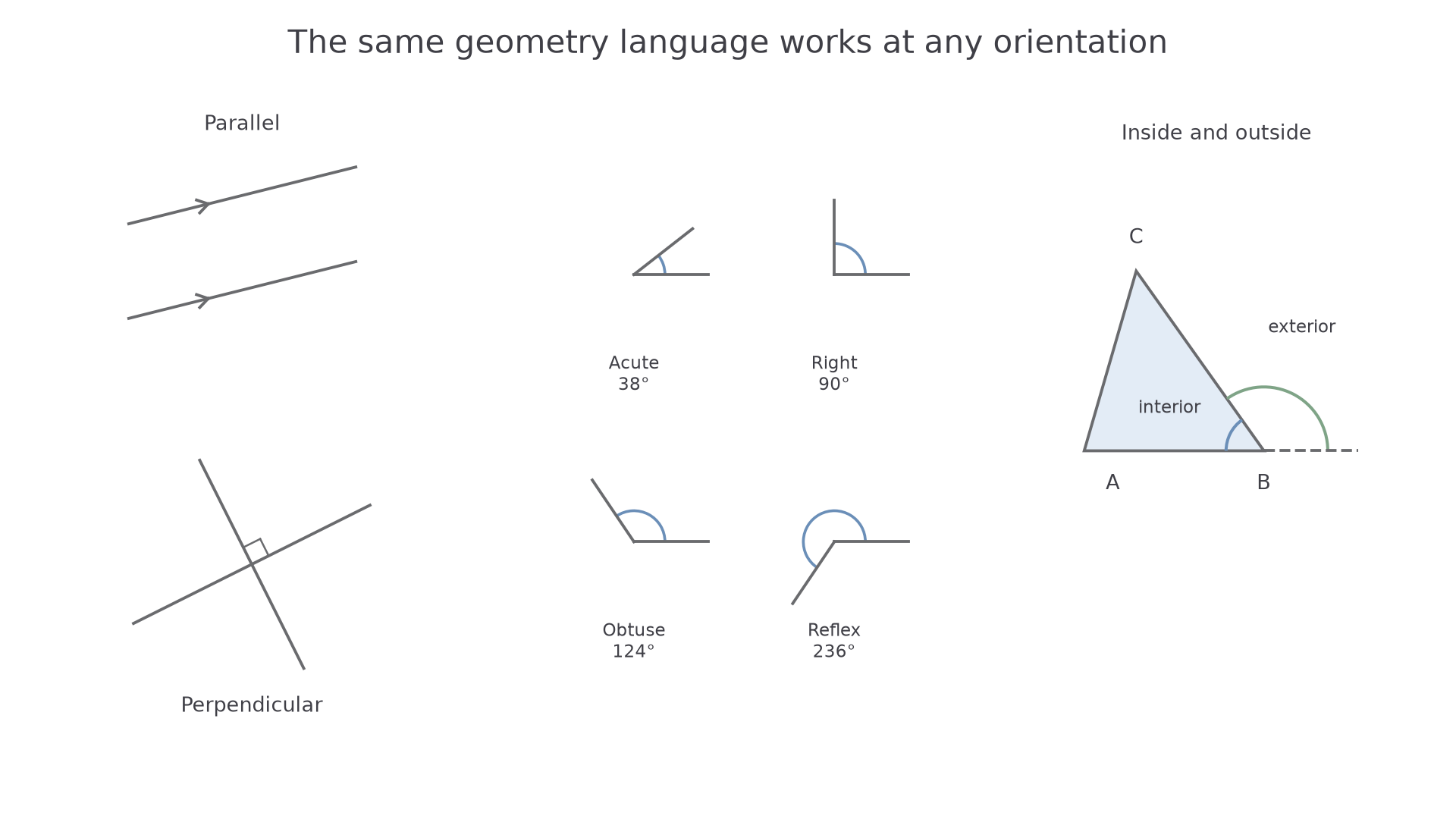
Parallel straight lines in the same flat surface never meet, however far extended. They stay the same distance apart. Perpendicular lines meet at a right angle, .
Matching arrow marks identify parallel lines; a small square at an intersection identifies a right angle. These marks describe properties even when the picture is slanted.
An angle measures a turn between two rays with the same endpoint. A full turn is ; a straight angle is . In , the middle letter is the vertex, and the arms run from towards and . A marked arc tells you which turn is intended when the same arms enclose two possible angles.
| Angle type | Size | Example |
|---|---|---|
| Acute | Greater than , less than | |
| Right | Exactly | A square corner |
| Obtuse | Greater than , less than | |
| Straight | Exactly | A half-turn |
| Reflex | Greater than , less than |
The strict boundaries matter: is right, not acute or obtuse. An interior angle lies inside a polygon at a vertex. An exterior angle is the turn between a side and the extension of its neighbouring side outside the polygon. For a convex polygon, use the outside angle adjacent to the interior angle, as marked below. Angle calculations come later; first identify the correct angle.
[DIAGRAM: asset_name: Lines and angle language; asset_slug: lines_and_angle_language; caption: Line markings and angle arcs describe properties regardless of orientation.; description: Three panels show parallel sloping lines and a perpendicular pair, acute right obtuse and reflex angle examples with correctly sized arcs, and a triangle with one side extended and its interior and adjacent exterior angles labelled.]
Watch out
“These lines are perpendicular because one looks vertical” is not a reason. Perpendicular means the angle between them is . A tilted pair can be perpendicular too.
Use the boundaries in the table to choose between similar-looking descriptions.
Triangles and quadrilaterals
Classify a shape using given measurements and markings, rather than how it happens to look. A shape can belong to more than one family.
An equilateral triangle has three equal sides and three equal angles, each . An isosceles triangle has at least two equal sides; the angles opposite those equal sides are equal. An equilateral triangle satisfies this condition too, but equilateral is its more specific name. A scalene triangle has no equal sides and no equal angles. A right-angled triangle has one angle. The last description is about angles, so a right-angled triangle can also be isosceles or scalene. For example, sides meeting at a right angle may both be , giving an isosceles right-angled triangle.
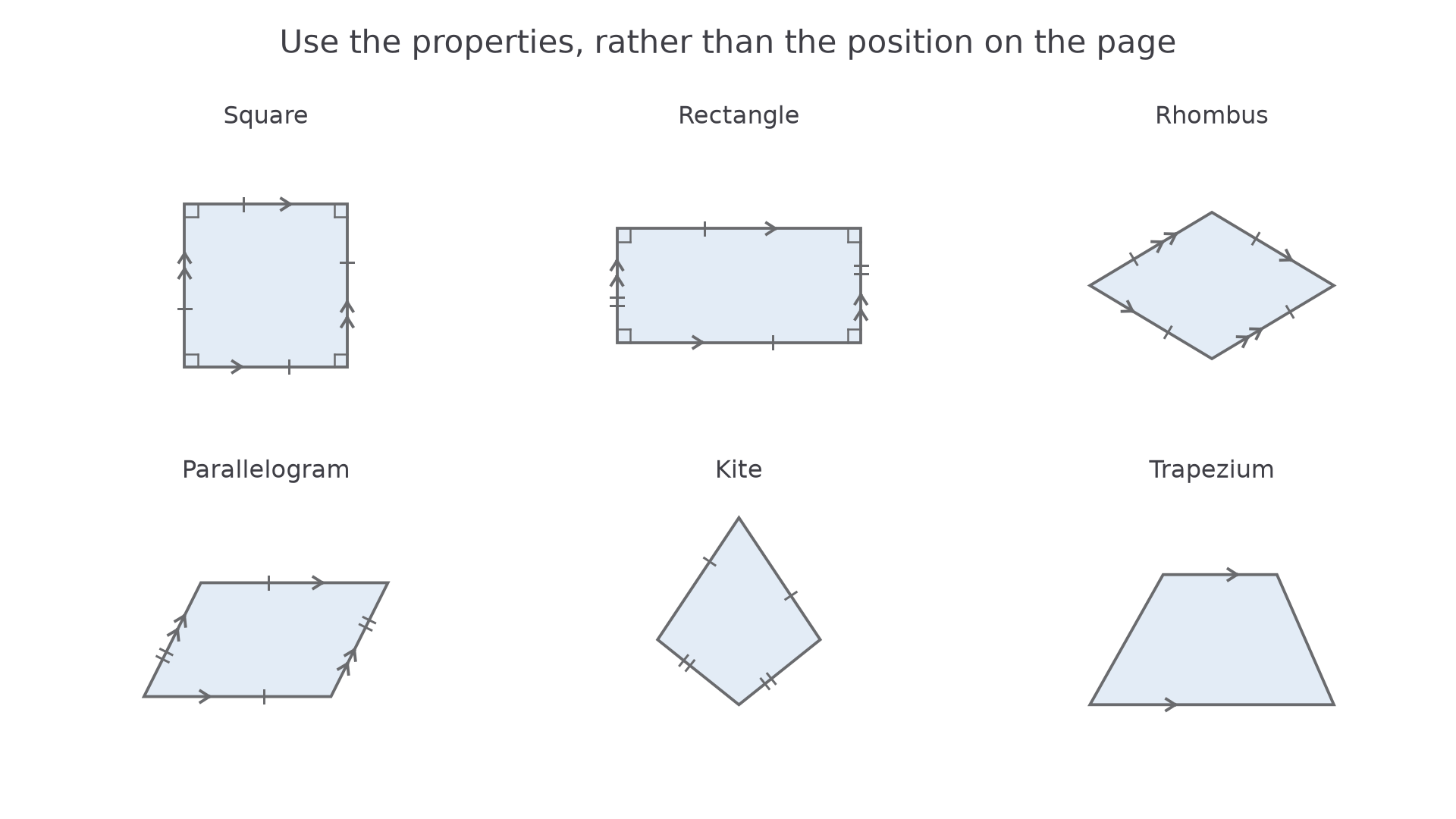
A quadrilateral is a polygon with four sides. Here are the properties that distinguish the special quadrilaterals. A diagonal joins two non-neighbouring vertices; bisect means cut into two equal parts.
| Shape | Sides and angles | Useful diagonal properties |
|---|---|---|
| Square | Four equal sides; four right angles; both pairs of opposite sides parallel | Equal diagonals that bisect each other at right angles |
| Rectangle | Opposite sides equal and parallel; four right angles | Equal diagonals that bisect each other |
| Rhombus | Four equal sides; opposite sides parallel; opposite angles equal | Diagonals bisect each other at right angles |
| Parallelogram | Opposite sides equal and parallel; opposite angles equal | Diagonals bisect each other |
| Kite | Two pairs of equal adjacent sides | Diagonals meet at right angles; the diagonal through the two vertices where equal sides meet bisects the other diagonal; the other pair of opposite angles is equal |
| Trapezium | One pair of opposite sides parallel; the other pair need not be equal | No equal-length or right-angle diagonal property is guaranteed |
For a kite, adjacent means sharing a vertex: it is not the same as opposite. For a general trapezium, do not assume equal sloping sides or equal base angles. In the usual classification used here, a trapezium has exactly one pair of parallel sides; when a problem supplies markings, describe those markings explicitly.
[DIAGRAM: asset_name: Special quadrilaterals; asset_slug: special_quadrilaterals; caption: Tick marks, parallel arrows and right-angle squares show the defining properties.; description: Six separately labelled exact quadrilaterals show a square rectangle rhombus parallelogram kite and trapezium. Equal-side ticks and parallel-side arrows distinguish adjacent from opposite equal sides, and right-angle squares appear only on the square and rectangle.]
Continue this lesson.
You’re previewing NovaLearn without an account. Create a free account to read the rest.
Create free account