E2.12 - Gradients of curves and differentiation
A curve can have a different gradient at every point. You will estimate a local gradient with a tangent, use differentiation to obtain an exact gradient rule for simple polynomials, and apply it at a specified point. This lesson is for Extended.
Drawing a tangent to estimate gradient
How can the curve have gradient 2 at one point and 4 at another? A single rise divided by run between two curve points measures an average gradient across that interval. To find its direction at one point, zoom in: a smooth curve looks increasingly like a straight line locally.
Tangent gradient
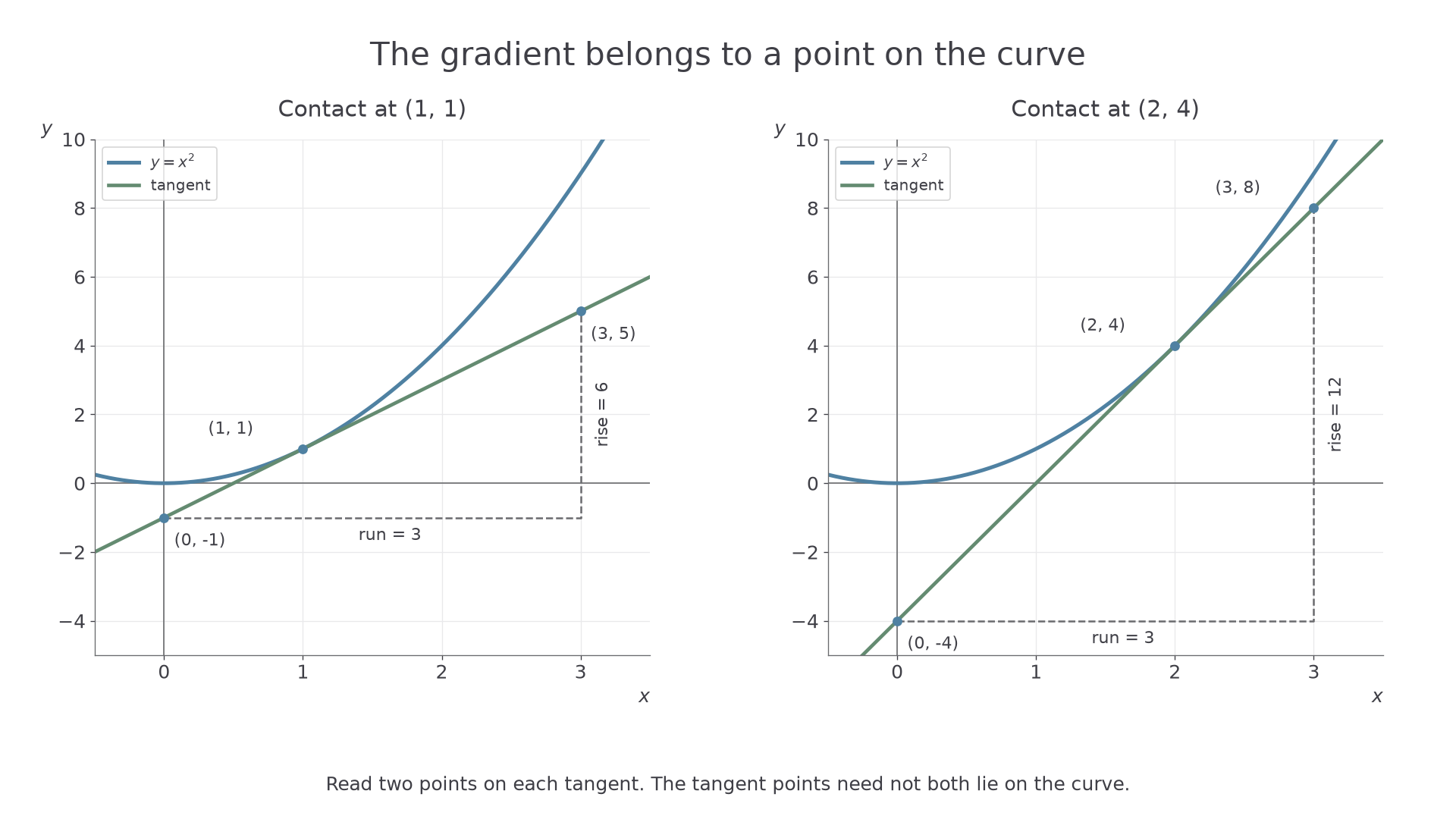
A tangent is a straight line matching a smooth curve's local direction at the chosen point. Its gradient is the curve's gradient there. Draw it with a ruler, then use two well-separated readable points on the tangent to calculate rise divided by run. Those points need not lie on the curve.
Balance your line against the nearby curve rather than forcing it through the origin. A tangent can cross its curve elsewhere; “touches exactly once” is not a general definition. Drawn and read gradients are estimates, so the precision should match the grid.
[DIAGRAM: asset_name: Different tangents on the same parabola; asset_slug: parabola_tangents; caption: Moving the contact point changes the local gradient even though the curve's rule is unchanged.; description: Two numbered coordinate grids show y equals x squared. The left has a tangent at one comma one passing through marked points zero comma negative one and three comma five, with a rise six run three triangle. The right has a tangent at two comma four passing through zero comma negative four and three comma eight, with a rise twelve run three triangle. Curve and tangent are distinct colours, and each contact point is marked.]
Worked example 1: a tangent near the origin
Question. Draw a tangent to the left curve at , and use it to estimate the gradient there.
Plan. Match the local direction, then choose the marked large triangle on the tangent.
Answer. The estimated gradient is 2. The left diagram shows a suitable tangent and triangle.
Check. Nearby curve points at have heights 0.81 and 1.21. Their short-interval gradient is , consistent with the tangent estimate.
Move only the contact point to . The curve is steeper there; its tangent must change too.
Worked example 2: a tangent farther right
Question. Draw a tangent to the right curve at , and estimate its gradient.
Plan. Use the new local direction and a large triangle on this new tangent.
Answer. The estimated gradient is 4.
Check. The curve heights at 1.9 and 2.1 are 3.61 and 4.41. Their gradient agrees. Dividing the contact coordinates would instead give the slope from the origin, not this tangent.
On a decreasing section the tangent gradient is negative. At a locally horizontal point it is zero. Choose the same left-to-right order in both differences; a rising tangent must not acquire a negative sign from reversing only one subtraction.
Watch out
Two convenient points on the curve may give the wrong tangent gradient. Draw the tangent first, extend it across the grid, then choose points on that line. A larger triangle reduces relative reading error.
The following check supplies the tangent points directly.
The power derivative rule
For , the tangent gradient at input 2 is 4. Here is why a symbolic rule can capture it. A second curve point at input , for a non-zero small change , has height , by ordinary two-bracket expansion. The connecting line's gradient is
For this is 4.1; for it is 4.01. As the second point gets closer, the line's direction approaches the tangent's and its gradient approaches 4. We never substitute zero into the fraction with denominator .
Repeating the same idea at input gives , approaching . The derivative records the tangent gradient as a function of the input. Differentiation is finding that new function; , read “dy by dx”, is its notation.
Power derivative rule
For a rational constant and a positive integer ,
Multiply the coefficient by the old power, then reduce the power by one. Differentiate sums term by term. A constant has derivative zero, including the constant term represented by exponent zero. These differentiation rules are not given in the List of formulas.
A constant graph is horizontal, explaining its zero derivative. A linear term has constant gradient , agreeing with the rule at power 1. Multiplying a graph's heights by a constant multiplies every rise and hence every tangent gradient by that constant; adding curves adds their local rises. This explains the coefficient and sum rules. Here we use sums of at most three terms with non-negative integer powers; the rule stated here does not authorise differentiating roots or reciprocals by assuming an unproved extension.
Continue this lesson.
You’re previewing NovaLearn without an account. Create a free account to read the rest.
Create free account