C5.3; E5.3 - Arcs and sectors
A slice of a circle has both a curved edge and two straight edges. You will use equal shares of a full turn to find arc lengths and sector areas, then decide which lengths belong in the sector's total perimeter.
A sector as a fraction of a circle
Take one sixth of a circular sheet. Is its perimeter one sixth of the sheet's circumference? Its curved edge is, but cutting the slice creates two straight edges. To count these correctly, first decide what fraction of the circle you have.
Sector and arc
A sector is the region bounded by two radii and the arc joining their endpoints. An arc is a portion of the circle's curved boundary. The sector angle is the angle between the two radii, measured through the sector.
A semicircle is a sector with angle . A quarter-circle sector has angle .
A full turn is . Six equal angles fill it, so each corresponding sector is one sixth of the circle. Equal angles at the centre cut off equal arc lengths and equal areas in the same circle. This lets you use fractions of the whole, without measuring a curved line.
[DIAGRAM: asset_name: Equal slices of a circle; asset_slug: equal_circle_slices; caption: A full turn of 360 degrees fixes the fraction represented by one slice.; description: One exact circle is divided into six 60 degree sectors with one shaded, and a second into three 120 degree sectors with one shaded. Each shaded sector has its angle marked at the centre and the captions identify one sixth and one third.]
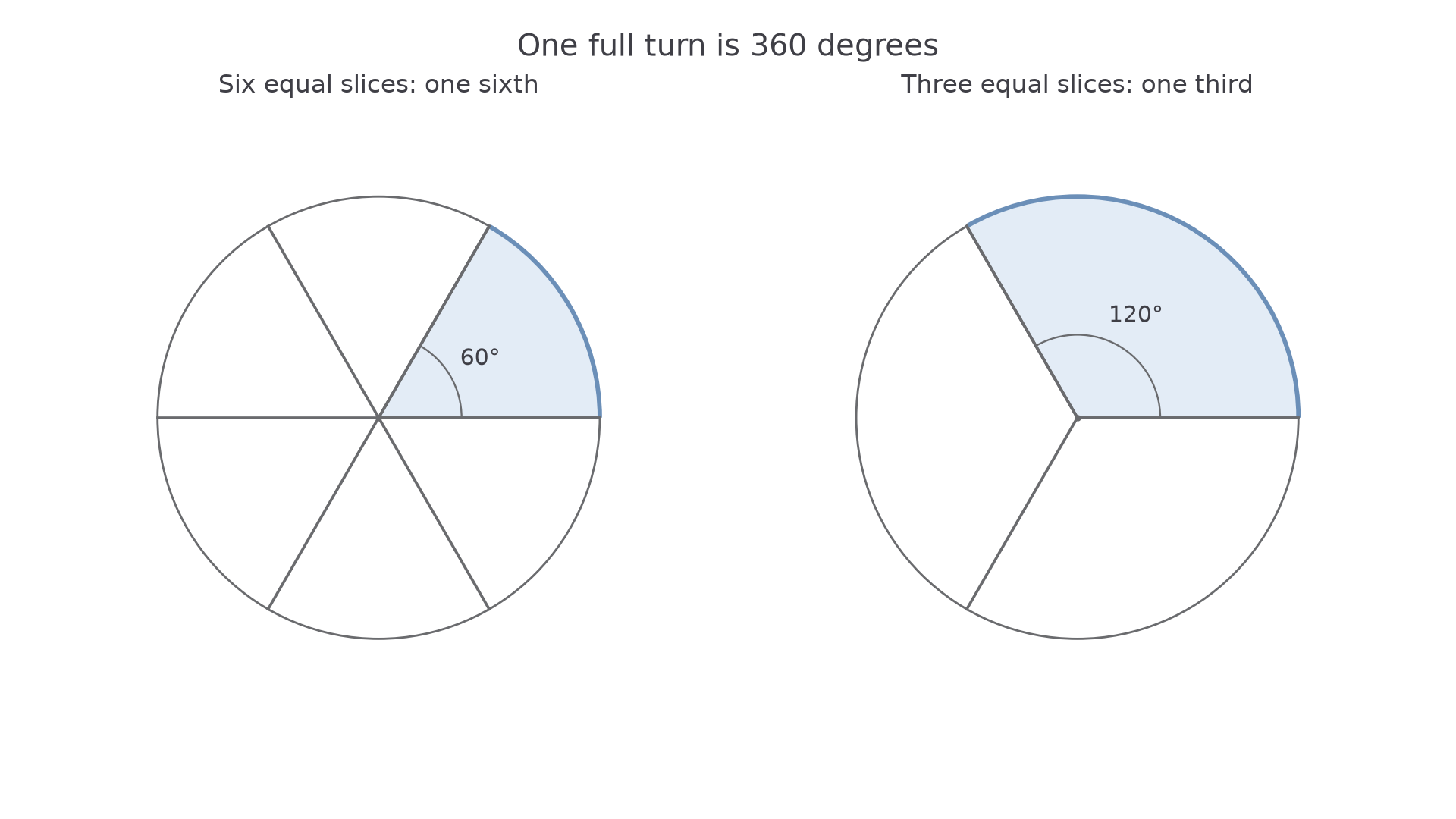
Here we use angles that are factors of : the angle fits a whole number of times around the centre. Examples include , , and . For a positive sector angle below , its fraction is , with numerator and denominator both in degrees.
Worked example 1: one of six equal sectors
Question. What fraction of a circle is a sector?
Plan. Count how many angles make a full turn.
Answer. of the circle.
Check. Six copies have total angle , and their fractions add to .
Change only the angle to twice its previous size. The share of the circle should double too.
Worked example 2: a wider sector
Question. What fraction of a circle is a sector?
Plan. Compare the sector angle with a full turn and simplify.
Answer. of the circle.
Check. Three sectors make , so three one-third shares fill the circle.
Counting equal sectors and stating one sector's share are reverse questions.
Watch out
counts sectors; it is not the fraction occupied by one sector. One of three equal sectors occupies .
Find the share before calculating any lengths or areas.
Arc lengths and sector perimeters
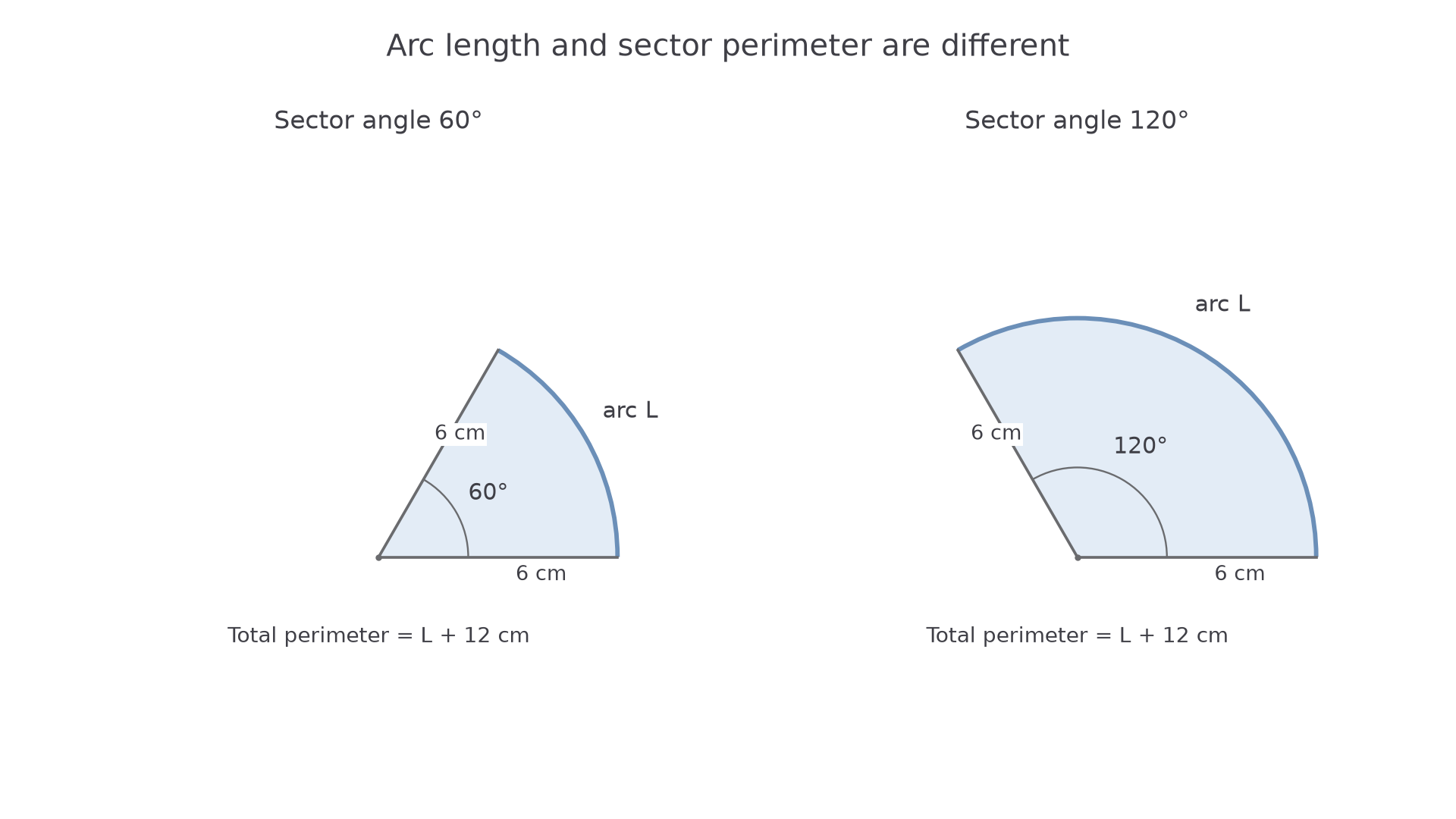
An arc is the sector's share of the whole circumference. A perimeter is the complete boundary of the sector region. After following its arc, you must travel along both radii to return to your starting point.
You already know
A circle of radius has circumference . Multiply by a fraction to find that share of the whole. Keep when the answer must be exact.
For example, one sixth of a circumference is . The cut edges have not become shorter fractions of a radius: each is still a whole radius.
Arc length and sector perimeter
For a sector of positive radius and angle , let . Then
is arc length; is the sector's total perimeter. Here the angle divides into equal whole-number shares.
These sector formulas are not given in the List of formulas; the full-circle circumference formula is given.
The angle condition matters. A full circle has no two cut edges in its outside boundary, so its perimeter is just the circumference.
[DIAGRAM: asset_name: Arc versus full sector boundary; asset_slug: arc_sector_boundary; caption: Follow the curved arc and then both radii to trace the complete boundary.; description: Two exact sectors of radius 6 centimetres have angles 60 and 120 degrees. Each arc is blue, its two radial edges are grey and labelled 6 centimetres, and a separate angle arc marks the central angle. Labels distinguish curved arc L from total perimeter L plus 12.]
Continue this lesson.
You’re previewing NovaLearn without an account. Create a free account to read the rest.
Create free account