E4.1, E5.3 - Major and minor sectors
Two points on a circle give you two routes round its edge. You will distinguish major and minor arcs and sectors, use angles that do not divide a full turn evenly, and work backwards from a sector's area or arc length.
Major and minor arcs
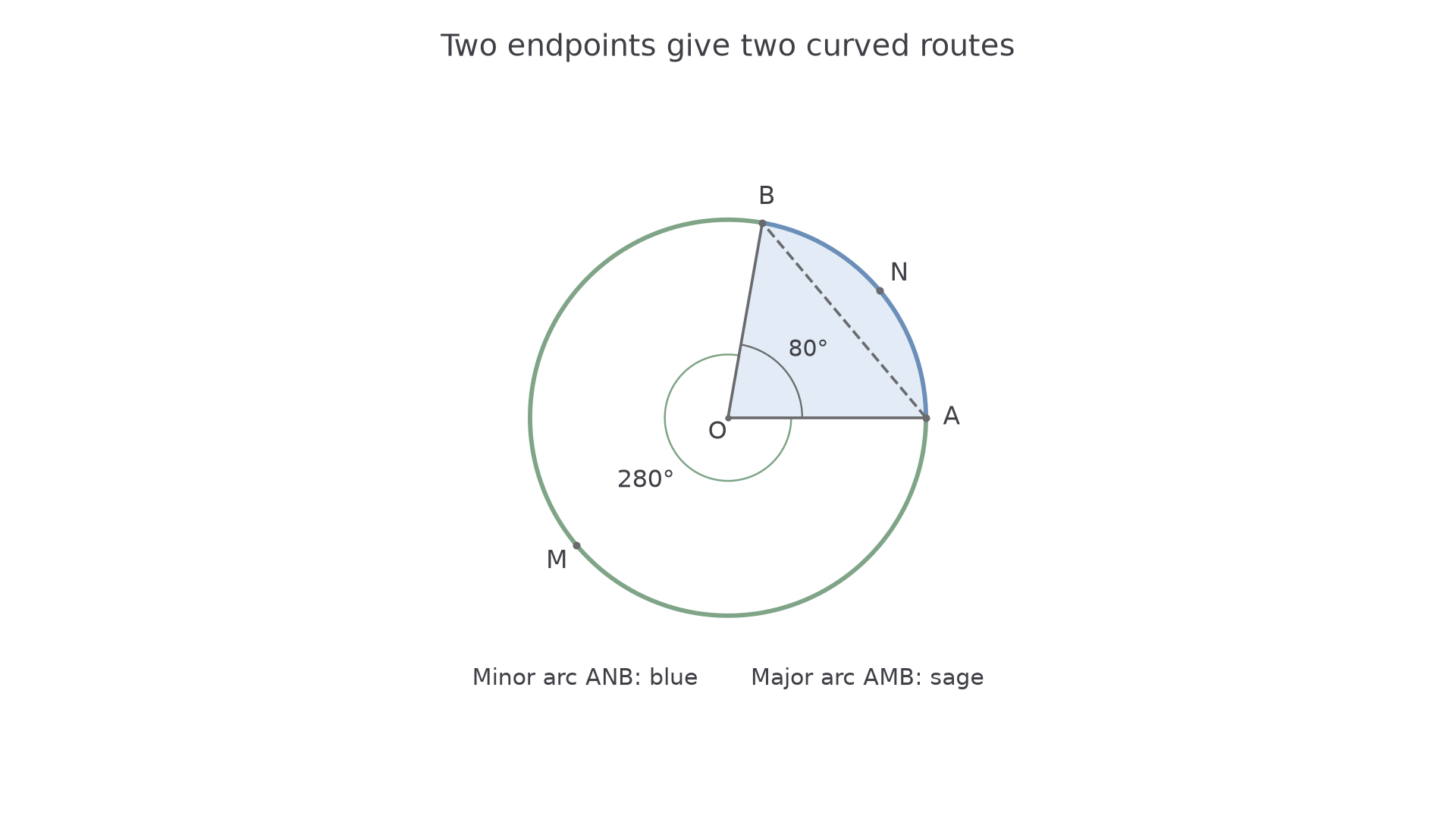
Two radii enclose a marked angle, but most of the circle is shaded. Should the shaded calculation use or ? The angle must describe the region you actually want, rather than whichever number is easiest to see.
Major and minor arcs and sectors
For two points that are not the ends of a diameter, the minor arc is the shorter route along the circle, corresponding to a central angle below . The major arc is the longer route, corresponding to an angle above .
Their two radii bound a minor sector and a major sector with those same respective angles. The two angles add to .
If the endpoints are the ends of a diameter, both routes are semicircles with angle : neither is longer. Do not label one major and the other minor.
You can name an arc with a third point on the required route. In the diagram, arc goes through on the short route; arc goes through on the long route. An arc follows the circle, whereas the chord is a straight segment.
[DIAGRAM: asset_name: Two arcs between the same endpoints; asset_slug: major_minor_arcs; caption: The marked 80 degree angle belongs to the minor sector; the remaining 280 degrees belong to the major sector.; description: An exact circle has centre O and endpoints A and B whose radii enclose 80 degrees. N lies halfway along the minor arc and M halfway along the major arc. The minor arc is blue, the major arc sage, the minor sector is pale blue, and a reflex angle marker labels the major sector 280 degrees. The chord AB is dashed and distinct from both arcs.]
Worked example 1: choosing the minor sector
Question. The smaller angle between and is . Find the angle and circle fraction for the minor sector.
Plan. Use the smaller angle, then compare it with a full turn.
Answer. Angle , occupying of the circle.
Check. , as a minor sector must occupy less than a semicircle.
Keep the endpoints and circle unchanged, but choose the major sector. Only the required route changes.
Worked example 2: choosing the other sector
Question. The smaller angle between and is . Find the angle and circle fraction for the major sector.
Plan. Subtract the smaller angle from a full turn before forming the fraction.
Answer. Angle , occupying of the circle.
Check. , so this is the larger region. Also, .
The endpoint letters alone do not distinguish these two routes; the word major or minor does.
Watch out
Using just because is printed beside the centre can select the wrong region. If the major sector is required, use .
Choose the angle for the named region.
Arbitrary sector angles
A sector need not fit into the circle a whole number of times. An sector occupies , even though is not a whole number. Angle, arc length and area still represent the same fraction of a fixed circle.
Sectors with any degree angle
For a proper sector with and ,
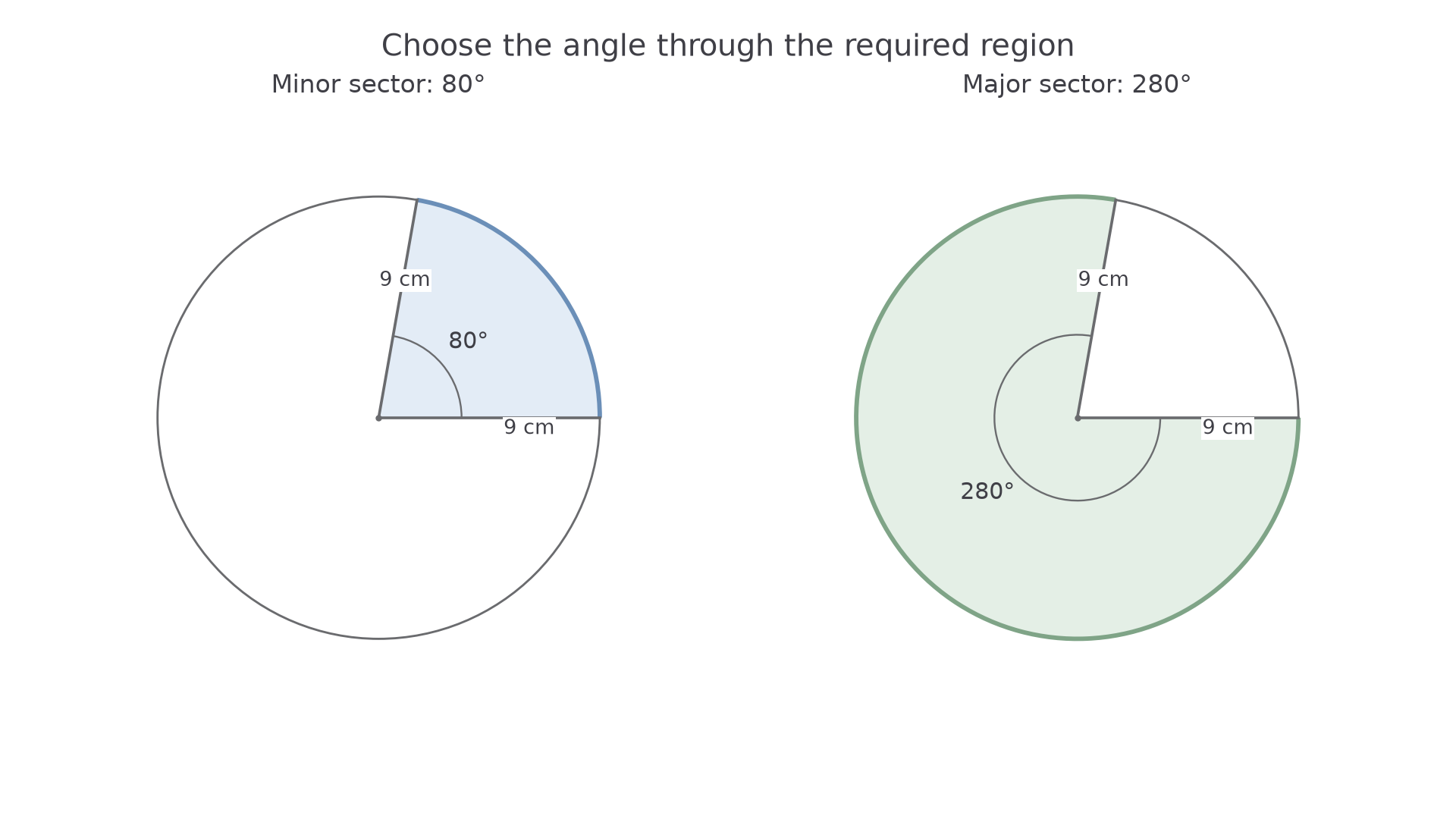
Choose through the required region. For a major sector, this is the reflex angle.
The sector formulas are not given in the List of formulas; the full-circle circumference and area formulas are given.
The two radial edges belong to either sector's perimeter. Adding a major and minor arc gives the circumference. Adding their perimeters counts each shared radial edge twice, giving circumference plus .
[DIAGRAM: asset_name: Minor and major sectors of radius nine; asset_slug: arbitrary_sector_measures; caption: Use the selected angle for area and arc, then add two radii for perimeter.; description: Two circles of radius 9 centimetres show the same rays separated by 80 degrees. The first shades the 80 degree minor sector and the second the 280 degree major sector. Both radial boundary lengths are identified as 9 centimetres, and the corresponding curved boundary is highlighted. The central angle markings follow the selected regions.]
Worked example 3: a non-unit fraction
Question. A minor sector has radius and angle . Find its area and total perimeter in terms of .
Plan. Take of the full-circle area and circumference, then add both radii to the arc.
Answer. Area ; perimeter .
Check. The area is of the whole , and the arc is of the whole .
Keep the circle and endpoints the same; change only the selected region to the major sector.
Continue this lesson.
You’re previewing NovaLearn without an account. Create a free account to read the rest.
Create free account