E1.10 - Calculating with bounds
Rounded measurements describe intervals of possible values, so calculations using them also have limits. You will choose the inputs that make a sum, difference, area or speed as small or large as possible. This Extended E1.10 lesson keeps the rounding intervals and the calculation separate so that an apparently precise answer does not hide measurement uncertainty.
Bounds of sums and differences
A walker covers km in hours, both rounded to the nearest whole unit. Is km/h definitely the true average speed? The actual distance and actual time can both differ from their recorded values. We will find the range of speeds they allow.
Start with simpler measurements. A length recorded as cm to the nearest centimetre means
The lower endpoint is included, but the upper endpoint rounds to cm. A bound is a limiting value; it need not be an attainable measurement. Keep that distinction when combining intervals.
Worked example 1: adding two uncertain lengths
Question. Two lengths are recorded as cm and cm, each correct to the nearest centimetre. Find the lower and upper bounds of their total length.
Plan. Add the two lower endpoints for the smallest total, and the two upper endpoints for its upper limit.
Answer. The lower bound is cm and the upper bound is cm:
Check. The recorded total cm is midway between the bounds. Both measurements can equal their lower endpoints, giving cm; neither reaches its upper endpoint, so cm is excluded.
Keep the measurements and change only addition to subtraction. To make small, making large helps rather than making it small.
Worked example 2: subtracting uncertain lengths
Question. Using the same two measurements, find the lower and upper bounds of the difference .
Plan. For the lower limit use small and large ; for the upper limit use large and small .
Answer. The lower bound is cm and the upper bound is cm:
Check. A difference near the lower bound is . A difference near the upper bound is . Neither endpoint is reached: cannot equal , and cannot equal .
For a rectangle, the perimeter adds two copies of each side. With these same length intervals, the perimeter therefore satisfies
The recorded dimensions do not have to be whole centimetres in reality; only the rounded reports are whole numbers.
Watch out
The lower bound of a difference is not “lower minus lower”. Here is a possible difference, but smaller differences are possible. Choose each input to make the whole expression small or large.
Apply the addition idea to a new perimeter.
Bounds of products and areas
For positive lengths, increasing either factor increases their product. A rectangle's area counts the unit squares in rows and columns, so its area is length multiplied by width. Its smallest area uses both smallest lengths; its upper limiting area uses both upper endpoints.
[DIAGRAM: asset_name: Rectangle area bounds; asset_slug: rectangle_area_bounds; caption: The smallest permitted rectangle lies inside the upper limiting frame.; description: Two rectangles share a bottom-left corner on a white background. The inner pale-blue rectangle has width 7.5 cm and height 3.5 cm, with both lengths labelled. The dashed outer limiting frame has width 8.5 cm and height 4.5 cm, labelled outside the frame. Text states that the inner area 26.25 square centimetres is attainable and the outer area 38.25 square centimetres is an excluded upper limit. The drawings use one consistent scale.]
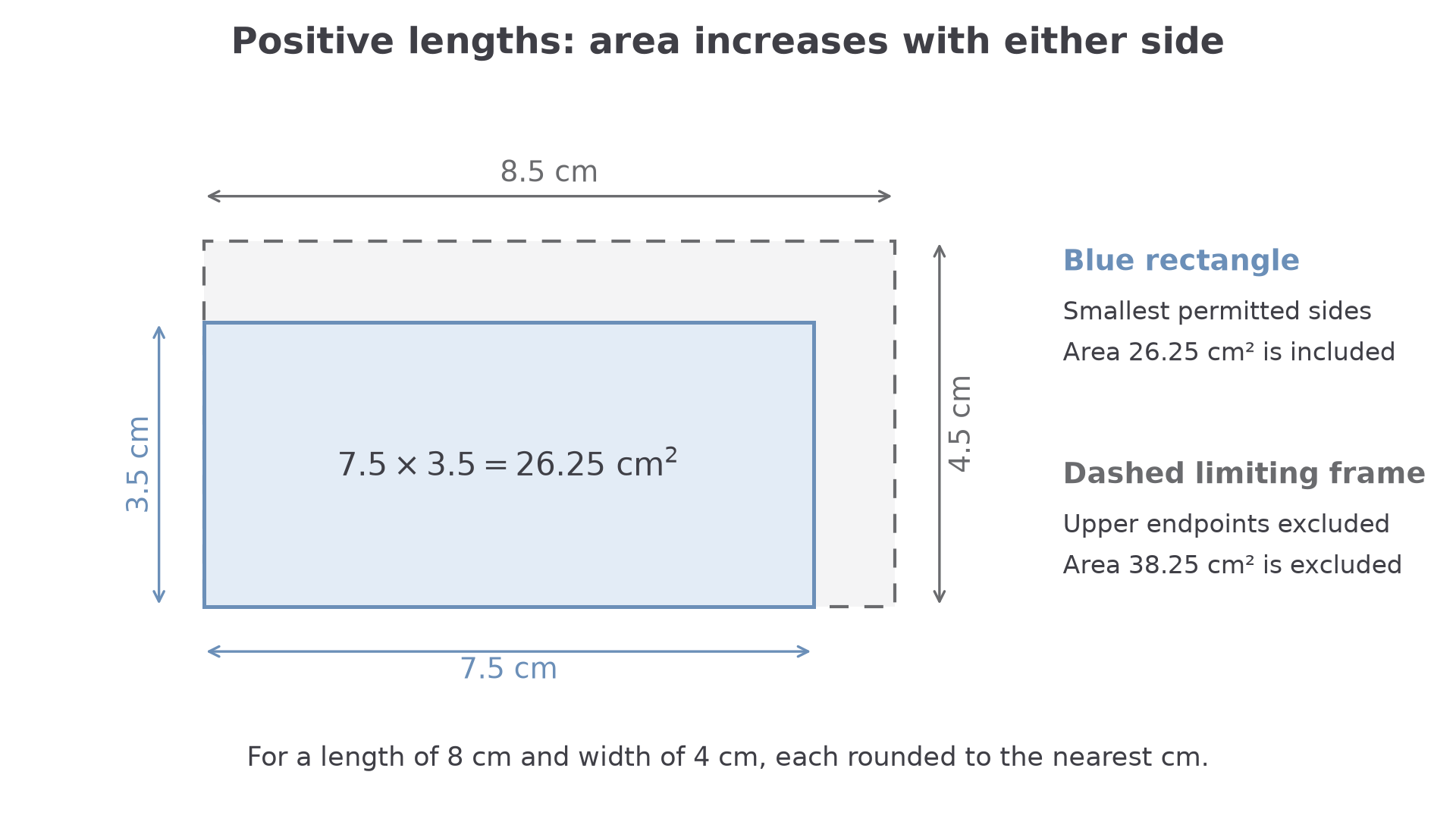
The positivity condition matters. These rules for taking the same endpoint in both factors are for positive quantities such as lengths and areas. If negative values are allowed, the effect of changing a factor depends on the other factor's sign; do not transfer the positive-length rule blindly.
Worked example 3: area from whole-centimetre measurements
Question. A rectangle is cm long and cm wide, each correct to the nearest centimetre. Find the lower and upper bounds of its area.
Plan. Write the length intervals, then multiply the two lower endpoints and the two upper endpoints.
Answer. The lower bound is and the upper bound is :
Check. The recorded-dimension area is , inside the interval. A rectangle with both lower lengths has exactly ; the outer frame's upper lengths are excluded.
Change only the accuracy of the width measurement. A more precise width should narrow the area interval.
Worked example 4: one more precise measurement
Question. A rectangle is cm long, correct to the nearest centimetre, and cm wide, correct to the nearest cm. Find the lower and upper bounds of its area.
Plan. Retain the length interval, but use half of cm for the width's error limits.
Answer. The lower bound is and the upper bound is .
Check. Use and . The interval is narrower than before and still contains .
Retain the exact endpoint products unless a particular final accuracy is requested. Rounding down to and calling it an exact upper bound would exclude some possible areas.
Watch out
“ cm to the nearest cm” has bounds and , not and . The written precision and the stated rounding unit must both be read.
Try another positive-area calculation.
Bounds of quotients and speed
For a positive numerator and positive denominator, increasing the numerator makes the quotient larger, while increasing the denominator makes it smaller. For example, , but . A denominator must stay strictly above zero throughout the interval for the following speed rule to apply.
For positive distance and time, the lower speed limit uses the least distance divided by the greatest time. The upper speed limit uses the greatest distance divided by the least time. These are opposite endpoint choices.
Worked example 5: lower speed limit
Question. A walker travels km, correct to the nearest kilometre, in hours, correct to the nearest hour. Find the lower bound of the average speed.
Plan. Use the smallest distance and upper limiting time, keeping both in km and hours.
Answer. The lower bound is , or .
Check. With and , the speed is greater than because the divisor is smaller than . Times can approach but cannot equal it, so the lower speed endpoint is not attained.
Keep the same journey measurements and change only which bound is requested. Both endpoint choices reverse.
Worked example 6: upper speed limit
Question. Find the upper bound of the same walker's average speed.
Plan. Use the upper limiting distance and smallest time.
Answer. The upper bound is . Together the bounds give
Check. At and , the speed is km/h, close to but below it. Reaching would require the excluded distance km at the minimum time.
This answers the opening question: km/h comes from the recorded values, but it is only one of many possible speeds. Also convert units before dividing: if time bounds are in minutes and speed is requested in km/h, divide each time endpoint by , retaining full accuracy.
Watch out
Dividing both lower endpoints does not give the lower bound of speed. Here km/h is possible, but much slower speeds are also possible. To minimise a positive quotient, increase its denominator.
Choose opposite endpoints in this new speed problem.
Quick Recap
- Write each original rounding interval before calculating with its endpoints.
- Sums use both lower or both upper endpoints. Differences use opposite endpoints.
- Products of positive lengths use both lower endpoints for the lower bound and both upper endpoints for the upper bound.
- A positive quotient uses a small numerator and large denominator for its lower limit; reverse these for its upper limit.
- A limiting bound can be excluded. Preserve exact endpoints and do not round early.
The opening walk's true average speed lies strictly between and km/h. The recorded-value calculation km/h does not determine its exact speed.