Xm3, Xm4 - Diagonalisation and matrix powers
Use a matrix of eigenvectors to put a matrix with distinct real eigenvalues into diagonal form. Then calculate powers of matrices of order and , keeping each eigenvector matched to its eigenvalue and stating when negative powers exist.
Put eigenvectors in columns
How could you find the fifth power of without multiplying five copies?
Along , each application multiplies by ; along , it multiplies by . Five applications should therefore multiply those components by and . We need a way to express an arbitrary vector using those directions.
You already know
Find eigenvalues from , then solve . Matrix multiplication is associative, and when is non-singular.
For distinct real eigenvalues, the associated eigenvectors are independent. In order or , collecting one eigenvector for each eigenvalue therefore gives an invertible matrix. We use this distinct-real case throughout the lesson.
Matrix of eigenvectors and diagonal form
Put the eigenvectors of in the columns of , and put their associated eigenvalues in the same order down the diagonal of . For example,
matches the first column to and the second to . The diagonal entries come from the eigenvalues of , not those of .
Multiplication by acts separately on every column of . Thus has columns , and, in three dimensions, . This is exactly .
Diagonalisation
For a matrix of order or with distinct real eigenvalues, construct and in matching order. Then
The middle equation reduces to diagonal form.
Not in the formula booklet: learn it.
A calculation of checks the column matching without multiplying three matrices.
Worked example 1: diagonalising a symmetric matrix
Question. Reduce to diagonal form, using eigenvectors and , in that order.
Plan. Identify the eigenvalue for each column, find , and verify the diagonal relation.
Why this step? The eigenvectors change the coordinate description, so the matrix becomes two separate scalar multipliers.
Answer. , with as above.
Check. Multiplying gives .
Change only the order of the eigenvector columns. The diagonal entries must follow them.
Worked example 2: the same matrix, a different column order
Question. Diagonalise the same with .
Plan. Read the first column's eigenvalue first, then calculate the transformed matrix.
Why this step? Eigenvectors have no compulsory order, but a choice of column order fixes the diagonal order.
Answer. .
Check. The first column is multiplied by , the second by , exactly as the displayed shows.
You may also rescale a column by any non-zero constant; recalculate the inverse if you do. Repeating a parallel column instead of using independent eigenvectors would make the column matrix singular.
Watch out
Wrong: put eigenvectors in rows, or reorder the columns while leaving unchanged. Right: columns of eigenvectors, matching diagonal entries. Check .
Keep the same eigenvector directions and change the matrix's two scalar multipliers.
Raise the diagonal entries to the power
Multiplying two copies of brings the middle inverse and matrix together:
The same cancellation continues for every positive integer power.
Powers from diagonal form
If , then
with a third diagonal entry in order . This holds for positive integers ; . Negative integer powers also exist when every eigenvalue is non-zero.
Not in the formula booklet: learn it.
This is the useful surprise: a large matrix power needs only powers of two or three numbers. The conversion matrices are used once at either end.
[DIAGRAM: asset_name: Coordinates along eigenvectors; asset_slug: eigenbasis_power_route; caption: Change coordinates once, scale independently, then change back; description: Four widely spaced cards show a physical vector3,1, its coordinates2,1 along the columns of P, the scaled coordinates8,2 after D=diag4,2, and the physical image10,6. Connecting arrows are labelled P inverse, D and P. Below, an n-step route replaces only D by D to the power n, keeping the two conversion matrices unchanged.]
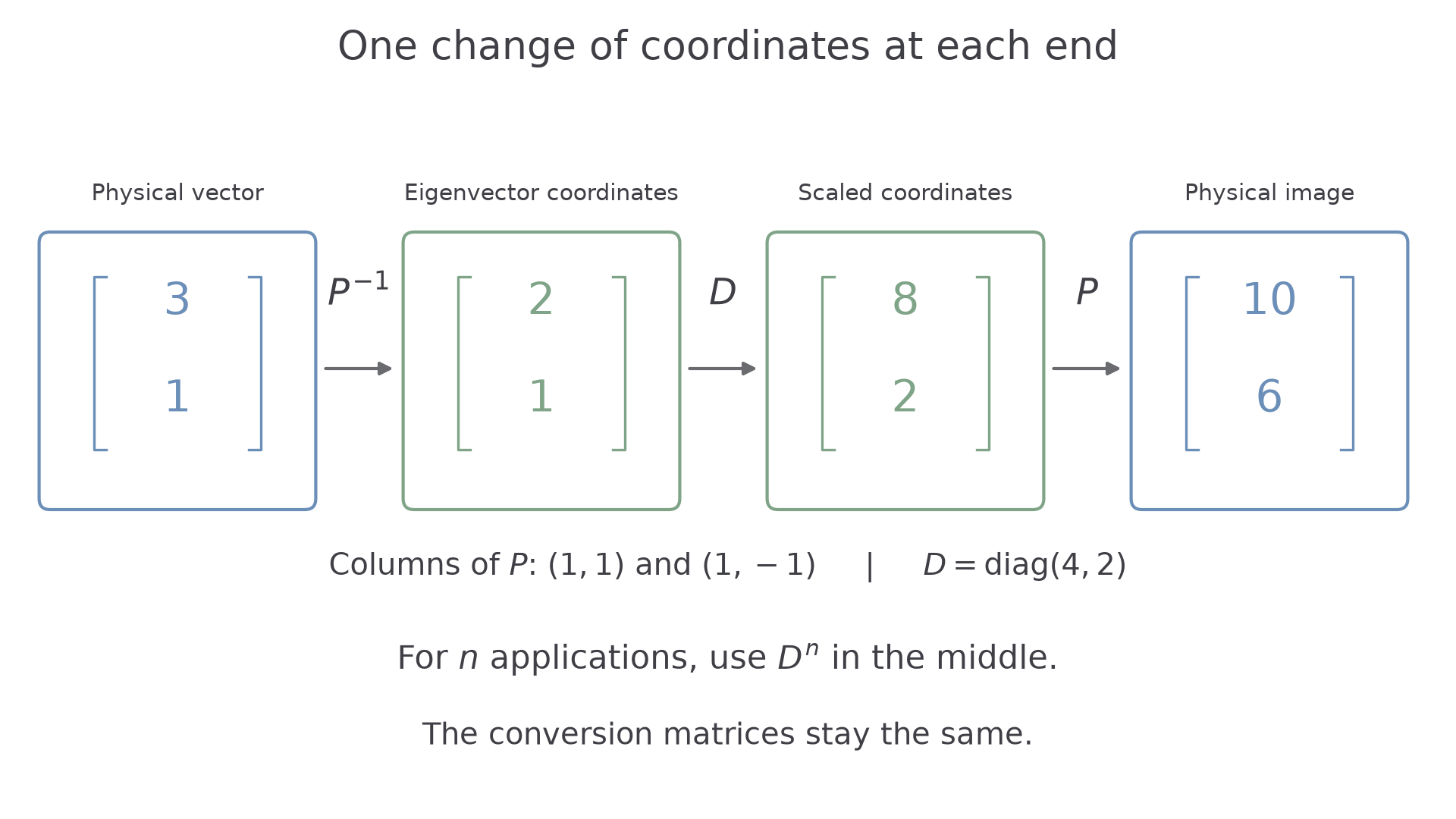
For the opening matrix, multiplication of the three factors gives the reusable expression
This is a consequence for this particular matrix, rather than another general formula to memorise.
Continue this lesson.
You’re previewing NovaLearn without an account. Create a free account to read the rest.
Create free account