Pc5 - Differentiating inverse trigonometric functions
Differentiate , and , then combine their derivatives with the chain and product rules. Pc5 explains the signs and domains from the principal inverse-function branches, so the formulae have a reason behind them.
Arcsine and the positive square root
Why does stay constant as varies over the positive numbers? Its two angles change, but their rates of change cancel. We will prove that after finding the inverse-trigonometric derivatives.
You already know
Inverse functions reverse an input-output relationship on a suitable restricted domain. The principal ranges are for , for , and for . Angles in differentiation are in radians.
Let . Then . Implicit differentiation gives . On the interior of the arcsine range, , so , with the positive square root.
[DIAGRAM: asset_name: Arcsine steepens near its endpoints; asset_slug: h645_b039_arcsine; caption: The inverse-sine branch has positive slope, growing without bound near plus or minus one; description: A graph of y equals arcsin x on minus one to one marks endpoint values minus pi over two and pi over two. A tangent at x equals zero has gradient one. Two additional short tangents near the endpoints are much steeper. A side panel gives the derivative one over square root of one minus x squared and its domain minus one less than x less than one.]
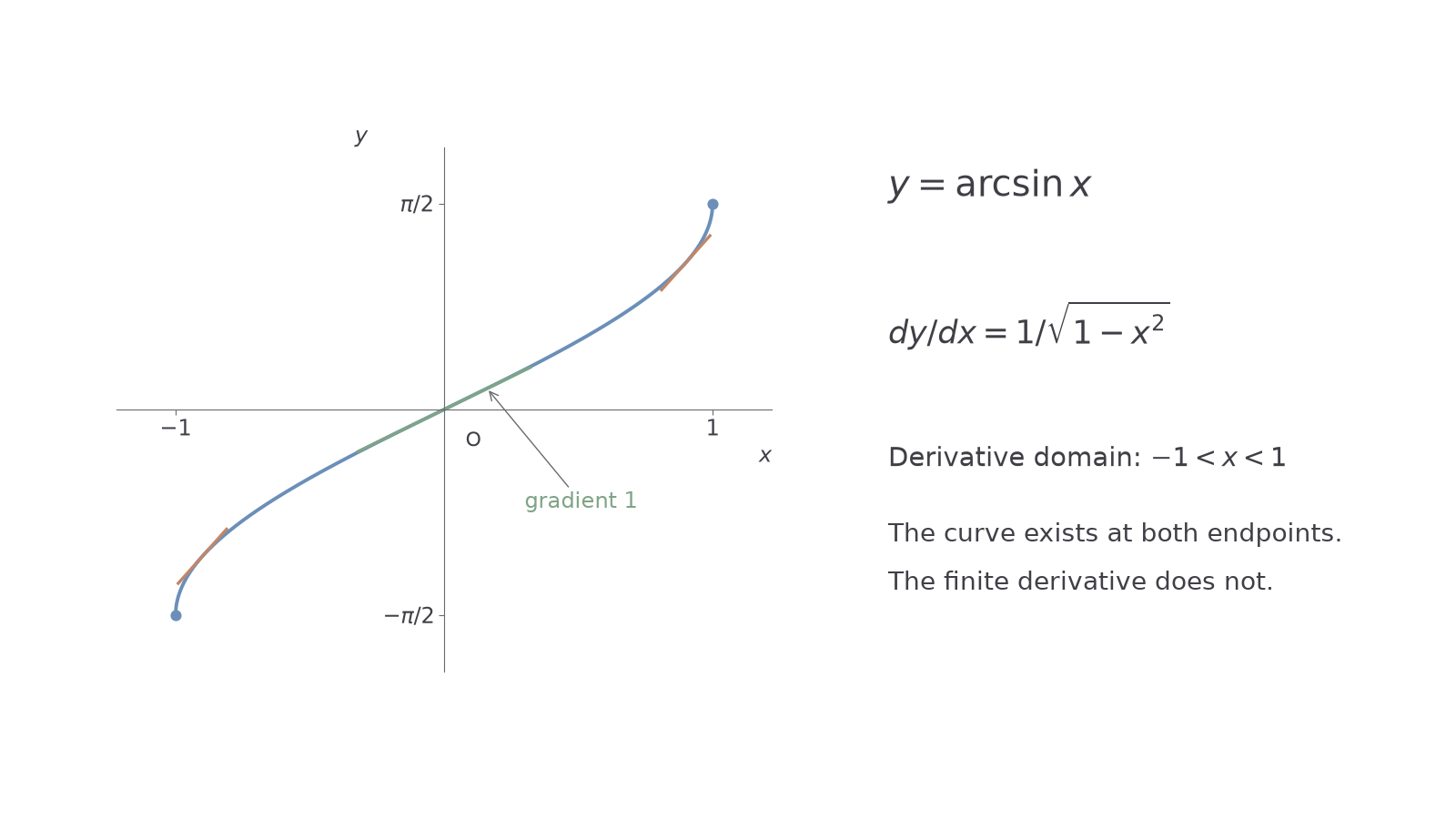
Derivative of arcsine
For ,
Thus, where and is differentiable,
The function exists at , but its finite derivative does not exist there.
In the formula booklet.
The booklet gives the basic derivative; the composed form comes from the chain rule. An inverse function is not a reciprocal: and mean different things.
Worked example 1: a scaled input
Question. Differentiate and state the open interval on which the derivative formula applies.
Plan. Use inner function , include , and require .
Why this step? The outside function differentiates with respect to its input ; multiplying by converts that rate to a rate with respect to .
Answer. , for .
Check. At , the gradient is , twice the gradient of at the origin, as horizontal compression suggests.
Change only the input's translation, from to . The inner derivative stays , but the valid interval moves.
Worked example 2: a shifted input
Question. Differentiate and state where its derivative formula applies.
Plan. Keep the chain factor and solve the strict inequality for the new input.
Why this step? A translation changes where the input reaches , even though its rate of change remains the same.
Answer. , for .
Check. At , the input is zero, giving gradient , matching the centre of the shifted curve.
Near the endpoints, the denominator tends to zero through positive values. That explains the increasingly steep inverse-sine graph, without changing its domain to include an invalid square root.
Watch out
Wrong: .
Right: the numerator is , from the inner derivative. Write the inner function and its derivative before substituting into a composed formula.
Change the scale factor again and track both its effects: one in the numerator and one in the valid interval.
Arccosine has the opposite sign
For , the inverse relation is . Differentiation gives . On , sine is positive, so , giving a negative derivative.
This sign matches the graph: as a cosine value increases from to , its principal angle decreases from to . You can also use on ; differentiating a constant sum makes their derivatives opposites.
Derivative of arccosine
For ,
Where and is differentiable,
The basic derivative is supplied; the composed form uses the chain rule.
In the formula booklet.
For a scaled input, simplify square roots carefully. With , for example, , because the scaling constant is positive.
Worked example 3: simplifying the square root
Question. Differentiate .
Plan. Include the inner derivative , then simplify the denominator.
Why this step? The from the chain rule cancels the denominator's scale. It has not been omitted.
Answer. , for .
Check. At , the gradient is , consistent with stretching the graph horizontally by factor .
Change only the input's translation. The negative sign remains because the outer function is still arccosine.
Worked example 4: translating an arccosine
Question. Differentiate .
Plan. Use inner derivative , simplify, and require the input to lie between and .
Why this step? The domain restriction belongs to the entire inner expression, not to alone.
Answer. , for .
Check. At the translated centre , the gradient is still .
The basic arccosine derivative is always negative, but a decreasing inner function can reverse the final sign. For instance, . The two minus signs have distinct sources.
Watch out
Wrong: .
Right: the square root applies to the whole difference. Squaring produces an extra term, so it cannot equal in general.
Use the same simplification for a new scale and translation.
Arctangent and a rational derivative
For , we have . Differentiation gives , and . No square root is needed, and the denominator is positive for every real .
Derivative of arctangent
For every real ,
For a differentiable real input ,
The basic derivative is supplied; the composed form uses the chain rule.
In the formula booklet.
This rational derivative will reverse into an inverse-tangent integral in the next lesson. For now, it combines with familiar differentiation rules.
Worked example 5: a scaled arctangent
Question. Differentiate .
Plan. Differentiate the outer arctangent, then multiply by .
Why this step? Squaring squares the coefficient too. A denominator would differentiate a different function.
Answer. , for all real .
Check. At , the gradient is , while it tends to zero as grows, agreeing with the curve flattening towards its horizontal asymptotes.
Change the expression by multiplying it by . The inverse-trigonometric derivative stays the same, but the product rule adds a second contribution.
Worked example 6: combining product and chain rules
Question. Differentiate .
Plan. Differentiate each factor once, retaining the other factor in each product-rule term.
Why this step? Differentiating both factors and multiplying would omit the original factors, which the product rule requires.
Answer. .
Check. The original function is even because both factors are odd. Its derivative is odd, as both terms in the answer are.
We can now settle the opening question. For ,
The sum is constant separately on and . At , it is . At , it is . Thus a zero derivative does not force the same constant across a gap in the domain. This identity is not in the formula booklet: learn how the derivative and one value establish it.
Exam tip
Show the inner derivative explicitly when a reciprocal, scale factor or polynomial appears inside an inverse function. Keep brackets around that input until its square has been formed.
The final check changes only the scale inside the product from to .
Watch out
Wrong: . This omits the inner derivative. The correct line is ; retain that factor inside the product-rule term too.
Differentiate the inner input explicitly before assembling the two product-rule terms.
Quick Recap
- Implicit differentiation of , and gives the three inverse derivatives.
- The principal branches determine the square-root sign: arcsine has positive derivative and arccosine negative derivative on .
- Arctangent has derivative for every real .
- For a composed input, multiply by its derivative and apply its domain restrictions; use product or quotient rules when other factors appear.
For , : the two rates cancel, and evaluating at fixes the constant.