MG4 - Centres of mass of composite bodies
A complicated uniform body can often be split into simple shapes whose centres of mass you already know. Treat each part as a particle at its own centre, using area, length or volume to find the appropriate mass ratios.
Add simple uniform areas
Can cutting a hole move a body's centre of mass into the hole itself? To understand why removing material can do that, first build a body by adding material and watch its centre move.
You already know
For particles, . A uniform rod has its centre at its midpoint; uniform rectangles and triangles have their standard centres. Symmetry may remove a coordinate calculation.
For a composite rigid body, replace each constituent part by its mass concentrated at its own centre of mass. Choose parts whose interiors do not overlap, so no material is counted twice.
Combining uniform laminas
For a lamina of uniform thickness and density, mass is proportional to area. If non-overlapping parts have areas and centres , then
The common mass per unit area cancels. If actual part masses are given, use those masses instead.
Not in the formula booklet: learn it.
Make a table of area, centre and area times coordinate before combining anything. A sketch should show which physical area each row represents.
[DIAGRAM: asset_name: A composite rectangle and triangle; asset_slug: h645_b067_addition; caption: Replace each non-overlapping area by its area at its own centre; description: A rectangle from x equals zero to six and y equals zero to four joins a right triangle with vertices six zero, nine zero and six four. Their centres three two and seven four thirds are marked, together with the combined centre nineteen fifths twenty-eight fifteenths.]
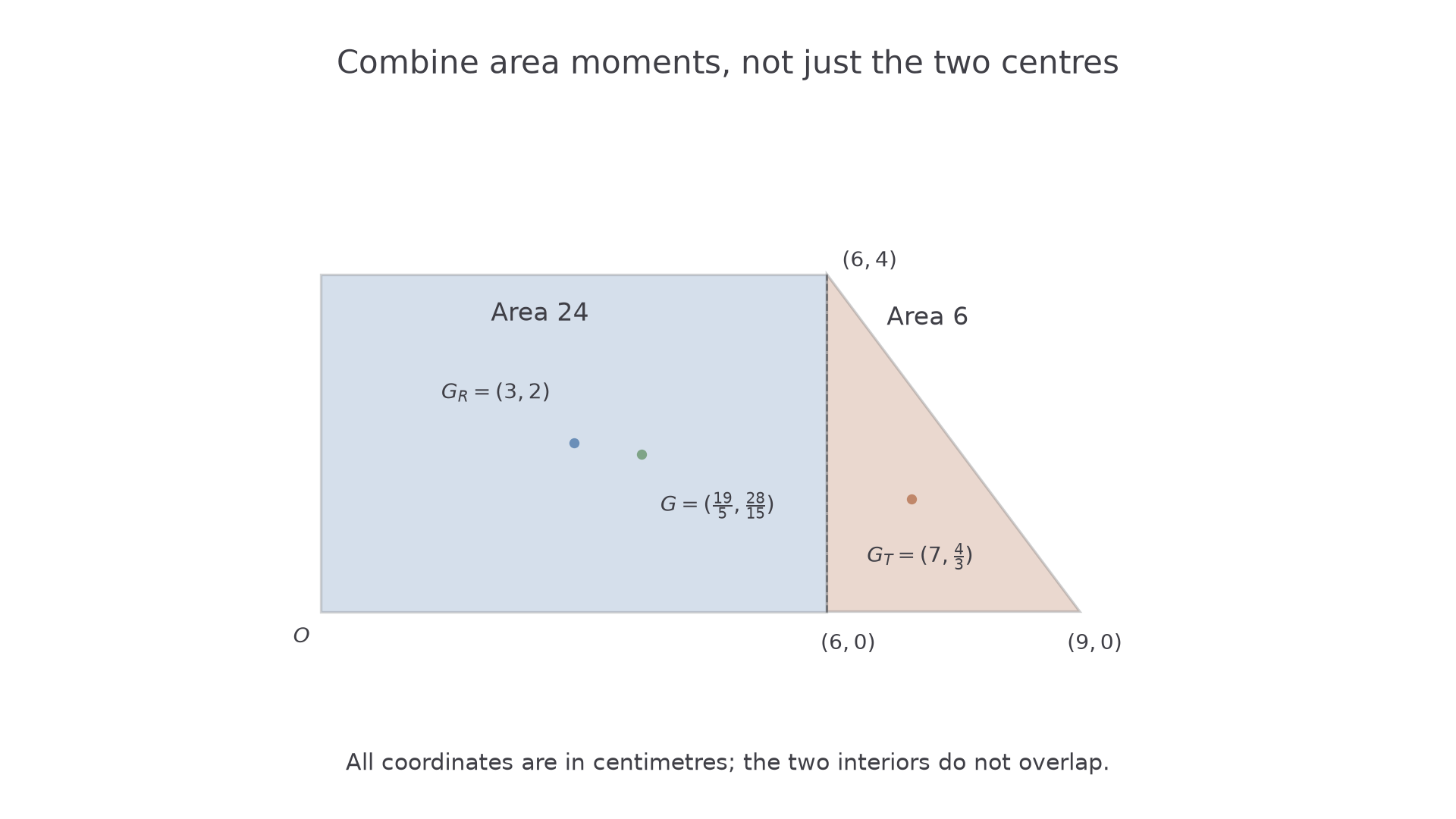
Worked example 1: a rectangle with a triangular extension
Question. A uniform lamina consists of the rectangle and the triangle with vertices , , . Coordinates are in centimetres. Find its centre of mass.
Plan. Use the rectangle and triangle as two non-overlapping parts.
| Part | Area | Centre |
|---|---|---|
| Rectangle | ||
| Triangle |
Why this step? The rectangle has four times the triangle's area, so it must have four times its weight in the average.
Answer. , in centimetres.
Check. Each coordinate lies between the corresponding coordinates of the two part centres, and is closer to the larger rectangle's centre.
Change only the triangle's horizontal reach, from to . Its area and horizontal centre both change, so update both entries.
Worked example 2: extending the triangular part
Question. Find when the triangle instead has vertices , , , with the rectangle unchanged.
Plan. Recalculate the triangle's area and centre, then combine with the same rectangle.
Why this step? Keeping the original triangle's area while moving its centre would model a different mass distribution.
Answer. , in centimetres.
Check. Compared with example 1, moves right and slightly down, towards the enlarged triangular part.
Splitting a trapezium into a rectangle and triangles is one useful choice, but it is not compulsory. Any complete partition into familiar shapes gives the same answer.
Watch out
Wrong: average the two part centres with equal weights.
Right: use the parts' masses, or their areas when the lamina has common uniform thickness and density. Two shapes do not automatically mean two equal masses.
Extend the same triangular part once more.
Remove a hole by subtracting its moments
To cut out a hole, start with the complete body and subtract the mass and moments of the removed part. A negative entry in the calculation represents removal; there is no physical negative mass.
A uniform lamina with a hole
If an original lamina has area and centre , and a hole has area and centre , then the remainder has
The original lamina and the removed piece must have the same uniform mass per unit area.
Not in the formula booklet: learn it.
The subtraction follows by writing “original equals remainder plus removed piece”. Removing mass on the right generally moves the centre of the remainder to the left.
Worked example 3: an off-centre circular hole
Question. A circular hole of radius , centred at , is cut from the uniform rectangle . Find the centre of mass of the remainder.
Plan. Subtract the hole's area and its area moments from those of the complete rectangle.
Why this step? The removed circle has its own centre, , rather than the rectangle's centre.
Answer.
Check. Reflection in remains a symmetry. Also, , consistent with removing material from the right.
Move only the hole's centre upwards by . Its area stays the same, but the vertical symmetry is lost.
Worked example 4: moving the hole
Question. Find the centre of mass when the same circular hole is centred at instead.
Plan. Keep the horizontal equation, but update the removed vertical moment.
Why this step? Moving the hole changes where mass is removed, rather than the amount removed.
Answer. , with exact coordinates above.
Check. Both coordinate shifts from are : the hole centre is one unit right and one unit above the original centre.
There is a striking limiting example. Take a disc of radius , and remove a circular hole of radius whose centre is distance to the right of the disc's centre. The hole fits, touching the outer rim. Along that diameter,
This point is only from the hole's centre, so the remaining crescent has its centre of mass inside the empty hole. Cutting away material really can produce the situation in the opening question.
Continue this lesson.
You’re previewing NovaLearn without an account. Create a free account to read the rest.
Create free account