Pc1 - Improper integrals
Evaluate integrals with an infinite interval or an integrand that becomes undefined within the interval. Pc1 replaces the troublesome boundary by a variable, evaluates an ordinary integral first, and then tests whether the required limit is finite.
An infinite interval can have a finite integral
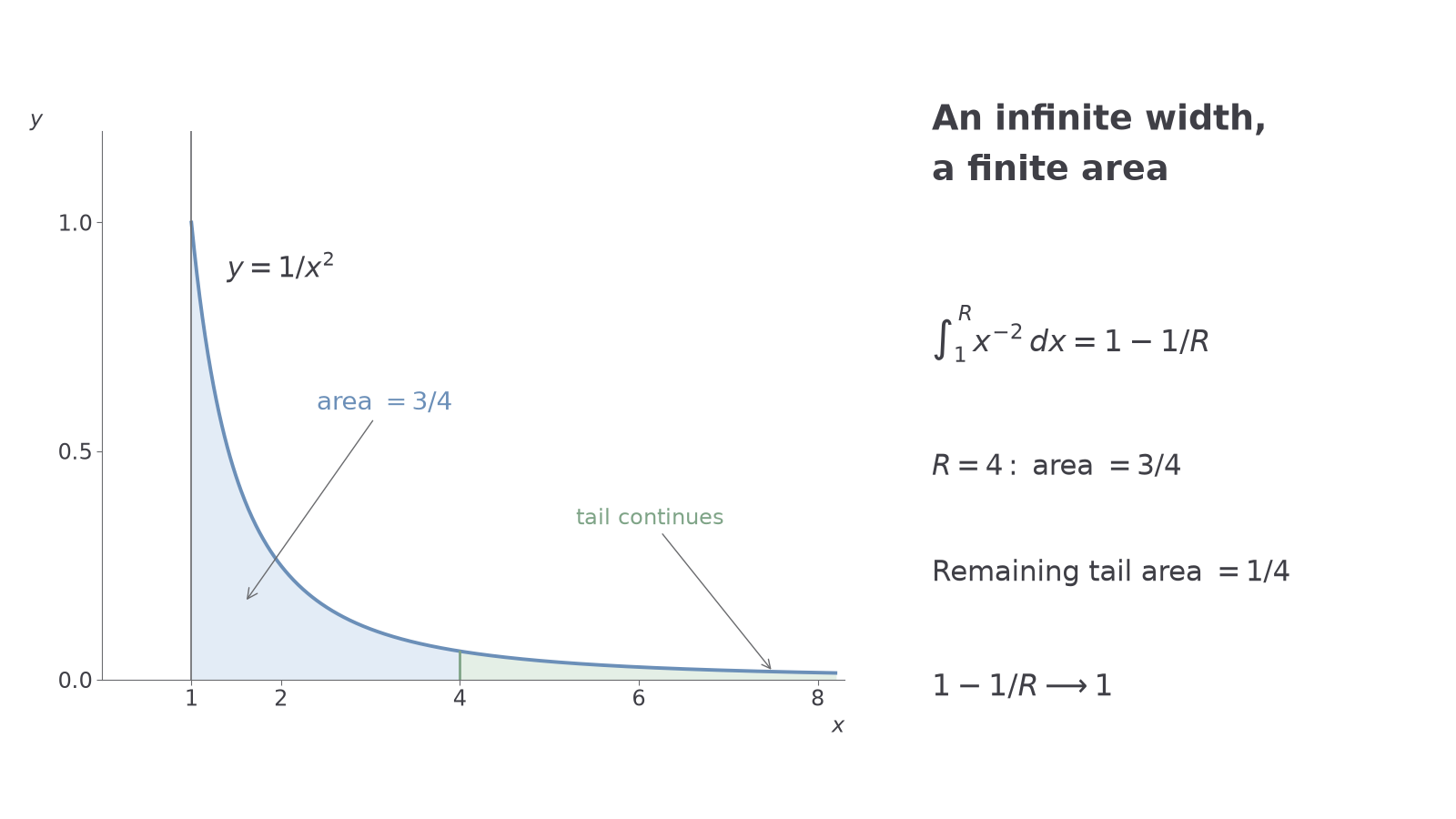
Can a region stretch infinitely far to the right and still have area ? The area under , above the -axis and to the right of , does exactly that. Its width is infinite, but its height decreases fast enough for the accumulated area to settle.
You already know
For finite endpoints at which an antiderivative applies, . Also, for , while .
Start with a finite upper endpoint . Between and , the area under is . As grows, that area approaches ; we never need to treat infinity as an ordinary number.
[DIAGRAM: asset_name: Finite area over an infinite interval; asset_slug: h645_b037_infinite_area; caption: The area under one over x squared approaches one as the right boundary moves out; description: A graph of y equals one over x squared for x at least one shows pale blue area between x equals one and x equals four, labelled one minus one over four equals three quarters. The remaining tail is pale sage and labelled one quarter. A side panel gives the finite accumulated area one minus one over R and its limit one as R tends to infinity.]
Improper integral and convergence
An improper integral has an infinite interval of integration, or an integrand that is undefined at a point in the interval, including an endpoint. It converges when every limit required to define it exists as a finite real number. Otherwise it diverges.
For example, converges. An ordinary finite integral of a continuous function, such as , is not improper.
The definition tells you what an infinite endpoint means. It is an instruction to take a limit after integrating.
An infinite endpoint
Provided the finite integrals exist,
The improper integral converges only if the limit is finite. Similarly,
Not in the formula booklet: learn it.
Show the finite endpoint in the integral and carry it into the evaluated expression. This makes the limiting step visible.
Worked example 1: a finite area
Question. Use a limit argument to evaluate .
Plan. Replace infinity by , integrate, then let .
Why this step? The finite expression tells us what tends to zero. Writing skips the definition of the integral.
Answer. The integral converges to .
Check. Up to the area is ; up to it is . Both are below , as a positive remaining tail requires.
Change only the decay power from to . The graph still approaches the axis, but that alone does not guarantee finite area.
Worked example 2: approaching zero too slowly
Question. Determine whether converges.
Plan. Evaluate the finite integral and inspect its limit.
Why this step? Convergence concerns the accumulated area, not just the height of the curve. Here the height tends to zero while the area grows without bound.
Answer. The integral diverges.
Check. Every interval adds , so infinitely many such intervals keep adding the same positive amount.
More generally, integrating shows that converges exactly when , with value . At use the logarithm; for , the power term grows. This criterion is not in the formula booklet: learn the limit argument behind it.
Watch out
Wrong: “, so converges.”
Right: evaluate the accumulated integral and take its limit. The examples and both tend to zero, but only the latter has finite area here.
A lower infinite limit works the same way: . If both limits are infinite, split at a finite point and require the two integrals to converge separately.
An undefined endpoint does not decide convergence
A curve can become infinitely high near an endpoint yet enclose finite area. The question is again how the accumulated integral behaves, rather than whether the integrand itself is defined at the endpoint.
For , the integrand is undefined at . Replace that endpoint by , then approach from the right. The direction matters because the integration stays inside its real domain.
An undefined endpoint
If is undefined at , define
when the limit is finite. For an undefined upper endpoint , use .
Not in the formula booklet: learn it.
The finite cutoff keeps every application of the fundamental theorem on a valid interval. Only after evaluating do you approach the singularity.
Worked example 3: an integrable vertical asymptote
Question. Evaluate using a limit argument.
Plan. Replace the lower limit by , integrate, then let .
Why this step? The integrand is undefined at , but its antiderivative has a finite one-sided limit there. The cutoff establishes that this is a valid area calculation.
Answer. The integral converges to .
Check. With , the finite area is , leaving a positive area near the singularity.
Change only the exponent from to . The stronger singularity now makes the accumulated area unbounded.
Worked example 4: a non-integrable vertical asymptote
Question. Determine whether converges.
Plan. Use the same positive cutoff and inspect the evaluated expression.
Why this step? Substituting into is impossible. The one-sided limit shows precisely how the finite integral fails to settle.
Answer. The integral diverges.
Check. At , the area is ; at , it is , already much larger.
For , the finite limit exists exactly when , with value . At , . The criterion is not in the formula booklet: learn it. Notice that the threshold reverses compared with an infinite upper interval: a mild singularity is acceptable near zero, while rapid decay is needed at infinity.
Exam tip
If the question asks for an appropriate limit argument, write the cutoff, the evaluated finite integral and the limiting value. A final number obtained by substituting the undefined endpoint does not show the requested reasoning.
An undefined upper endpoint needs the same care, approached from below.
Watch out
Wrong: , obtained by discarding the undefined lower-end contribution. That contribution cannot be set to zero. The correct cutoff integral is as , so the integral diverges.
Keep the finite cutoff until after evaluating both limits.
Split at every interior singularity
An integrand may be defined at both stated endpoints but fail in between. Before integrating, check the entire interval. If a singularity occurs at , split at and calculate the two one-sided limits independently.
An interior singularity
For , where is undefined at ,
Both limits must be finite. If either diverges, the original improper integral diverges.
Not in the formula booklet: learn it.
The two cutoffs are independent. Tying them together can hide divergence by forcing positive and negative infinities to cancel.
Worked example 5: convergence on both sides
Question. Evaluate , interpreting powers using real cube roots.
Plan. Split at , use antiderivative on each side, and take separate one-sided limits.
Why this step? The antiderivative exists on each side, but the integrand is undefined at . Splitting proves that both contributions really have finite limits.
Answer. The integral converges to .
Check. The integrand is positive on both sides. The contribution from is larger than that from , agreeing with .
Keep the singularity at , but replace the integrand by . This adds a sign change across the asymptote; apparent cancellation is now the trap.
Worked example 6: false cancellation across an asymptote
Question. Determine whether converges.
Plan. Evaluate the left and right integrals separately rather than applying one endpoint subtraction across .
Why this step? The quantities and are not finite numbers that may be added to obtain zero. Each one-sided integral must converge first.
Answer. The improper integral diverges.
Check. Symmetric cutoffs give , but this forces the two approaches to match. Independent cutoffs reveal the two divergent pieces.
This is why a graph check matters: an antiderivative can look harmless at the stated endpoints even though the path between them crosses a singularity.
Watch out
Wrong: .
Right: split at . The fundamental theorem cannot be applied across the undefined point as if the integrand were continuous throughout the interval.
The opening infinite region really has area ; the separate limiting calculation established it. The same standard of evidence decides whether a finite interval with an infinite spike has a finite integral.
Quick Recap
- An infinite endpoint means a limit of finite integrals; it is not an ordinary number to substitute.
- An undefined endpoint may still give a convergent integral. Approach it from inside the interval.
- Split at every interior singularity, and require each one-sided integral to converge separately.
- converges for ; converges for .
The infinite region under , starting at , has finite area : its accumulated area is , which tends to .