Mh6–Mh8 - Elastic energy and Hooke's law limits
Calculate stored elastic energy, use it to find speeds and extreme positions, and decide whether Hooke's law remains a sensible model. You will add one energy store to your existing energy methods, while keeping track of slack strings and stretched or compressed springs.
Energy stored by stretching or compressing
A particle is released from rest at the fixed upper end of a light elastic string. The string has natural length and modulus . How far below the support will the particle first come to rest?
The string first goes taut after a fall. That is where stretching begins, not where the particle stops. The answer will involve a familiar number from pentagons and Fibonacci sequences.
You already know
Include kinetic energy and gravitational potential energy once each. With no dissipative work or energy input, their total plus any other conservative potential-energy store is conserved. A turning point has zero speed; equilibrium means zero resultant force.
Stretching an elastic connector stores energy because the pulling force increases as the connector extends. A constant-force calculation using the final tension overestimates the work.
Elastic potential energy
Elastic potential energy is energy stored by the deformation of an elastic string or spring. Take its value to be zero at natural length. An ideal slack string stores no elastic potential energy; an ideal spring can store it in compression as well as extension.
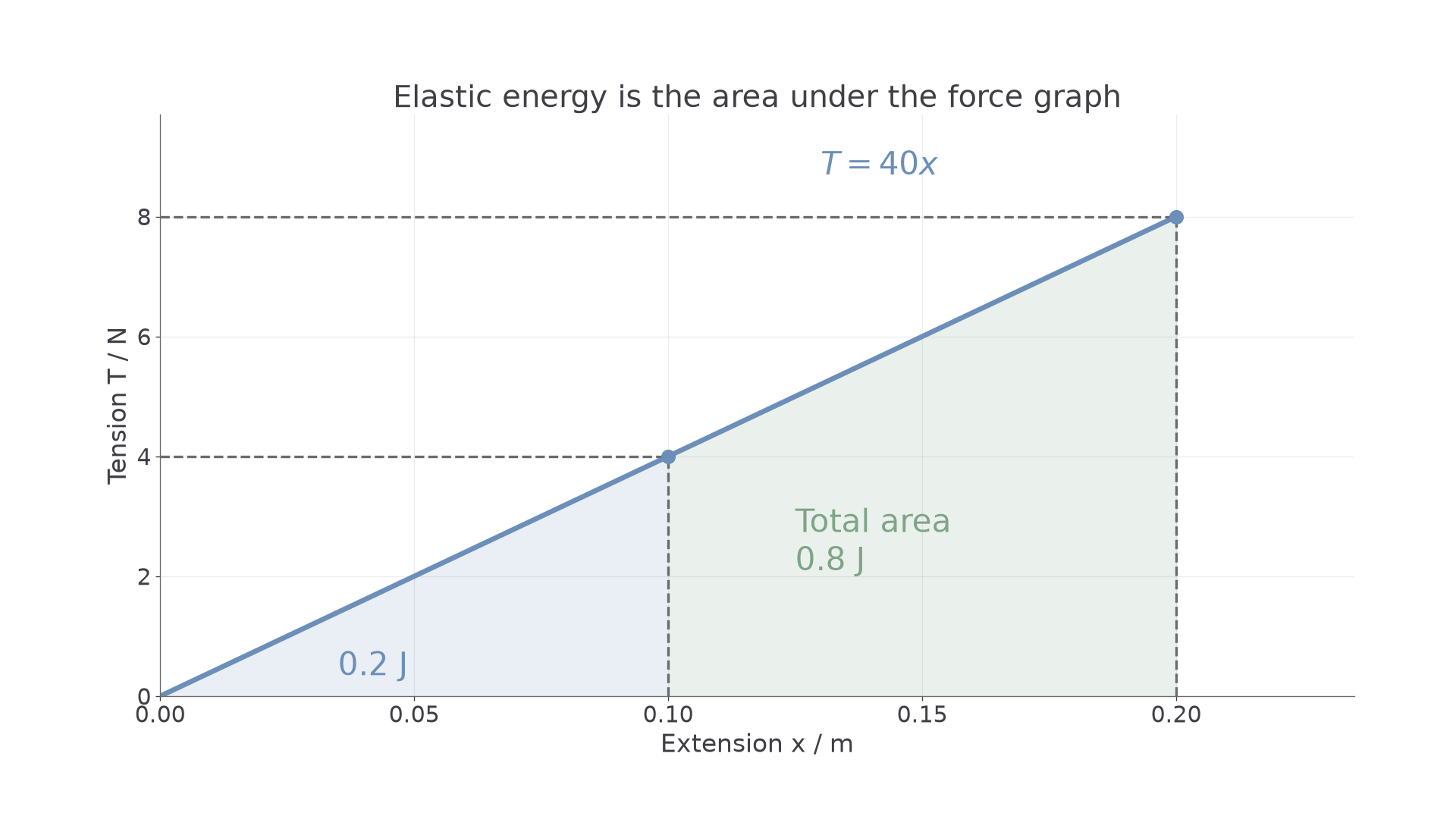
For Hooke's law, the force rises linearly from zero to . Its work-extension graph is a triangle, so the stored energy is half the final tension multiplied by the extension. This is the permitted elastic-work use of calculus, too:
Here is a temporary deformation variable. For a compressed spring, integrating its signed required force gives the same positive expression.
[DIAGRAM: asset_name: Elastic energy is a triangular area; asset_slug: hooke_energy_area; caption: Stretching to 0.1 m stores 0.2 J; doubling the extension stores four times as much energy; description: A force against extension graph has the straight line T equals 40x through the origin. A blue triangular area under the line from x equals zero to 0.1 m is labelled 0.2 J, with the endpoint force 4 N. A larger pale sage triangle to 0.2 m reaches 8 N and is labelled total area 0.8 J. Dashed endpoint guides distinguish the final force from the average force.]
Elastic potential energy
For a Hooke's-law connector of stiffness :
For a stretched connector with tension and extension , this also gives . For a spring, the squared signed extension covers compression too; its energy is non-negative. A slack string has .
Not in the formula booklet: learn it.
The square is worth noticing: doubling extension doubles force but quadruples stored energy.
Worked example 1: energy at a known extension
Question. A light elastic string has natural length and modulus . Find its tension and stored energy when its length is .
Plan. Find extension, calculate tension, then use the triangular work area.
Why this step? The force grows from zero to , so the average stretching force is , not .
Answer. Tension ; elastic potential energy .
Check. The triangle gives .
Now change only the string's current length, doubling its extension.
Worked example 2: the extension doubles
Question. The same string has length . Find its tension and stored energy.
Plan. Recalculate deformation from natural length and retain the square in the energy formula.
Why this step? depends on , not on . Scaling the tension alone misses the increased distance over which the force acts.
Answer. Tension ; elastic potential energy .
Check. .
For a spring of the same stiffness compressed by , the energy would also be . That statement would be false for a slack string.
Watch out
Wrong: . This uses the final force throughout the stretching. Right: , or ; the factor belongs in both forms.
Change the extension again and compare the tension with the energy separately.
Extreme positions in horizontal motion
On a horizontal surface, gravity and the normal reaction do no work. A moving particle attached to an elastic connector can transfer its kinetic energy into stored elastic energy.
Energy accounting with elasticity
Let be elastic potential energy and the positive energy dissipated. With no driving work:
Set only when the model justifies it. Do not count elastic force work again if its effect is already included through .
Not in the formula booklet: learn it.
At a greatest extension, the speed is zero. The elastic force need not be zero: that force can bring the particle back.
Worked example 3: maximum extension on a smooth table
Question. A particle on a smooth horizontal table is attached to a fixed point by a light elastic string of stiffness . Initially the string is at natural length. The particle is projected directly away from the fixed point at . Find the greatest extension.
Plan. Equate initial kinetic energy to stored elastic energy at the first turning point.
Why this step? Motion is directly away from the support, so after projection the string is stretched and stores energy until the particle stops.
Answer. The greatest extension is .
Check. . The tension is nonzero there, so this is a turning point rather than equilibrium.
Change only the surface: add a constant resistance that opposes motion.
Worked example 4: energy is also dissipated
Question. The particle in Example 3 instead moves on a surface exerting a constant resistance of . Find the greatest extension reached on its first outward motion.
Plan. Divide the initial kinetic energy between elastic storage and the positive work against resistance.
Why this step? Resistance removes energy over the whole outward distance , reducing the extension reached. A negative root does not describe this outward stretched-string phase.
Answer. The greatest first extension is .
Check. Elastic energy , and dissipation ; together they account for .
If motion started with the string already stretched, use the initial elastic energy too, and use the actual distance travelled in the resistive-work term.
Watch out
Wrong: add a term for work against tension as well as the final elastic energy. Right: the elastic energy change already accounts for that work. Include the separate resistive work once.
Keep the rough surface and change only the projection speed.
Vertical motion and the equilibrium position
A vertical spring exchanges energy with both motion and gravity. Its equilibrium position is where the combined potential energy is smallest, which can make it the position of greatest speed.
Consider a particle attached below a fixed spring. Write for extension, positive downwards, and take GPE to be zero at the spring's natural-length position. Then
The minus sign matters: a downward displacement loses GPE. Completing the square shows the minimum:
Thus, while this ideal spring model applies, the potential-energy minimum is at , the force-balance equilibrium extension.
Write for the conserved total mechanical energy. On the graph, the kinetic energy is the vertical gap between the total-energy level and the combined potential-energy curve.
[DIAGRAM: asset_name: Equilibrium and turning points on the energy graph; asset_slug: vertical_spring_energy; caption: The speed is greatest at the potential-energy minimum, while the endpoints have zero speed; description: A graph of combined potential energy 49y squared minus 19.6y in joules against downward spring extension y in metres shows a blue upward parabola. For a 2 kg particle and stiffness 98 N per metre, the minimum is at y equals 0.2 m and energy minus 1.96 J. A grey horizontal total-energy line at zero intersects at y equals zero and 0.4 m. A sage vertical gap at y equals 0.2 m is labelled maximum KE 1.96 J. A clay horizontal total-energy line at minus 1.47 J intersects at y equals 0.1 m and 0.3 m. Labels distinguish equilibrium from the two pairs of turning positions.]
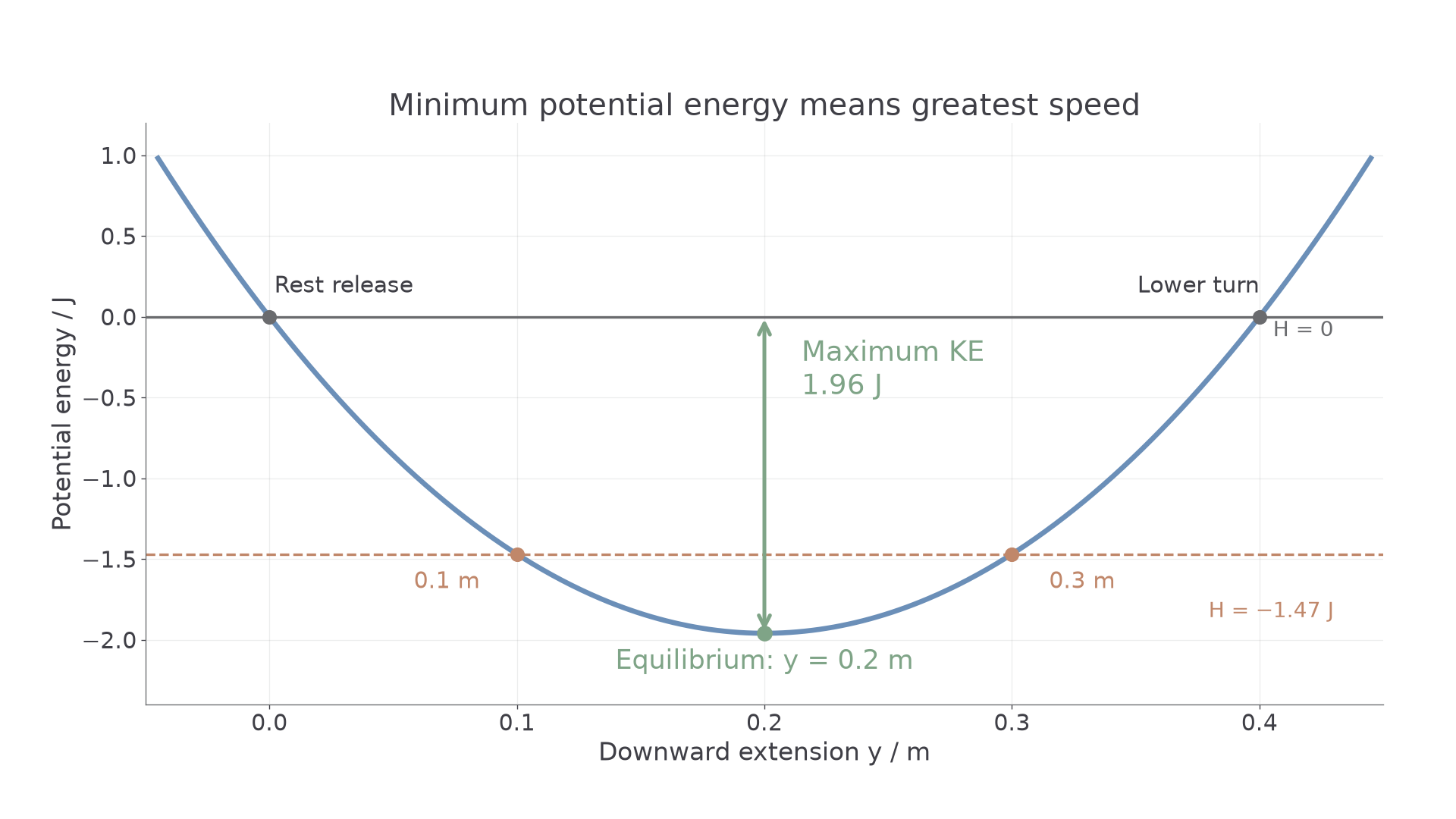
The graph also explains why zero speed does not imply zero resultant force. A particle can be instantaneously at rest away from the potential-energy minimum.
Continue this lesson.
You’re previewing NovaLearn without an account. Create a free account to read the rest.
Create free account