Ne1, Ne2 - Bisection, false position and secant methods
Locate a root by halving an interval or by intersecting a chord with the horizontal axis. You will distinguish false position from the secant method, implement their different updates, and justify the decimal places claimed for a numerical root.
Bisection keeps a root inside a shrinking interval
Two methods start from and on . Both draw the same chord and obtain . Must all their later answers agree too?
No. Choosing the next pair of points is part of the method, not a detail. First meet the method with the clearest guarantee: preserve opposite signs and halve the interval.
You already know
A continuous function with opposite signs at two endpoints has a zero between them. Cell references can retain a fixed parameter or follow the previous row. Keep full stored precision and round only the requested output.
Continuity is essential. A sign change across a discontinuity, such as across zero, need not enclose a root. Also, a sign change guarantees a root, not uniqueness; a monotonicity argument can establish uniqueness where needed.
Bisection
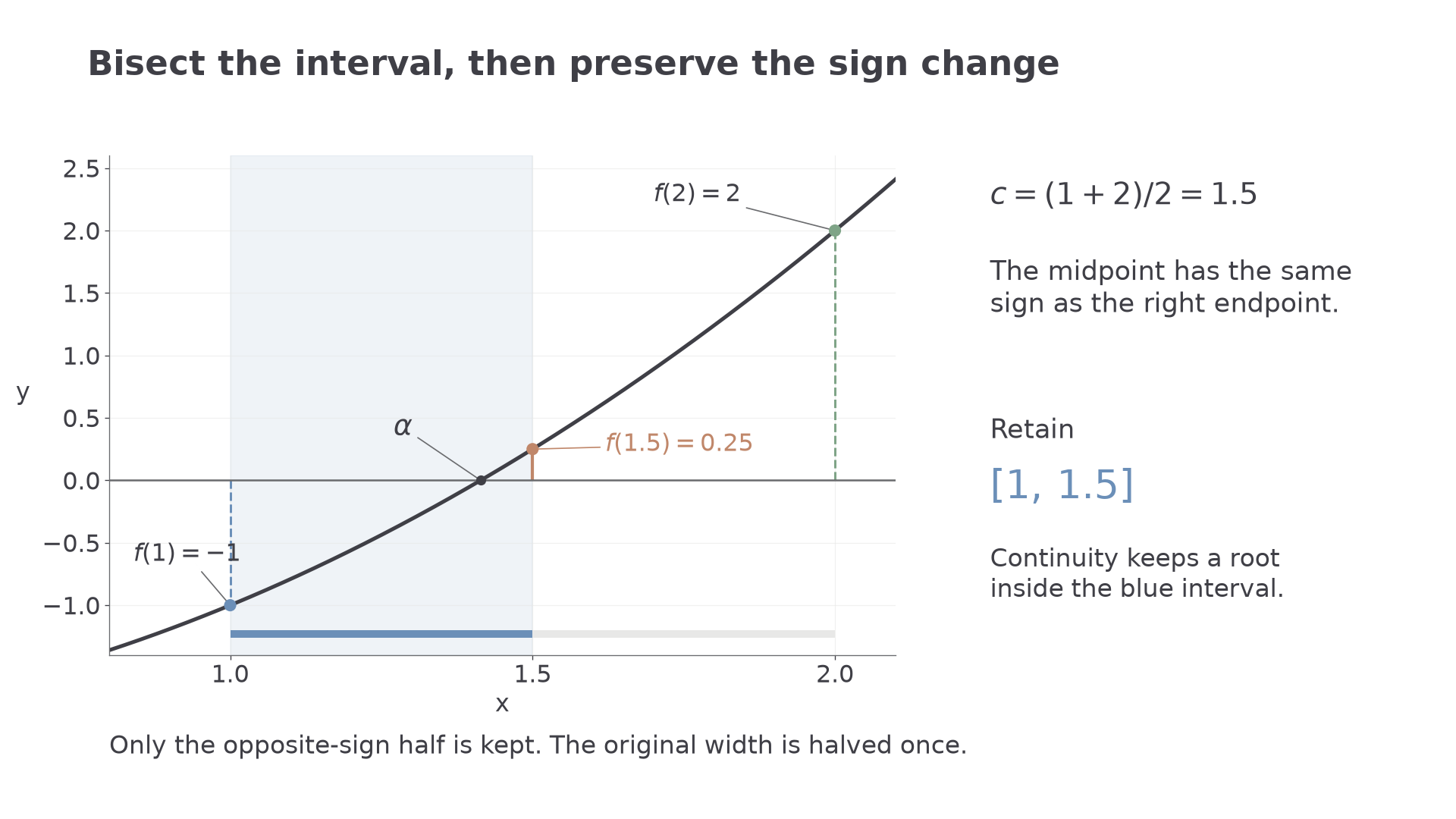
Suppose is continuous on and . Form
If , stop. Otherwise retain whichever of or has opposite endpoint signs.
After completed halvings, the bracket width is . Its midpoint has error magnitude at most half that width.
Not in the formula booklet: learn it.
The error bound is geometric: every point of the retained interval is within half its width of its midpoint. Count completed halvings from the original bracket, rather than count the printed rows indiscriminately.
[DIAGRAM: asset_name: The first bisection retains opposite signs; asset_slug: bisection_bracket; caption: The midpoint splits the interval and the sign change selects the retained half; description: The graph y=x squared minus 2 is drawn on positive x. Points at x=1 and x=2 have opposite signs. The first midpoint x=1.5 has positive function value, so a blue interval from 1 to 1.5 is retained and the interval from 1.5 to 2 is pale. The root is inside the retained half.]
Worked example 1: three halvings
Question. Apply three bisections to , starting from . Give the final bracket and its midpoint error bound.
Plan. Calculate each midpoint and retain the sign-changing half.
| Halving | Midpoint | Retained bracket | |
|---|---|---|---|
Why this step? The last tested point is an endpoint of the final bracket; its midpoint gives the stated half-width guarantee.
Answer. ; midpoint , error magnitude at most .
Check. The original width , divided by , is , matching the retained bracket.
Change only the starting bracket to , which is already narrower.
Worked example 2: a tighter initial bracket
Question. Repeat three bisections for the same function, starting from .
Plan. Use the same sign rule, starting from and .
| Halving | Retained bracket | ||
|---|---|---|---|
Why this step? A better starting bracket improves the guarantee without changing the number of iterations.
Answer. Bracket , midpoint , error magnitude at most .
Check. The bound is one tenth of the previous one, matching the one-tenth starting width.
To obtain midpoint error magnitude below a specified tolerance , choose so that . This is an error bound, not automatically a guarantee about every decimal-rounding boundary.
Watch out
Wrong: replace the left endpoint whenever the midpoint is negative, regardless of the endpoint signs. Right: retain the sign-changing half; the sign at the original left endpoint need not always be negative.
Use a new function and keep the same three-halving procedure.
False position uses a chord and keeps the bracket
A midpoint ignores the actual heights of the two endpoints. False position uses the straight line joining their graph points, then retains opposite signs as before.
The chord through and has equation
Setting gives its horizontal-axis intercept.
False-position step
For a continuous function with ,
Stop if . Otherwise replace the endpoint whose function value has the same sign as , preserving the sign-changing bracket.
Not in the formula booklet: learn it.
The intercept lies between opposite-sign endpoints. It need not halve the interval, and one endpoint can remain fixed for several steps.
Worked example 3: one endpoint stays fixed
Question. Apply three false-position steps to , starting from . Record the new intercepts to eight decimal places.
Plan. Find each chord intercept and replace only the endpoint with the same sign.
Why this step? The right endpoint is retained because its function value remains the opposite sign.
Answer. , , , with final bracket .
Check. All three intercepts lie below the positive root, and still supplies the other bracket endpoint.
Change only the initial right endpoint from to .
Worked example 4: a closer opposite-sign endpoint
Question. Apply three false-position steps to the same function on .
Plan. Retain while the successive intercepts have negative function values.
Why this step? Replacing the right endpoint merely because it is older would turn this into a different method.
Answer. The last two function values are and , so both new intercepts replace the left endpoint. The recorded intercepts are , with final bracket .
Check. The closer initial endpoint gives better intercepts here, but the final bracket remains much wider than the last two intercepts' difference.
A sequence of close intercepts is not the same object as the maintained sign bracket. Do not silently use the last two negative intercepts as opposite-sign bounds.
Watch out
Wrong: keep the newest two points after every false-position step. Right: keep the pair with opposite signs, even if one endpoint is old.
Use a new equation with the same positive-side endpoint pattern.
Continue this lesson.
You’re previewing NovaLearn without an account. Create a free account to read the rest.
Create free account