Xm1, Xm2 - Eigenvalues and eigenvectors
Find the directions a matrix preserves, calculate their eigenvalues, and form and solve characteristic equations of order and . You will distinguish a vector's scale from its direction, handle zero and repeated eigenvalues, and recognise when some eigenvalues are not real.
An eigenvector keeps its line
Can the same matrix stretch one arrow forwards and send another backwards?
Try . It sends to , but to . Neither arrow leaves its original line through the origin. One grows forwards; the other reverses. We will find these special directions systematically.
You already know
A matrix acts on a column vector by multiplication. A homogeneous system can have non-zero solutions only when its coefficient matrix is singular. You can expand a determinant of order using cofactors and solve quadratic equations, including those with non-real roots.
Most vectors change direction under a matrix. These particular vectors make the transformation much easier to describe.
Eigenvalue and eigenvector
A non-zero vector is an eigenvector of a square matrix if
for a scalar , its associated eigenvalue. Any non-zero multiple of is also an eigenvector with the same eigenvalue.
For the opening matrix, has eigenvalue . The zero vector is never an eigenvector: it would satisfy the equation for every and tell us no direction.
For a real eigenvalue, positive values keep the vector's sense, negative values reverse it, and zero sends the vector to the origin. The eigenvector must be non-zero; the eigenvalue need not be.
[DIAGRAM: asset_name: Two eigenvector directions; asset_slug: eigenvector_directions; caption: The same matrix stretches one eigendirection and reverses the other; description: Two equal-scale coordinate panels show the lines y=x and y=minus x. On y=x a blue vector from the origin to1,1 maps to a sage vector to4,4, labelled eigenvalue4. On y=minus x a blue vector to1,minus1 maps to a clay vector to minus2,2, labelled eigenvalue minus2. All arrows start at the origin and the two image vectors remain on their original lines.]
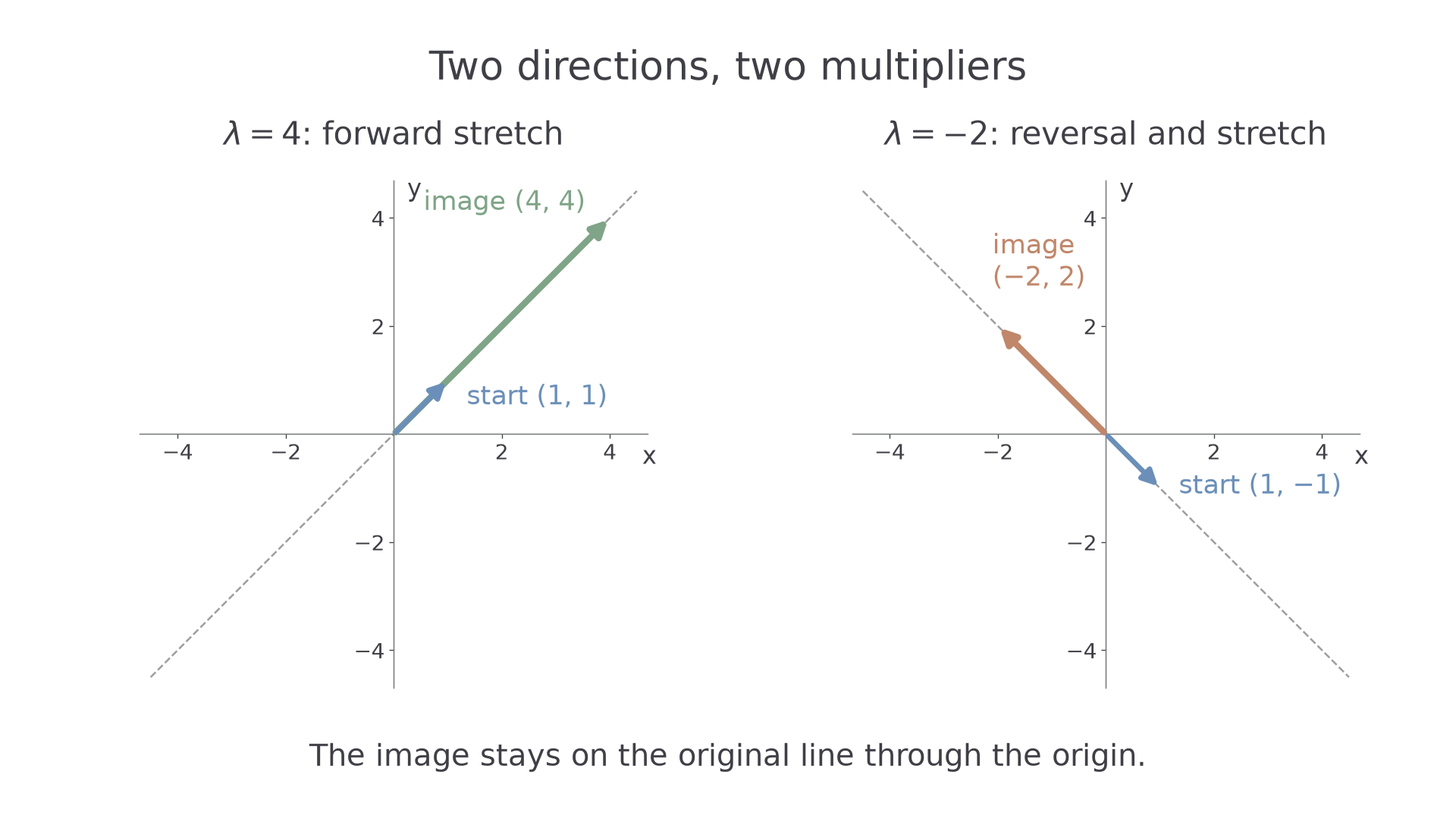
The quickest way to verify a proposed eigenvector is to multiply, then factor the result.
Verifying a proposed eigenvector
For a supplied non-zero vector, calculate . It is an eigenvector exactly when the result is a single scalar multiple . State the value of explicitly.
Not in the formula booklet: learn it.
You do not need a characteristic equation when the vector is already supplied.
Worked example 1: a forward stretch
Question. Verify that is an eigenvector of , stating its eigenvalue.
Plan. Calculate the image and compare both components with the original vector.
Why this step? The same multiplier must work in every component; changing length alone is insufficient unless the direction also matches.
Answer. The vector is an eigenvector with eigenvalue .
Check. Its image lies on , four times as far from the origin.
Change only the supplied direction, keeping the matrix fixed.
Worked example 2: a negative eigenvalue
Question. Verify that is an eigenvector of the same matrix, stating its eigenvalue.
Plan. Factor the image as a multiple of the whole vector, including its negative component.
Why this step? The multiplier is , rather than , because the image points the opposite way.
Answer. The eigenvalue is .
Check. Multiplying this eigenvector by gives ; its image is , with the same eigenvalue.
A vector such as is a non-example here: its image is not parallel to it.
Watch out
Wrong: “every vector is an eigenvector because its image is another vector”. Right: the image must be a scalar multiple of the original non-zero vector. When asked to verify and state the eigenvalue, show that multiple and name it explicitly.
Keep the direction from the second example but change the matrix.
Find eigenvalues and eigenvectors in two dimensions
When the special directions are unknown, start by finding the possible multipliers.
Rearrange as . A non-zero solution requires a singular coefficient matrix. This turns the search for a vector into an equation for one scalar.
Characteristic equation
The eigenvalues of a square matrix satisfy
This is its characteristic equation. For each real root , solve
to find the associated eigenvectors. Subtract from diagonal entries only.
Not in the formula booklet: learn it.
Using gives the same roots. Its polynomial changes sign in order , so keep one convention throughout a calculation.
Worked example 3: two distinct real roots
Question. Find the eigenvalues and associated eigenvectors of .
Plan. Solve the characteristic quadratic, then solve the homogeneous equations for each root.
For ,
For ,
Why this step? Once the determinant is zero, the equations are dependent. Choose a convenient non-zero solution, rather than try to force a unique vector.
Answer. Eigenvalue has eigenvectors ; eigenvalue has eigenvectors , where .
Check. Multiplication gives and .
Change only the lower-left entry from to . One root now reaches zero.
Worked example 4: zero is an allowed eigenvalue
Question. Find the eigenvalues and associated eigenvectors of .
Plan. Form the new quadratic and retain the zero root when solving for directions.
The equations are
Why this step? At , solve ; it is the vector, not its image, that must be non-zero.
Answer. Eigenvalues and , with the respective vector families above, .
Check. , while . Also , consistent with a non-zero vector being collapsed.
The determinant equation finds the allowed eigenvalues; it does not replace the vector equations.
Continue this lesson.
You’re previewing NovaLearn without an account. Create a free account to read the rest.
Create free account