Pj11 - Regions on the Argand diagram
Use complex inequalities to describe regions, including exactly which boundaries belong. You will combine circles, half-planes and angular sectors using intersections and unions, and check the result with particular points.
Inside, outside and the boundary
Does belong to the region described by and ? What changes if “and” becomes “or”? One word changes the answer. First, we need to know what each inequality includes.
You already know
is a circle centred at , for . The expression is a distance, so smaller values lie nearer the centre. is a perpendicular bisector when .
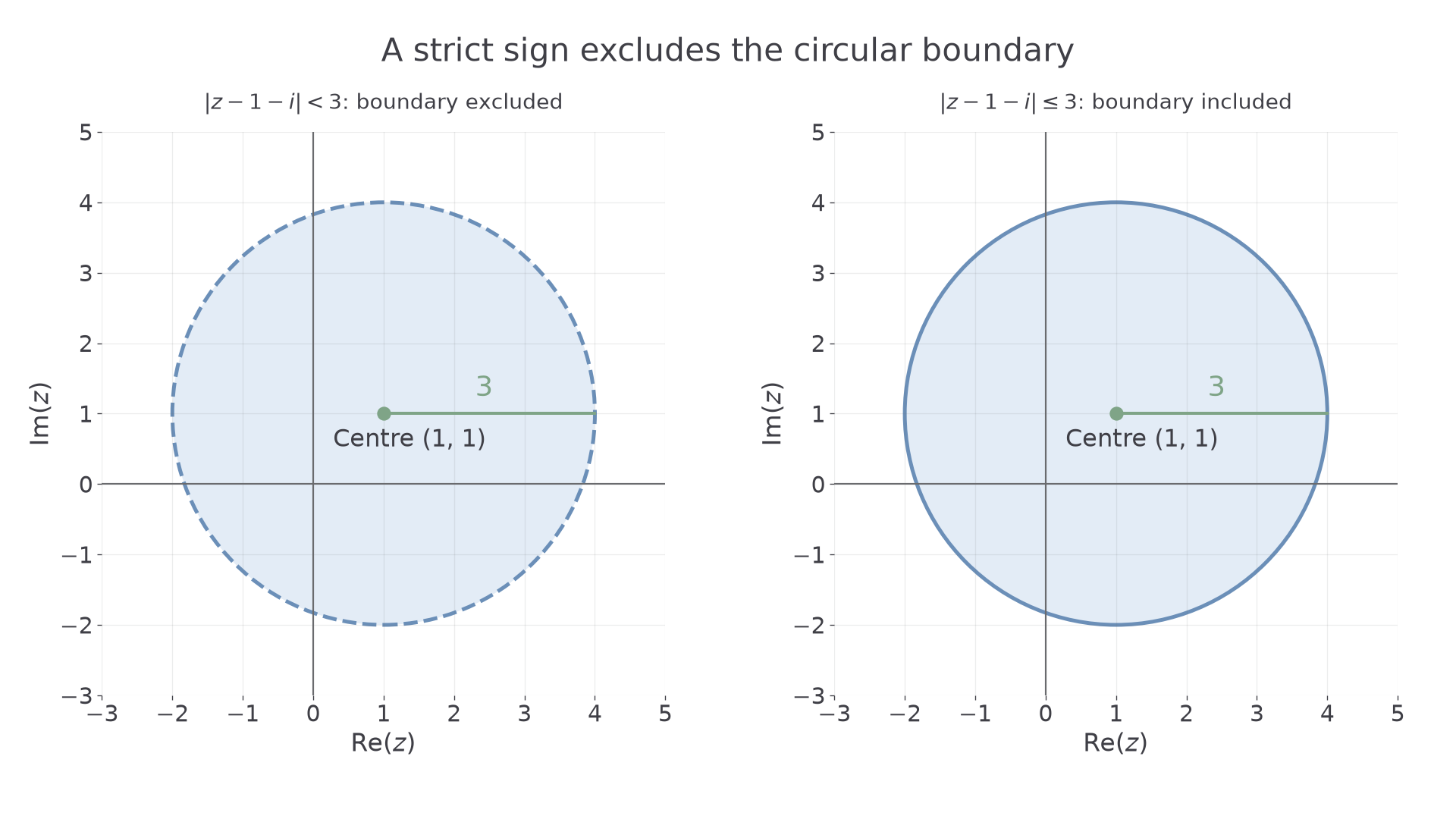
For example, includes the centre and every point less than units away. It excludes the circumference, where the distance is exactly .
Distance inequalities
For fixed and ,
Not in the formula booklet: learn it.
In these diagrams, solid curves are included and dashed curves are excluded. Always state the inclusion in words as well; a shading convention alone should not carry the meaning.
[DIAGRAM: asset_name: Strict and inclusive circular boundaries; asset_slug: b003_007_circle_regions; caption: A strict inequality excludes the circumference; replacing it by less than or equal includes the circumference; description: Two Argand panels shade the same disc centred at (1,1) with radius 3. The first has a dashed boundary and is labelled distance less than 3, circumference excluded. The second has a solid boundary and is labelled distance at most 3, circumference included.]
Worked example 1: an open disc
Question. Describe , giving a Cartesian inequality and stating whether the boundary is included.
Plan. Identify the centre and radius, then square the non-negative distance.
Why this step? Squaring preserves the comparison because both sides are non-negative; it does not change a strict sign into an inclusive one.
Answer. The interior of the circle with centre and radius , excluding its circumference; .
Check. The centre satisfies , but gives , which is false.
Change only to . The region's interior stays the same; the boundary changes.
Worked example 2: including the circumference
Question. Describe , giving a Cartesian inequality and stating whether the boundary is included.
Plan. Keep the same centre and radius, and retain the inclusive sign when squaring.
Why this step? Equality now satisfies the condition, so every point at distance exactly must be included.
Answer. The closed disc with centre and radius , including the circumference.
Check. now gives , which is true; still fails since .
Distance inequalities can describe an exterior as well as an interior. The centre itself is a quick test of which side you need.
Watch out
Wrong: shade only the circumference for . Right: include all points inside it as well. Conversely, describes the exterior and circumference, not a larger disc with an unspecified radius.
The next inequality reverses the side and changes the centre. State both effects.
Nearer one point gives a half-plane
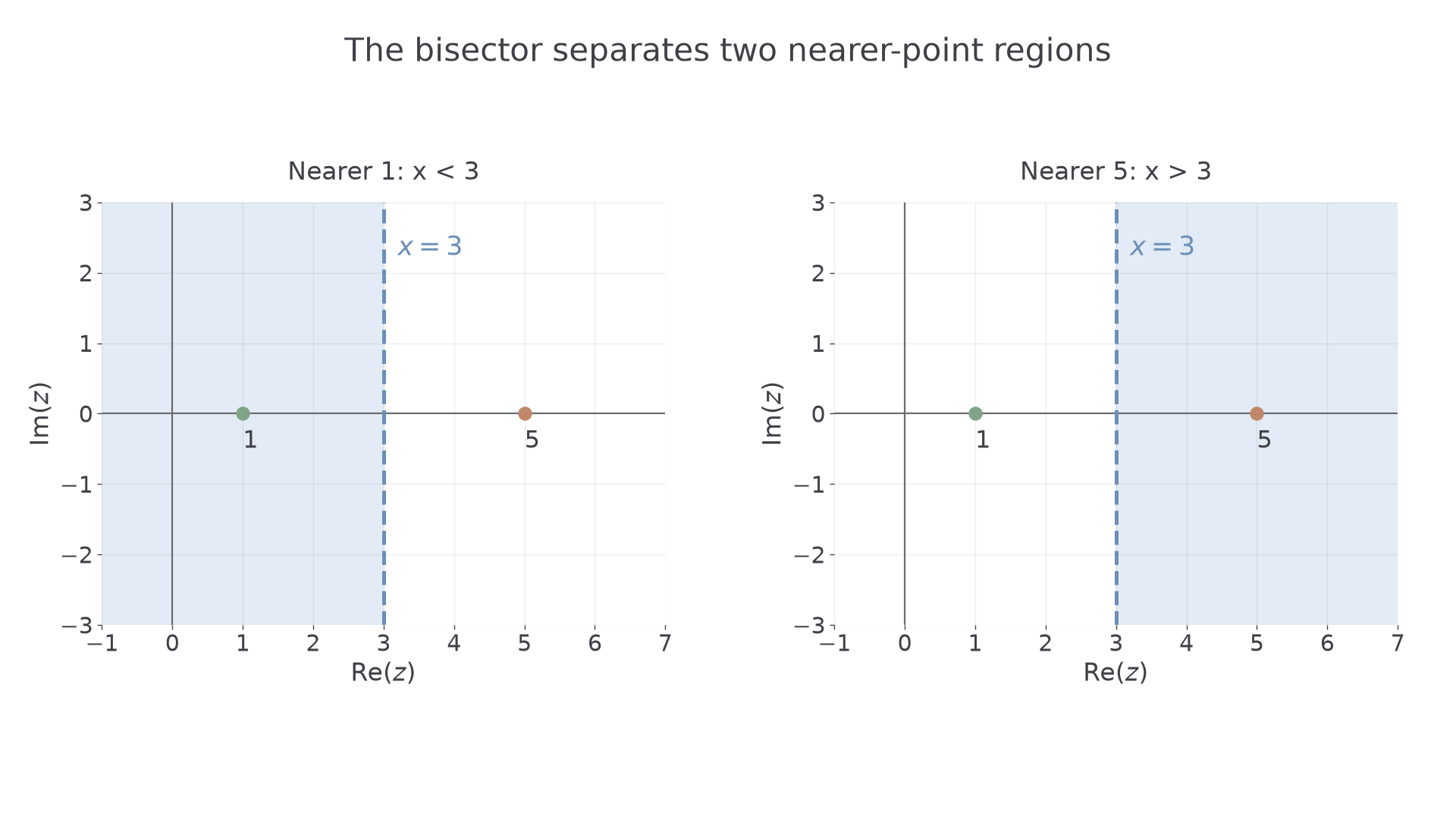
A perpendicular bisector divides the plane into points nearer and points nearer . Thus selects the side containing , with the equal-distance line excluded. Replace by to include that line. These interpretations are not in the formula booklet: learn them.
You can choose the side with a test point, or simplify the inequality algebraically. A test point on the boundary is unhelpful because its two distances are equal.
Worked example 3: nearer the first point
Question. Describe , and give its Cartesian inequality.
Plan. Square the distances and simplify, then check the side using the point .
Why this step? The same cancellation that gave a perpendicular bisector now gives one side of that line.
Answer. The half-plane left of , excluding the line itself.
Check. At , the distances are and , so the side containing is included.
Change only the inequality sign from to . This exchanges which fixed point the region is nearer.
Worked example 4: nearer the second point
Question. Describe , and give its Cartesian inequality.
Plan. Repeat the distance comparison with its reversed sign, then test .
Why this step? Being farther from than from means being nearer , so the selected side must switch.
Answer. The half-plane right of , excluding the line itself.
Check. At , is true; at , is false.
The test points identify the sides without any dependence on a particular shading convention.
[DIAGRAM: asset_name: Which point is nearer; asset_slug: b003_007_half_plane_regions; caption: The perpendicular bisector separates points nearer 1 from points nearer 5; description: Two Argand panels mark the fixed points (1,0) and (5,0) and the excluded dashed bisector x equals 3. The left panel shades x less than 3; the right shades x greater than 3. Labels state which fixed point is nearer.]
Problem-solving
First find the equality boundary. Then choose a simple point off it, substitute into the original inequality, and include the side containing that point if it works. This also catches a sign reversal in your algebra.
For an oblique boundary, the same method works. The next check includes its equal-distance line.
Watch out
Wrong: selects . The left distance is larger, so the point is nearer . The correct inequality is , as the test point confirms. No point on satisfies the strict inequality.
Test a point away from the boundary when choosing the next half-plane.
Between two directions gives a sector
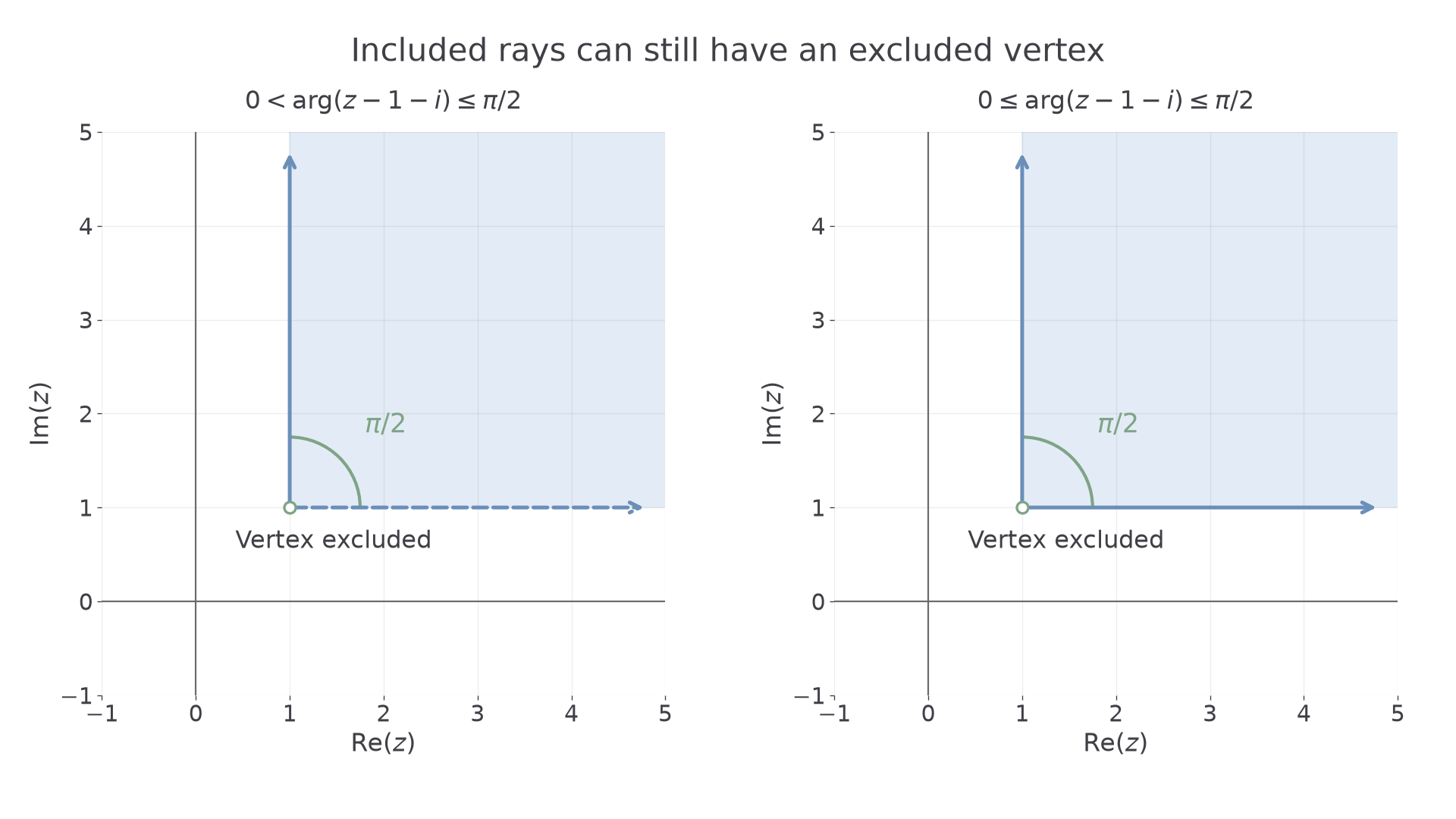
An inequality for selects directions from the point . Each limiting direction gives a half-line boundary. A strict inequality excludes that ray; an inclusive inequality includes it. The vertex itself is always excluded, because is undefined, even when both angle inequalities are inclusive.
Use principal arguments in . For instance, points just below the negative real axis have arguments near , rather than slightly greater than . Mark the stated angular interval before shading; do not silently replace it by the smaller angle between two rays. These argument-region rules are not in the formula booklet: learn them.
Worked example 5: one ray included
Question. Describe , including its boundaries.
Plan. Take directions from between the rightward and upward rays, applying each inequality separately.
Why this step? The upper angle is allowed, so , belongs. The angle is forbidden, so , does not.
Answer. The infinite sector above and right of , including the upward boundary ray but excluding the rightward ray and the vertex. In coordinates: , .
Check. has displacement and is included; has displacement and is excluded.
Change only the lower sign to . The rightward ray is now included, but the vertex still has no argument.
Worked example 6: both rays included, vertex excluded
Question. Describe , including its boundaries.
Plan. Include both limiting directions while excluding the zero displacement.
Why this step? Inclusive angle signs allow rays made of positive-length displacements; they cannot assign a direction to a displacement of length .
Answer. The upper-right infinite sector, with both rays included and the vertex excluded.
Check. and now both satisfy the condition. Substituting would require , so that point still fails.
This gives a small but important surprise: a region can include both of its straight edges while excluding the point where they meet.
[DIAGRAM: asset_name: Angular boundaries and an excluded vertex; asset_slug: b003_007_sector_regions; caption: Inclusive angle signs include rays, but the vertex is always excluded; description: Two Argand panels shade the upper-right sector based at (1,1), with an open circle at the vertex. The first has a dashed horizontal rightward boundary and solid vertical upward boundary. The second has both rays solid but retains the open vertex. Labels state the relevant angle intervals.]
Watch out
Wrong: include because . Right: test whether the argument exists first. The complex number is a point; it is not an angle, and is undefined.
The next sector moves left and swaps which ray is excluded.
Intersections and unions
An intersection contains points satisfying both conditions: “and”. A union contains points satisfying at least one condition: “or”, including points satisfying both. For a union, a point excluded by one condition can still be admitted by the other.
Draw each boundary first, identify each individual region, then combine them. State boundary inclusion for the combined region, rather than assuming that every original boundary remains an edge of the final shape. These set interpretations are not in the formula booklet: learn them.
Worked example 7: an intersection
Question. Describe and . Find where the two boundaries meet and state whether those points belong.
Plan. Intersect the closed disc with the closed half-plane, then substitute into the circle equation.
Why this step? Solving the boundary equations locates the two corners of the common region; it does not replace checking the inequalities.
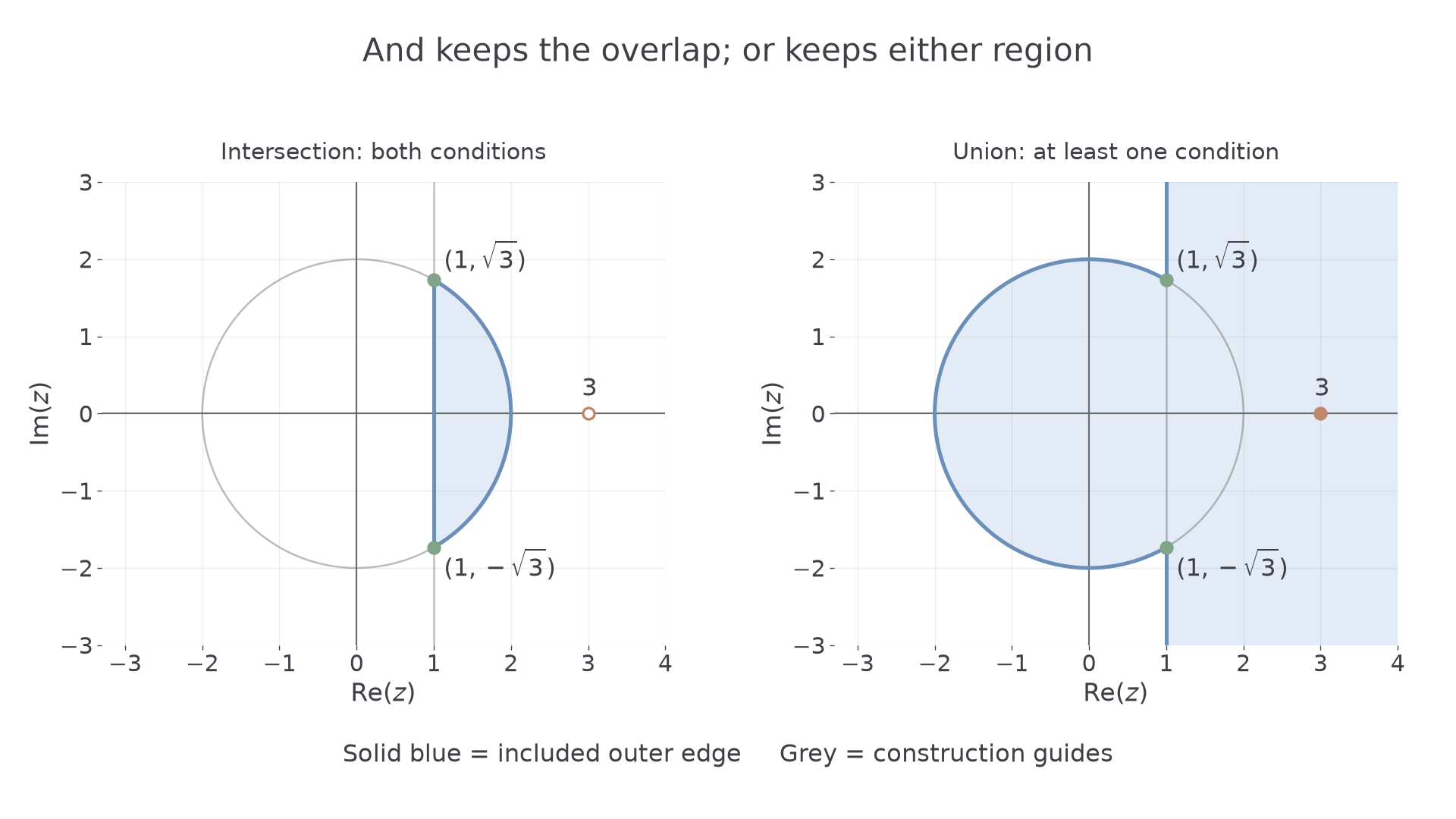
Answer. The part of the closed disc to the right of . Its edge is the circle arc with and the segment , , all included. The meeting points are , both included.
Check. fails , so it is excluded even though its real part is at least .
Change only “and” to “or”. The individual regions stay the same, but keeping either one is now enough.
Worked example 8: a union
Question. Describe or , including its boundary.
Plan. Keep the entire disc and the entire right half-plane, then identify their exposed edges.
The circle arc with is now inside the half-plane, and the segment , is inside the disc.
Why this step? A boundary of one original region can lie inside the other, so it need not be an outer edge of their union.
Answer. The whole closed disc together with the closed half-plane . The exposed boundary is the circle arc with and the two parts of with . All these boundary points are included.
Check. now belongs through the half-plane condition. satisfies neither condition and is excluded.
The two diagrams answer the opening puzzle: is outside the intersection but inside the union.
[DIAGRAM: asset_name: Intersection and union of the same regions; asset_slug: b003_007_intersection_union; caption: And keeps only the overlap; or keeps either region, including their overlap; description: Two Argand panels use the closed disc centred at the origin with radius 2 and the half-plane x at least 1. The intersection panel shades only the right circular cap. The union panel shades the full disc and the whole right half-plane. The points (1, square root 3) and (1, minus square root 3) are marked, and the point z equals 3 is shown excluded from the intersection but included in the union.]
Exam tip
For a region sketch, label the centre and radius of a circular boundary, locate any straight boundary, and state which side and boundary points are included. Drawing the correct circle alone does not answer an inequality question.
Translate the circle upwards for the final check. The combination is again an intersection.
Watch out
Wrong: is excluded from or because . A union requires only one condition. The correct conclusion is that belongs, since ; it fails the corresponding intersection.
Decide whether both conditions or either condition must hold before shading.
Quick Recap
- A distance inequality selects the interior or exterior of a circle; equality in the sign decides whether its circumference belongs.
- Comparing two distances selects a half-plane. Find its perpendicular-bisector boundary and test a point to choose the side.
- An argument interval selects directions from its vertex. Check each ray separately, and always exclude the vertex.
- An intersection requires both conditions; a union requires at least one. Check the combined region's actual boundary.
For the opening conditions, fails the circle condition and passes the half-plane condition: “and” excludes it, while “or” includes it.