Pc6 - Integrals giving inverse trigonometric functions
Recognise integrals that reverse the derivatives of arcsine and arctangent, including scaled inputs. Pc6 also uses sine and tangent substitutions for related integrals, with careful choices of angle range, transformed limits and square-root signs.
Two shapes to recognise
How can an area under produce a multiple of ? The graph is a circle's upper half, but the same answer can be found algebraically by turning into a squared cosine. First, recognise the simpler inverse-trigonometric integrals that make that method work.
You already know
and . The chain rule means that a scaled input needs a compensating constant when these derivatives are reversed.
For example, differentiating gives . Differentiating gives , so its coefficient must be divided by to integrate .
Standard inverse-trigonometric integrals
For ,
In the formula booklet.
The square root distinguishes the two shapes. A difference under a square root suggests arcsine; a positive sum of squares in the denominator suggests arctangent. A denominator without a root is a different integral, generally handled by partial fractions.
Worked example 1: recognising both shapes
Question. Find
Plan. Integrate the two terms separately, using in both standard formulae.
Why this step? The arctangent formula has an outside factor ; the arcsine formula does not. They look similar but scale differently.
Answer. , for .
Check. Differentiating gives , the original integrand.
Change only the input from to throughout the two kernels. The substitution contributes an extra factor .
Worked example 2: a scaled variable
Question. Find
Plan. Put , so , then use the previous recognition rules.
Why this step? Replacing by in an antiderivative would double its derivative. The factor compensates for that chain factor.
Answer. , for .
Check. At , the integrand is ; the derivative of the answer is also .
Completing the square can reveal the same forms after a translation. For example, , so its reciprocal integrates to . The standard formula is supplied; spotting and making the translation is your job.
The same idea applies to a quadratic under a square root. In this example the completed square reveals both the translation and the appropriate radius.
Worked example 3: a hidden difference of squares
Question. Evaluate exactly.
Plan. Complete the square, put , and use the standard arcsine integral with transformed limits.
Why this step? The negative coefficient of signals a difference of squares after completing the square; it does not prevent a real-valued square root on the given interval.
Answer. .
Check. The integrand increases from to over an interval of width , so its integral lies between those numbers; does.
After recognising the completed square, the integration is the same standard form as before. The extra work is algebra and careful translation of the endpoints.
Watch out
Wrong: .
Right: . Differentiate a proposed answer to catch a missing scale factor immediately.
The next pair changes the variable scale again, while keeping the two standard shapes.
Sine substitution removes a difference of squares
When appears in a more complicated integrand, put , with . Then
The last equality uses and on the chosen range. Without that restriction, , not automatically .
[DIAGRAM: asset_name: A triangle for the sine substitution; asset_slug: h645_b040_sine_triangle; caption: Measuring theta from the vertical gives x equals two sin theta and the square root equals two cos theta; description: The first-quadrant part of the circle x squared plus y squared equals four contains the point one comma square root three. A right triangle joins the origin, the point and its projection on the x-axis. Its hypotenuse is two, horizontal side is x equals one, and vertical side is square root of four minus x squared equals square root three. Theta is measured clockwise from the positive vertical axis to the radius and is pi over six. A side panel connects the triangle with x equals two sin theta and the square root equals two cos theta, with non-negative cosine on the principal sine interval.]
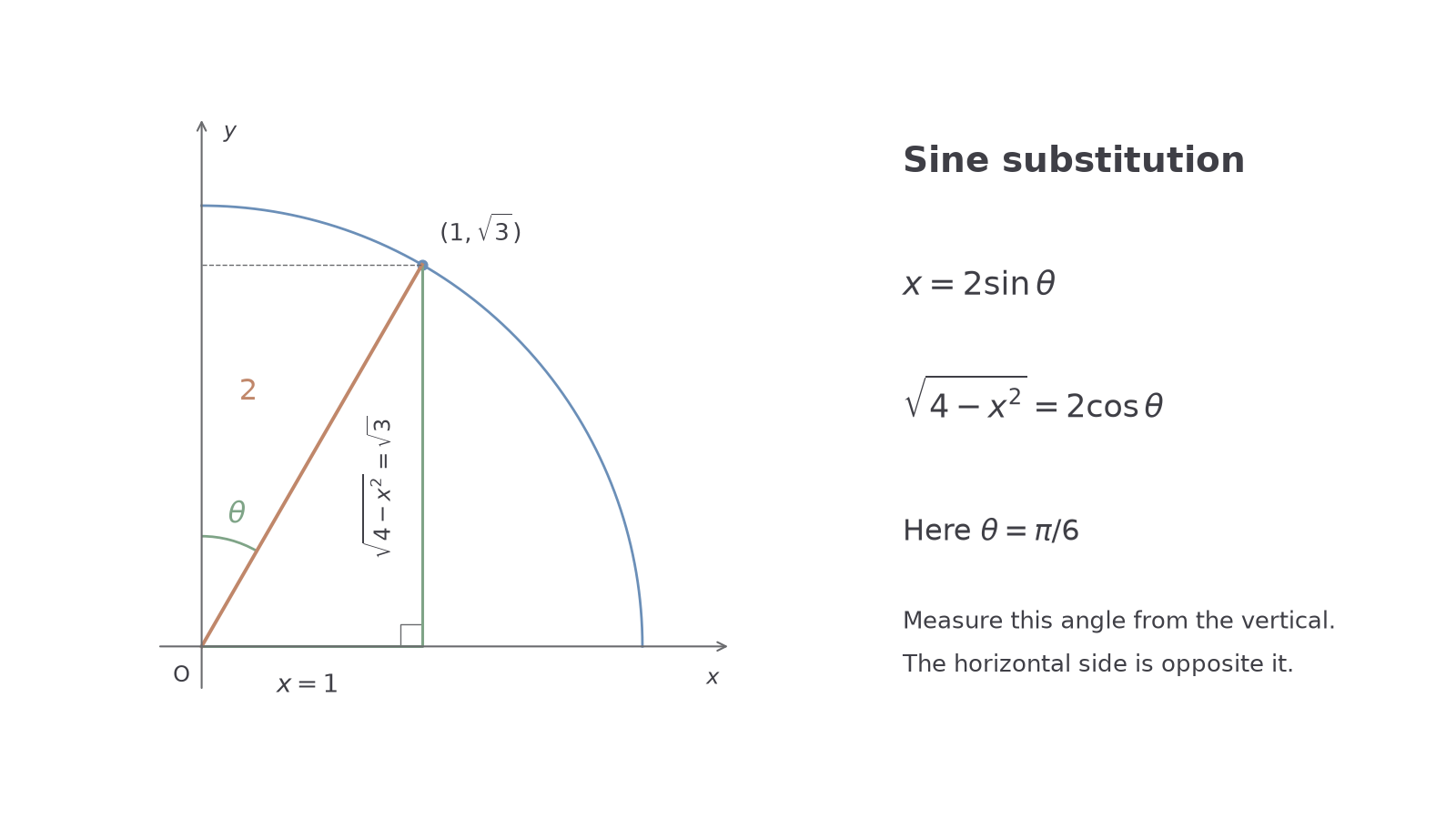
The angle in this triangle is measured from the vertical, so the horizontal coordinate is the opposite side. That makes it a picture of the sine substitution rather than the usual cosine-coordinate parametrisation.
Sine substitution
For and , use
so that . Convert , the entire integrand and any limits consistently.
Not in the formula booklet: learn it.
The substitution is useful because removes the square root. The remaining squared cosine can be integrated using the booklet's double-angle identities.
Continue this lesson.
You’re previewing NovaLearn without an account. Create a free account to read the rest.
Create free account