MG9, MG10 - Lamina centres of mass and equilibrium
MG9 finds a uniform plane lamina's centre of mass by adding the moments of thin strips, including regions between curves. MG10 then uses the calculated centre in rigid-body equilibrium, particularly suspension and the competition between sliding and toppling.
A thin strip has its own midpoint
A uniform solid hemisphere has its centre above the flat face. Does a uniform semicircular plate with the same outline have its centre at the same fractional height? The outline agrees, but the mass distribution does not: a plate is weighted by strip area, whereas the solid was weighted by disc volume.
You already know
For a uniform lamina, mass is proportional to area. The centre satisfies and for component areas. The weight acts through that centre when moments are calculated.
In the lamina below , a strip near has height and centre height . The material is spread through the whole strip, not concentrated along the curve.
For a region between , the -axis and , a thin vertical strip has area . Its centre is approximately . It therefore contributes to the horizontal area moment and to the vertical area moment.
[DIAGRAM: asset_name: A vertical strip and its centre; asset_slug: h645_b077_strip; caption: A strip of height y has centre halfway up, so its vertical moment is one half y squared dx; description: The uniform lamina under y equals x squared from zero to two is shaded. A thin vertical strip is highlighted at a labelled x, with height y and width dx. Its midpoint is marked at x comma y over two, and the whole lamina centre is marked at three halves comma six fifths. A side panel distinguishes strip area y dx from the moment integrands x y dx and one half y squared dx.]
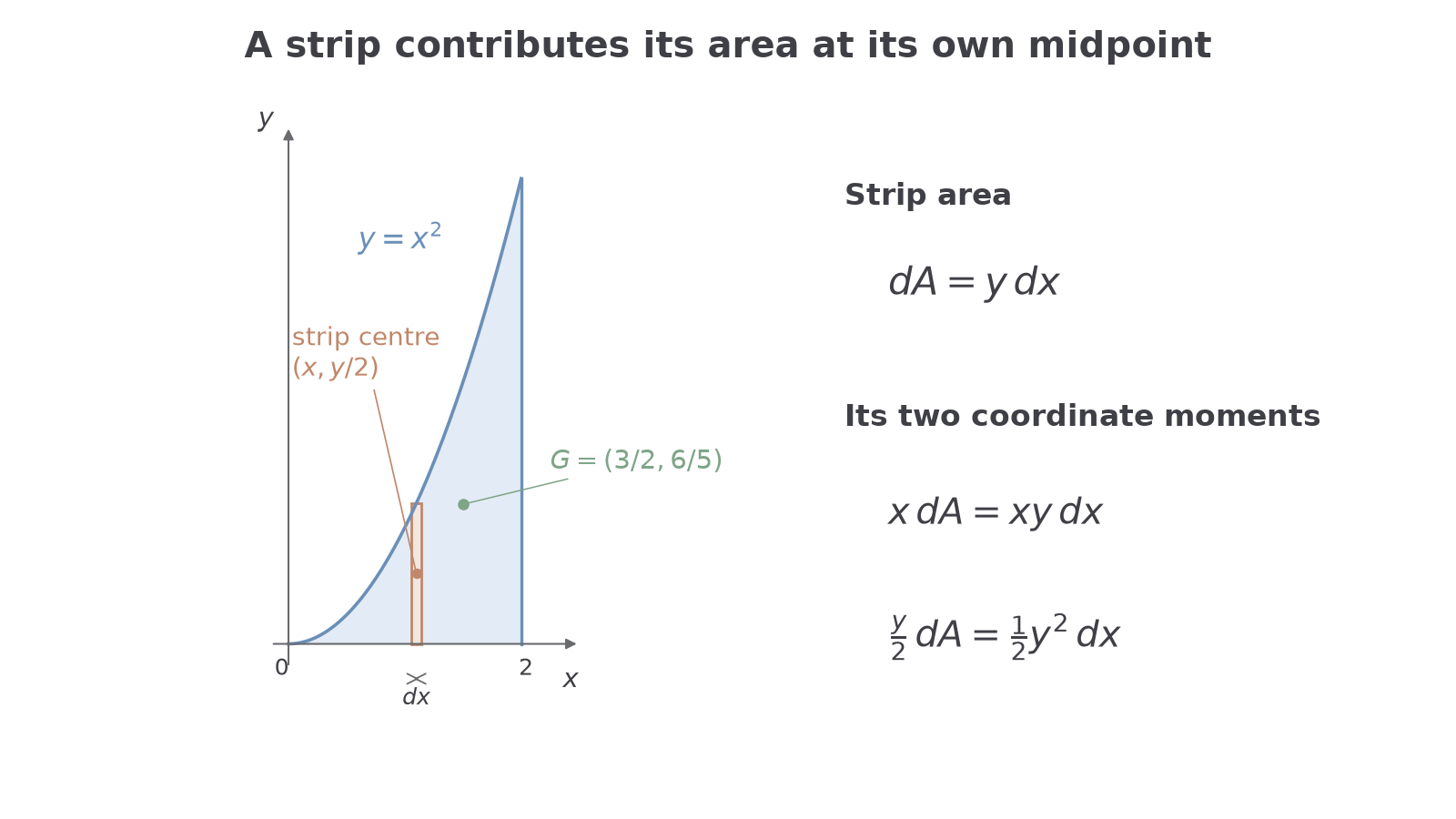
Lamina below a non-negative curve
For and uniform mass per unit area,
Here the coordinate weights come from each strip's centre, not from the curve's upper boundary.
Not in the formula booklet: learn it.
There is no factor : this is a plane lamina, not a solid formed by rotation. The area moments have units of length cubed; dividing by area gives a length.
Worked example 1: a parabolic boundary
Question. A uniform lamina occupies , . Find its centre of mass.
Plan. Integrate the strip areas and their two coordinate moments, then divide by area.
Why this step? The factor comes from the strip centre at height . Weighting its area at height would put all its mass on the upper boundary.
Answer. .
Check. The centre is inside the lamina: at , its upper boundary is . Its horizontal coordinate is towards the wider right end.
Change only the right endpoint from to . This stretches the lamina horizontally by factor and vertically by factor .
Worked example 2: extending the same curve
Question. Find the centre for , .
Plan. Use the same three integrands with the new endpoint.
Why this step? Changing the endpoint changes the entire weighted distribution. It is not enough to move the original centre by one unit.
Answer. .
Check. The coordinates have scaled by and , respectively, matching the geometric stretches described above.
For a curve supplied as , horizontal strips may be simpler; the corresponding formulae are developed later in the lesson. Always choose the direction that makes each strip a single clear interval.
Watch out
Wrong: .
Right: . The missing half is a misplaced strip centre, not an integration error.
Use another endpoint and give both coordinates.
Use the midpoint between both boundaries
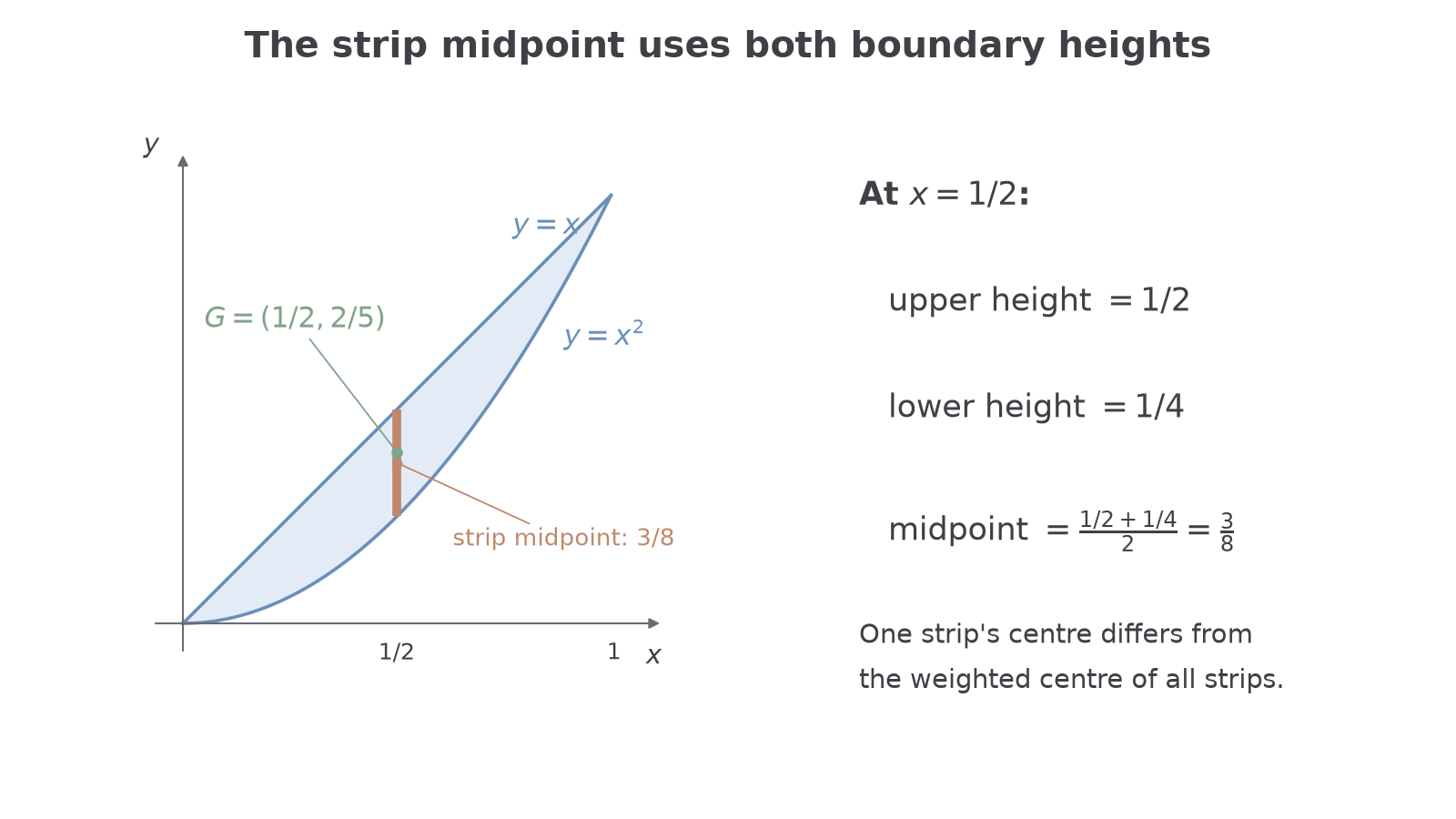
If a vertical strip lies between and , where , its height is , but its midpoint height is . A difference of heights alone does not locate that midpoint.
Multiplying area by midpoint gives
for the vertical moment. This works even when a boundary is below the axis, provided the upper and lower curves are identified correctly.
A uniform lamina between curves
For , , and positive area,
Not in the formula booklet: learn it.
You can also obtain these equations by subtracting lower-region area moments from upper-region moments when that partition is appropriate. The strip derivation shows directly why the squared boundaries are subtracted.
Worked example 3: a curved region between two graphs
Question. A uniform lamina lies between and , for . Find its centre.
Plan. Use upper curve , lower curve , then integrate their area and moment differences.
Why this step? The strip's centre is at , not at half the gap , which would be measured from the wrong baseline.
Answer. .
Check. At , the bounds are and , containing . Also the strip-area distribution is symmetric about , agreeing with .
Change only the vertical scale, multiplying both boundary heights by . The horizontal centre remains fixed, while the vertical centre doubles.
Worked example 4: stretching both boundaries
Question. Find the centre of the uniform lamina between and , for .
Plan. Update the strip height and squared-boundary difference.
Why this step? Area scales by , while the vertical area moment scales by : it contains both a height in the strip area and a height in the lever arm.
Answer. .
Check. Dividing the scaled vertical moment by the scaled area gives twice the original , as a vertical stretch requires.
[DIAGRAM: asset_name: The centre of a strip between two curves; asset_slug: h645_b077_between; caption: The strip midpoint lies halfway between the actual upper and lower heights; description: The region between y equals x and y equals x squared on zero to one is shaded. A vertical strip at x equals one half runs from one quarter to one half, with midpoint three eighths marked. The whole lamina centre one half comma two fifths is marked separately, showing that a single strip midpoint is not automatically the whole centre.]
Regions that change which curve is upper must be split at their intersections. For a hole, subtract its area and both area moments, just as in the Minor composite-body method.
Watch out
Wrong: use as the vertical-moment integrand.
Right: use . The first expression would shift every strip down to the axis before calculating its moment.
Stretch the same region once more.
Horizontal strips can make a curved lamina simple
Horizontal strips reverse the coordinate roles. For boundaries and , the strip has area and centre . A symmetry line may make one moment zero before any integration.
Horizontal-strip moments
For , , and positive area,
For symmetry about the -axis, , so .
Not in the formula booklet: learn it.
For an upper semicircle, a horizontal strip has width . Its first moment about the diameter contains , which is straightforward with .
Worked example 5: a uniform semicircular plate
Question. Find the centre of the uniform lamina , .
Plan. Use symmetry for , then horizontal-strip moments for .
Why this step? The full width is twice the positive -boundary. Forgetting the left half would halve both area and moment if done consistently, but mixing half-width and full area gives a wrong centre.
Answer. .
Check. The height is approximately , between and the semicircle's height .
Continue this lesson.
You’re previewing NovaLearn without an account. Create a free account to read the rest.
Create free account