Mi7–Mi12 - Restitution and energy loss in impacts
Use Newton's experimental law to complete a direct-impact model. You will interpret the coefficient of restitution, solve wall and two-body collisions, and calculate kinetic energy lost while distinguishing perfectly elastic impact from coalescence.
What the coefficient of restitution measures
If two bodies stick together after a collision, must all their kinetic energy disappear?
They may still move together. The coefficient of restitution tells you about their relative motion, rather than the speed of either body or the fraction of energy retained. The final section will put numbers on this distinction.
You already know
With left of and right positive, approach speed is when positive. Separation speed is after impact. Use signed velocities on one axis.
Newton's experimental law compares these two non-negative relative speeds. It adds the second equation that momentum conservation alone cannot supply.
Coefficient of restitution
For a direct collision with positive speed of approach, the coefficient of restitution is the speed of separation divided by the speed of approach. It has no units. In the passive impact model used here, .
An impact cannot be described by dividing two zero relative speeds: the bodies must actually approach before the collision.
Newton's experimental law
For initially left of , with ,
At , : the bodies coalesce in the impact model. At , the impact is perfectly elastic and total kinetic energy is conserved.
Not in the formula booklet: learn it.
For , the collision is inelastic and kinetic energy is lost. The case does not require zero common velocity; it requires zero relative velocity.
[DIAGRAM: asset_name: Approach and separation in a direct impact; asset_slug: restitution_relative_speeds; caption: Restitution compares the rate of opening after impact with the rate of closing before it; description: Separate before and after rows show equal-radius spheres A left of B on one horizontal line. Before impact, A moves right at 6 and B left at 2 metres per second, so approach speed is 8. After impact, A moves left at 1.2 and B right at 2.8 metres per second, so separation speed is 4 and e is one half. A common positive-right axis is displayed.]
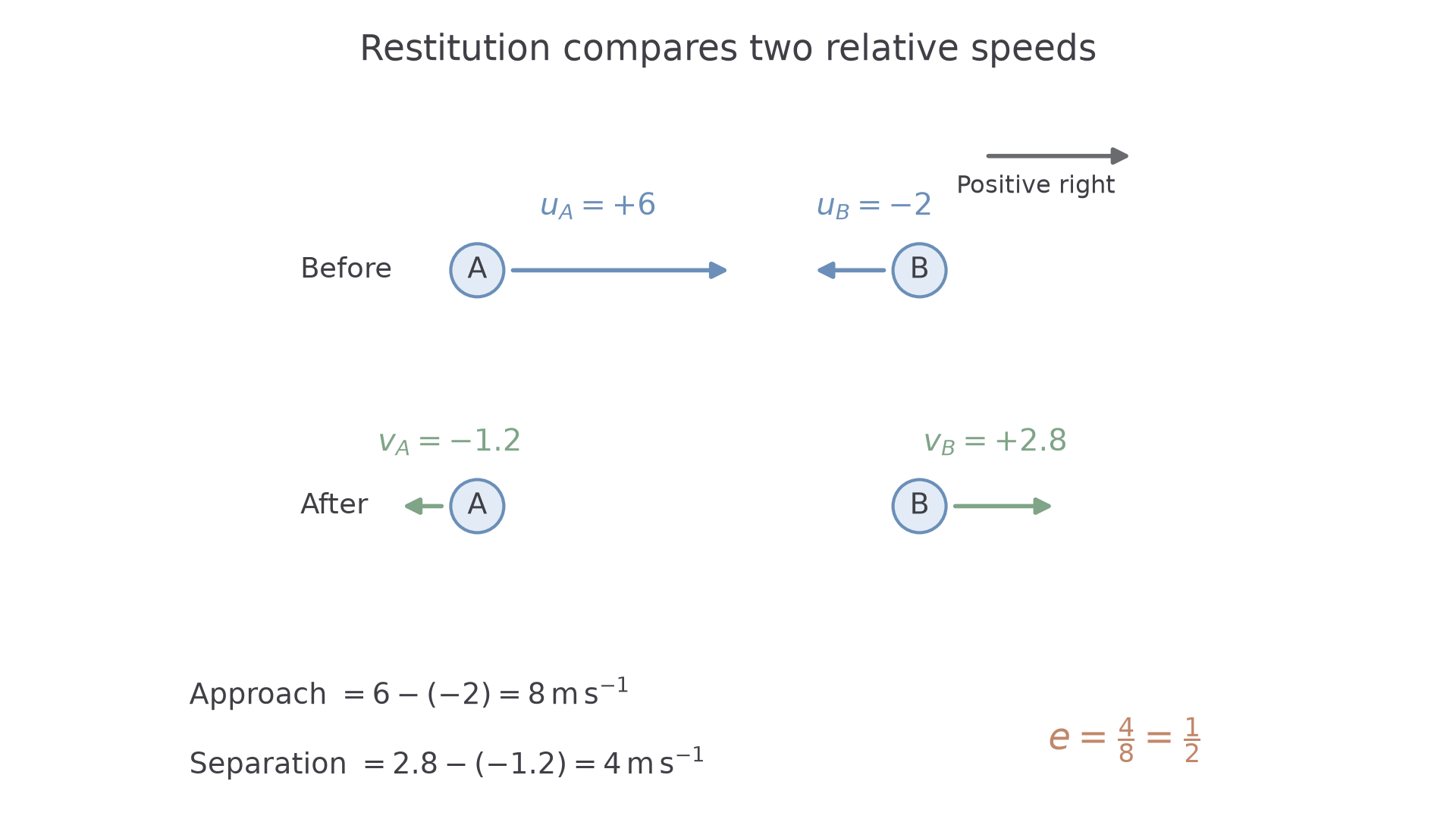
At , “perfectly elastic” describes the collision's energy behaviour; it does not say the objects are connected by a spring. At , common motion can retain kinetic energy even though relative motion has disappeared.
Key idea
Restitution scales relative separation speed, not each body's outgoing speed and not the system's kinetic energy.
Use that precise meaning in the check.
Direct impact with a fixed wall
A fixed wall has zero velocity before and after contact, so the relative speeds are just the particle's approach and rebound speeds.
Take towards the wall as positive. For an incoming velocity , a rebound velocity is negative.
A fixed-wall rebound
For direct impact with a fixed wall,
Thus rebound speed is . At , the particle has zero velocity immediately after impact. The impulse on mass is
under the same sign convention.
Not in the formula booklet: learn it.
The wall supplies an external impulse to the particle. Use restitution and impulse–momentum; do not conserve the particle's own momentum through impact.
Worked example 1: a fixed-wall rebound
Question. A particle moves directly towards a fixed wall at . The coefficient of restitution is . Find its velocity immediately after impact.
Plan. Choose towards the wall positive and use the wall's zero velocity in the restitution law.
Why this step? Restitution gives a speed; the coordinate convention supplies the outgoing velocity's negative sign.
Answer. away from the wall.
Check. The speed ratio is .
Change only the coefficient to . The more elastic rebound has a larger outgoing speed.
Worked example 2: a different coefficient
Question. The same incoming particle has coefficient of restitution with the wall. Find its outgoing velocity.
Plan. Use the same positive direction and change the speed ratio.
Why this step? A larger increases the speed away from the wall; it does not reverse the meaning of the positive direction.
Answer. away from the wall.
Check. , with as required.
For this fixed-wall model, kinetic energy after impact is times the initial kinetic energy, since . This derived energy ratio is not printed in the booklet. It applies to a fixed-wall rebound; it is not generally the energy ratio for two freely moving bodies.
Watch out
Wrong: write on an axis pointing towards the wall. Right: . The rebound reverses direction.
Use the new coefficient to find both the rebound and the wall impulse.
Two-body impact equations
For two freely moving bodies, combine momentum conservation with restitution: one equation controls the mass-weighted total, and the other controls the relative velocity.
Use one positive direction for all four velocities. Unless a direction is explicitly given, treat the outgoing velocities as signed unknowns. A negative solution is a rebound, not a failure of the method.
The two direct-impact equations
For masses , with negligible external impulse and initially left of ,
The bodies must approach initially, so ; afterwards .
Not in the formula booklet: learn it.
The final inequality checks that the gap is not still closing at the end of the modelled impact.
Continue this lesson.
You’re previewing NovaLearn without an account. Create a free account to read the rest.
Create free account