Md1–Md5 - Modelling friction
Md1–Md3 describe normal contact, friction and their resultant, with a model that distinguishes resting from sliding. Md4 derives the condition for impending slipping on a slope, and Md5 applies Newton's laws with friction in the correct direction.
Contact has normal and tangential components
Would doubling a block's mass make it start slipping down the same rough slope at a smaller angle? More weight pulls it downhill, but more weight also presses it against the surface. We will find which effect wins in this friction model.
You already know
A body's weight is , vertically downwards. Use unless told otherwise. Newton's second law relates the resultant force on one body to its acceleration: along a chosen direction.
Contact between two surfaces can exert two perpendicular components on the body you are modelling. The normal contact force, or normal reaction, acts perpendicular to the surface. Friction acts along the surface, opposing sliding or the tendency to slide relative to it. A smooth surface is modelled as frictionless.
[DIAGRAM: asset_name: Contact force and its two components; asset_slug: h645_b056_contact; caption: Normal reaction and friction are perpendicular components of one total contact force; description: A block on horizontal rough ground has upward normal reaction R, leftward friction F, rightward applied force P and downward weight W. A separate vector triangle adds leftward F and upward R to a diagonal total contact force C. It states C squared equals R squared plus F squared.]
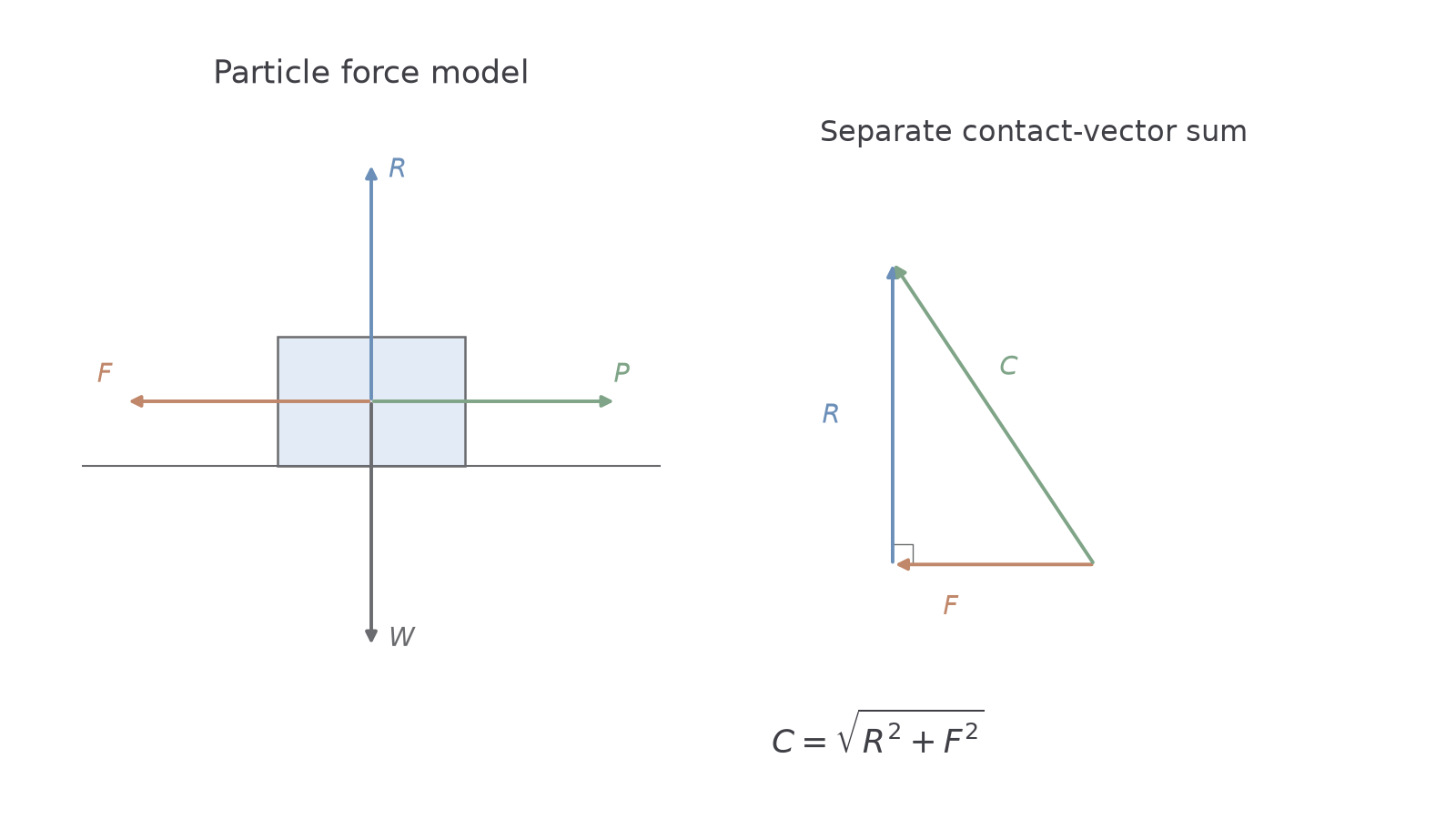
Total contact force
The total contact force is the vector sum of the normal reaction and the frictional force. If their magnitudes are and , its magnitude is
For example, , give , not . With no friction, the total contact force is just the normal reaction.
The magnitude relation is Pythagoras' theorem and is not in the formula booklet: learn it. If the direction is required, define the reference line: the angle between the total contact force and the normal satisfies , for . The complementary angle is the angle to the plane; confusing those two reference lines gives the wrong direction.
The normal reaction need not equal the weight. On a horizontal surface, an upward component of a pull reduces ; a downward push increases it. A non-adhesive surface can push but cannot pull, so . A calculation giving means the assumed contact cannot be maintained.
Key idea
Draw either the total contact force or its normal and frictional components on a force diagram. Drawing all three as separate forces would count the same contact twice.
A force diagram shows forces on the selected body only. Its equal-and-opposite forces on the surface belong to the surface's diagram, not to the block's.
Resting friction adjusts up to a limit
A rough surface does not automatically exert its maximum friction. A book resting on a horizontal table with no horizontal force has friction , even though the surfaces are rough. When a small horizontal push is applied, friction can adjust to balance it.
The friction model
For coefficient of friction and normal reaction , a resting contact can supply a frictional magnitude satisfying
At limiting equilibrium, when sliding is just about to occur, . During sliding, this course models the frictional magnitude by , directed against the relative sliding velocity.
Not in the formula booklet: learn it.
The coefficient is dimensionless. Its value is the limiting ratio in this model; there is no general restriction . Treating it as constant and using the same simple relation throughout sliding are modelling assumptions, not claims that every real contact behaves identically at every speed or condition.
Worked example 1: friction below its maximum
Question. A particle of weight rests on a rough horizontal surface with . A horizontal force of acts to the right. Determine whether equilibrium is possible and find the friction if it is.
Plan. Find the normal reaction, calculate the friction needed for equilibrium, then compare it with the maximum.
Why this step? Equilibrium determines the actual friction; only checks whether the surface can supply it.
Answer. Equilibrium is possible, with friction to the left. The contact is not limiting.
Check. The horizontal resultant is , and .
Change only the horizontal push, from to . The normal reaction and friction limit stay the same.
Worked example 2: more friction is required than available
Question. For the same particle and surface, a horizontal force of acts to the right. Determine whether it can remain at rest.
Plan. Compare the equilibrium requirement with the unchanged maximum friction.
Why this step? Writing would describe a force the model cannot supply. Once sliding starts, its modelled magnitude is , not .
Answer. It cannot remain at rest; it begins sliding to the right.
Check. During rightward sliding, the horizontal resultant is to the right, consistent with the predicted motion from rest.
At exactly , the particle is in limiting equilibrium. Equality describes the threshold; strict inequality describes a reserve of available friction.
Watch out
Wrong: “The body is at rest, so .”
Right: resting friction satisfies . Use equality only at a specified or established limiting case, or during modelled sliding.
Check the required force first, before assigning a friction value.
The slope at the point of slipping
Consider a particle on a plane inclined at to the horizontal, acted on only by its weight and the plane's contact force. Resolve parallel and perpendicular to the plane. Weight supplies downhill component and inward normal component .
Continue this lesson.
You’re previewing NovaLearn without an account. Create a free account to read the rest.
Create free account