Pa2 - Equations with transformed roots
You can move or rescale every root of a cubic or quartic without finding any root individually. Pa2 uses a linear relation between an old root and a new one to build the new equation by substitution. You will handle shifts, scale factors and their combinations, keeping all roots and simplifying the final coefficients.
Moving every root by the same amount
The cubic has roots , , . What equation has roots , , ? You do not need to solve the original cubic first.
Call an old root and its corresponding new root . The requested change is , so the old value is . Substitute that old value into the original equation. Whenever is a requested new root, is an old root and makes the original polynomial zero.
You already know
If roots have sum , the coefficient of the next-highest power in a monic polynomial is . Multiplying an equation by a non-zero constant does not change its roots. A repeated root is counted with its multiplicity.
The picture makes the direction clear. Moving roots to the right by requires evaluating the old polynomial at an input smaller.
[DIAGRAM: asset_name: Shifting all three roots; asset_slug: transformed_roots_shift; caption: Replacing the input by y minus 2 moves every root two units to the right; description: Two equal-scale graphs show f(x) equals x cubed minus 3x squared minus x plus 3 with roots minus 1, 1 and 3, and g(y) equals f(y minus 2) with roots 1, 3 and 5. Matching root labels and horizontal dimension arrows identify the shift of 2. The second graph has the same shape translated two units right.]
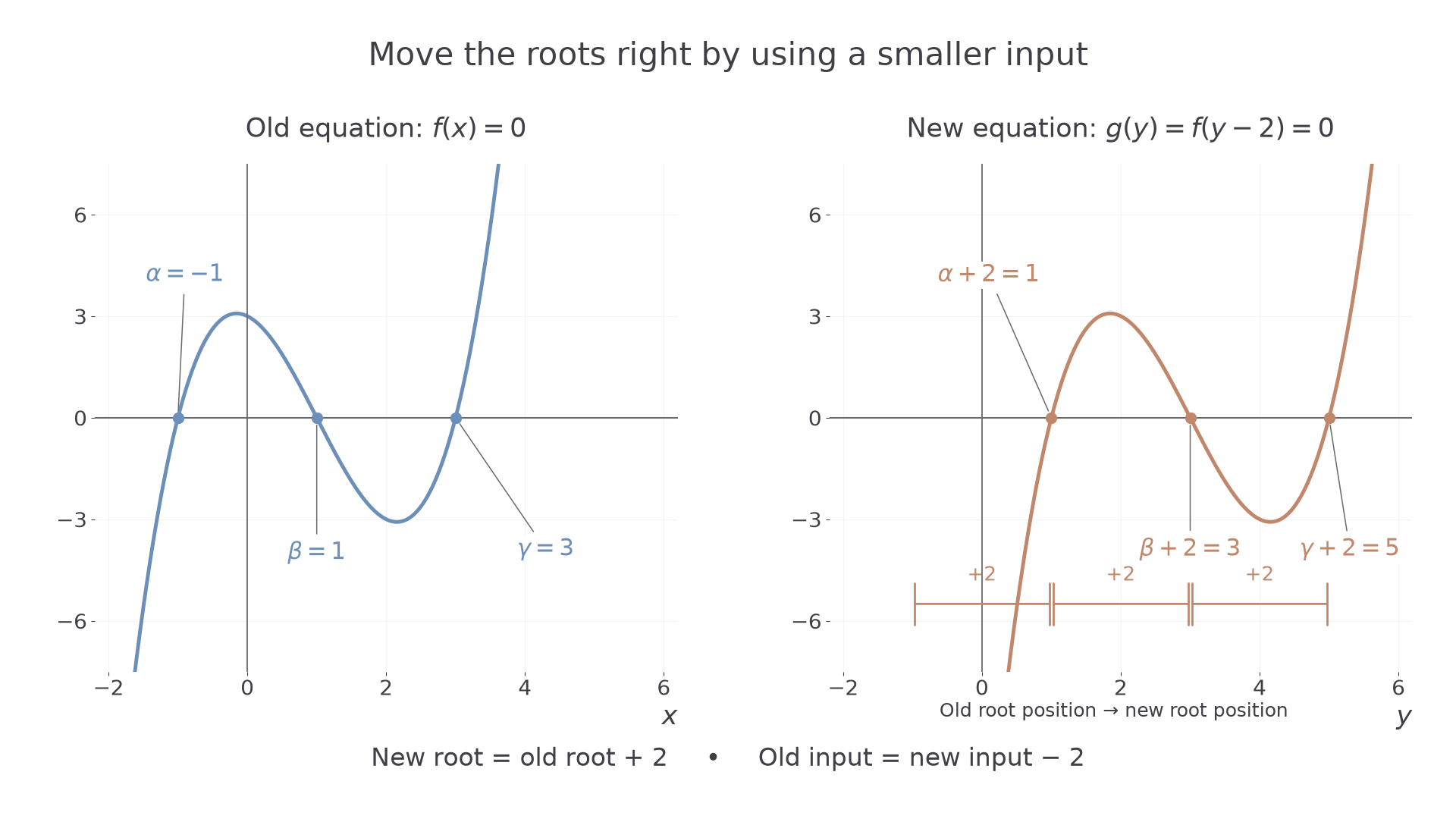
Use an inverse substitution: describe the new root, then rearrange for the old one.
Shifting roots
If is a cubic or quartic and the required roots are each old root plus , set
The new equation is
The substitution is reversible, so each old root gives a new root and each new root comes from an old root, with multiplicities preserved.
Not in the formula booklet: learn it.
Keep the substituted expression bracketed until every power has been expanded. The shift affects the entire input, not only the leading term.
Worked example 1: shifting roots to the right
Question. The roots of are , , . Determine a cubic equation whose roots are , , .
Plan. Write , rearrange to , substitute, expand and collect powers of .
Why this step? Substituting , rather than , ensures that the new root sends the original polynomial back to its root .
Answer. .
Check. The old root sum is , so the new sum is , matching the coefficient . Also, the factorisation shifts to , which expands to the same result.
Worked example 2 changes only the direction of the shift: subtract from each old root. The sign inside the substitution reverses too.
Worked example 2: shifting roots to the left
Question. Find an equation whose roots are , , , for the same original cubic.
Plan. Start with , so , then substitute into the original equation.
Why this step? Moving the roots left uses the old value , because adding to a new root recovers its old position.
Answer. .
Check. The new root sum is , matching the coefficient . The shifted factors are .
The sign error is easy to detect before expanding anything: put one requested new root into your substituted input.
Watch out
Wrong: for new roots , substitute . Then gives , which need not be an old root. Right: gives , exactly as required.
The next cubic and shift are different. Show the inverse relation before expanding.
Multiplying every root by a scale factor
If every new root is times an old one, divide the new variable by before putting it into the original polynomial.
For example, a desired new root must become inside the original polynomial. Its input must therefore be . Multiplying out afterwards may introduce fractions, but these can be cleared by multiplying the whole equation by a suitable non-zero constant.
Scaling roots
For a cubic or quartic and a non-zero scale factor ,
The equation with scaled roots is
For degree , where or , multiplying by clears powers of from the denominators. This changes no root because .
Not in the formula booklet: learn it.
A factor such as in the input is raised to the power of each term. It does not multiply the whole polynomial uniformly.
Worked example 3: doubling all roots
Question. The roots of are , , . Determine a cubic equation with integer coefficients whose roots are , , .
Plan. Substitute , then multiply the entire equation by .
Why this step? The cubic term has denominator , so multiplying the whole equation by clears every denominator at once.
Answer. .
Check. The original sum doubles to . The original product is , and three doubled roots have product , matching the new constant .
Worked example 4 changes only the scale factor from to . The inverse substitution now multiplies the input by .
Worked example 4: halving all roots
Question. Find a cubic equation with integer coefficients whose roots are , , , for the same original cubic.
Plan. Use , so , then substitute and simplify.
Why this step? Halving the roots means that twice a new root is an old root. Substituting would double the roots instead.
Answer. .
Check. The coefficient ratios give root sum and product , half the old sum and one eighth of the old product.
For the boundary case , every requested new root is zero, so the required equation is or , according to the number of roots. The inverse substitution is unavailable because division by zero is undefined; form that special equation directly.
Watch out
Wrong: . Right: . Each power acts on the whole substituted fraction, including its denominator.
The next polynomial is not monic, and its scale factor is . Preserve its leading coefficient when clearing denominators.
Combining a scale factor and a shift
A relation such as changes both the scale and the position of each root, so rearrange the complete relation before substituting.
The order matters. Halving gives , whereas halving and then adding gives . Read the brackets in the requested roots exactly as printed.
A general linear transformation of roots
For a cubic or quartic , let every new root be , where . Rearranging gives
so the required equation is
Clear denominators with a non-zero constant and simplify. If , all new roots equal ; form or directly.
Not in the formula booklet: learn it.
You may also construct the new root sums and products, but substitution keeps the whole relationship in one place. It is particularly helpful when fractions and translations occur together.
Worked example 5: halving after adding one
Question. The cubic has roots , , . Determine a cubic equation with integer coefficients whose roots are , , .
Plan. Rearrange , substitute , then collect and remove a common constant factor.
Why this step? Dividing by preserves every root; dividing by would lose the root .
Answer. .
Check. The original equation has root , which transforms to ; the new constant is correctly zero. Its root sum is , matching .
Worked example 6 changes only the in the requested roots to . The rearranged substitution changes from to .
Worked example 6: halving after subtracting one
Question. For the same original cubic, determine an equation with integer coefficients whose roots are , , .
Plan. Rearrange , substitute , then simplify the resulting equation.
Why this step? The final in the original polynomial stays outside the substituted expression. Only occurrences of are replaced.
Answer. .
Check. The old root becomes . Substitution gives . The new root sum is , matching the coefficient ratio .
A requested equation must remain an equation after simplification.
Exam tip
End with the polynomial equal to zero, using integer coefficients when requested. You may change its variable name, or multiply it by a non-zero constant, but a polynomial expression alone does not state the required equation.
The next root relation adds and divides by . Work backwards through those operations before expanding.
Watch out
Wrong: from , substitute . That applies the change again instead of undoing it. The correct rearrangement is , so .
Rearrange the next complete root relation before replacing any occurrence of the old variable.
Transforming quartics and checking coefficients
A quartic follows exactly the same inverse-substitution rule; the extra power makes organised expansion and a coefficient check more valuable.
For a cubic, a shift by changes the root sum by . For a quartic it changes it by . In general, for these degrees, a transformation changes a root sum to , where is the number of roots counting multiplicity. This gives an independent check on the next-highest coefficient after expansion.
Checking the transformed root sum
For a cubic or quartic with roots, or , and transformed roots ,
The transformed sum must equal minus the ratio of the next-highest coefficient to the leading coefficient in the new equation.
Not in the formula booklet: learn it.
For expansion, first clear denominators while retaining brackets. Then work from the highest power down, grouping coefficients of the same power together.
Worked example 7: a quartic with scaled and shifted roots
Question. The roots of are , , , . Determine an equation with integer coefficients whose roots are , , , .
Plan. Substitute , multiply the equation by , expand and check the root sum.
The needed expansions are
Collecting gives
Why this step? Multiplying before expanding leaves integer coefficients outside each bracket, which makes the powers and signs easier to track.
Answer. .
Check. The old root sum is , so the new sum is , matching the coefficient . At , the substituted input is , and both sides of the polynomial identity give .
Worked example 8 changes only the translation from to . This time the new root sum is zero, so the cubic term should disappear.
Worked example 8: making the cubic term disappear
Question. For the same original quartic, determine an equation whose roots are , , , .
Plan. Substitute , clear denominators and check for a zero root sum.
Using the positive-sign binomial expansions,
Why this step? The missing cubic term is predicted by the transformed sum . It is a mathematical feature, not an omitted term.
Answer. .
Check. At , the old input is . The new polynomial gives , agreeing with the substituted identity.
Here is a useful surprise: you can always remove the next-highest term of a cubic or quartic by subtracting the mean of its roots from every root. The new sum is zero even when you do not know the individual roots. For a cubic use the old sum divided by ; for a quartic divide by . This follows directly from the root-sum check above and is not in the formula booklet: derive it when needed.
Watch out
Wrong: cancel a factor from the transformed equation because every term contains it. That removes the root . Right: divide only by a known non-zero constant when simplifying an equation intended to retain the complete root list.
The opening question needed no root solving: substituting produced . The quartic method is the same operation with one additional power to expand.
In the final check, the original quartic is not monic. Keep its leading coefficient until the final common constant is removed.
Quick Recap
- Name a new root , write its relation to an old root , and rearrange for before substituting.
- A shift by uses ; scaling by non-zero uses .
- A combined change uses . The method works for cubics and quartics without finding their individual roots.
- Clear denominators and simplify using non-zero constants. Preserve zero roots and repeated roots, and finish with an equation equal to zero.
- Check the new root sum against the next-highest coefficient: it is .
For the opening cubic, the equation with roots , , is .