Xa7, Xa8 - Isomorphic groups
Groups can describe different objects while obeying exactly the same combination rules. Xa7 recognises that common structure; Xa8 specifies an isomorphism, proves it preserves the operation, and uses element orders to rule out impossible correspondences.
Recognise the same operation behind different labels
What could adding one on a four-position dial have in common with multiplying by or rotating a square through a quarter-turn? Each action takes four repetitions to return to the identity. More is true: we can pair up the elements so that every combination agrees.
You already know
A finite cyclic group is generated by one element, whose order equals the group order. Subgroups use the original operation. A composition performs first, then , matching matrix multiplication .
Pair the additive residues with , respectively. For example, corresponds to . The identity changes its label from zero to one, but its role is preserved.
Isomorphism
An isomorphism from to is a bijection that preserves the operation:
A bijection assigns each element of to exactly one element of , with every element of used exactly once. If such a map exists, the groups are isomorphic.
There are two jobs: match the elements one-to-one, and show that combining before mapping agrees with mapping before combining. A list pairing equal-sized sets deals with the first job only. One successful product is a check, not a proof for all products.
[DIAGRAM: asset_name: One four-step structure in three models; asset_slug: h645_b142_correspondence; caption: Identities and successive generator steps correspond across residues, roots of unity and square rotations; description: Three rows list additive residues zero, one, two, three; complex numbers one, i, minus one, minus i; and square rotations I, R, R squared, R cubed. Vertically aligned arrows pair each column. A note shows three plus two modulo four equals one corresponding to minus i times minus one equals i and R cubed composed with R squared equals R.]
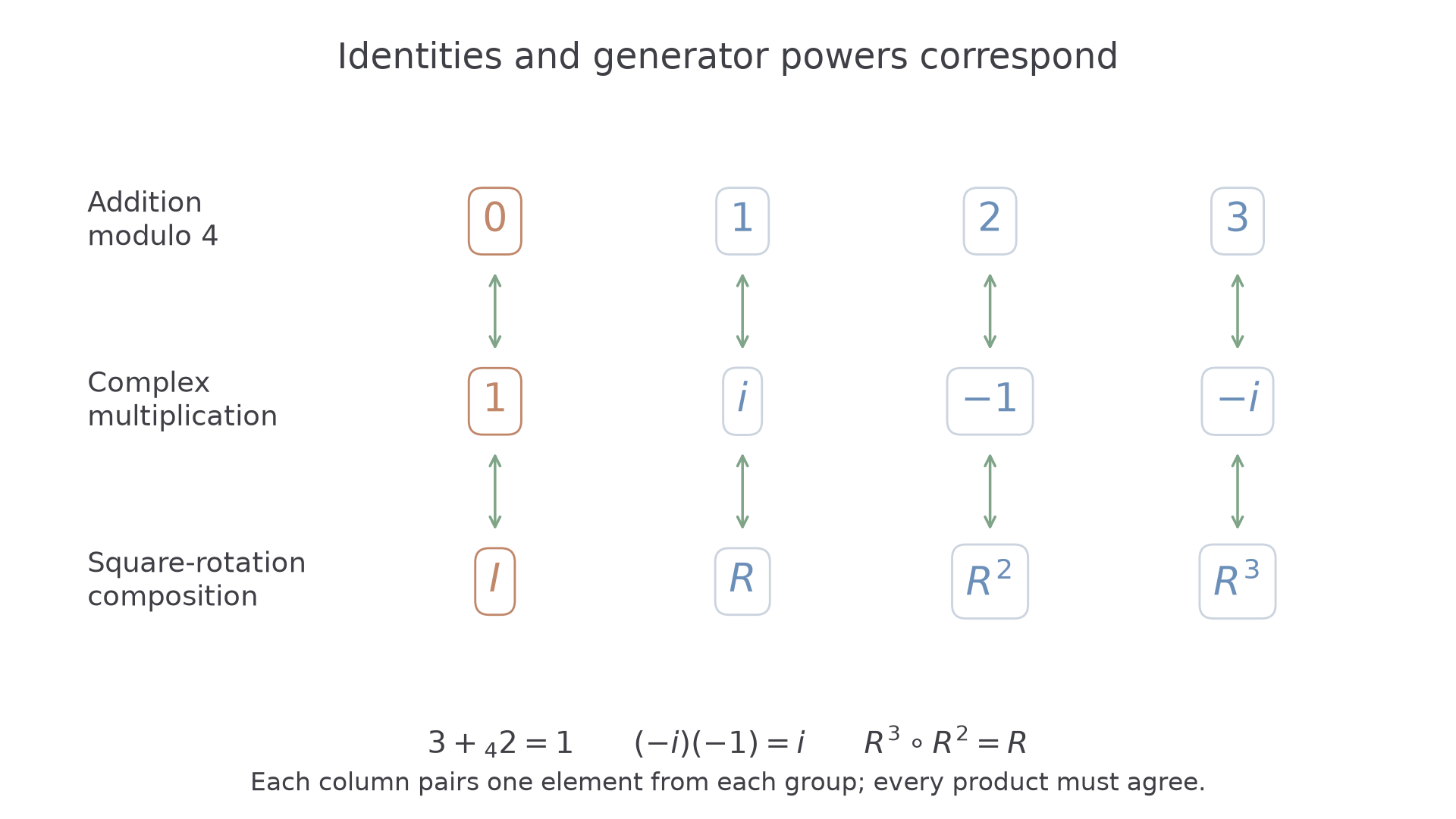
Isomorphisms preserve identities, inverses and element orders. For example, ; surjectivity lets run through all of , so . Similarly, . A first identity return must occur at the same step in both groups, because the map is one-to-one.
These definitions and properties are not printed in the formula booklet. They explain why the label can legitimately correspond to : preserve the identity's role rather than its written value.
Specify an isomorphism by matching generators
For finite cyclic groups, one generator determines the whole correspondence. If and both have order , send to . The exponents are read modulo , so the rule is well-defined: two expressions for the same source element differ by a multiple of and give the same target element.
Finite cyclic groups of equal order
Two finite cyclic groups of the same order are isomorphic. Given generators , an isomorphism is
It is a bijection because these are all the distinct elements of each group. It preserves products because
Not in the formula booklet: learn it.
In an additive source group, a generator's repeated sums take the place of powers. Its identity must map to the target identity. Choose a generator of the target, not an element that produces only a proper subgroup.
Worked example 1: addition becomes modular multiplication
Question. Let and let , where is multiplication modulo . Specify an isomorphism sending to , and justify it.
Plan. List the powers of modulo , then use exponent addition to prove the product condition.
Why this step? The first row uses addition modulo six, while the second uses multiplication modulo seven; ordinary equality of numerical labels is irrelevant.
Answer. The table, or equal to the remainder of modulo , specifies an isomorphism. It is bijective and preserves every product as shown.
Check. maps to ; agrees.
Change only the image of the source generator: send to instead of . A different generator can give a different isomorphism.
Worked example 2: a second valid correspondence
Question. Construct and justify this second isomorphism .
Plan. Repeat the generator construction with powers of , checking that all target elements appear.
Why this step? A changed generator image forces new images for every element; changing only one table entry would generally destroy operation preservation.
Answer. is the remainder of modulo . The table gives a bijection, and the displayed general identity proves it is an isomorphism.
Check. It differs from , since whereas , but both send zero to one.
If we tried , powers would repeat after three steps, missing half of . The proposed map could not be bijective. Matching the source generator's order prevents that error.
Watch out
Wrong: for the map from addition modulo six to multiplication modulo seven.
Why: an isomorphism preserves the identity's role, not its numerical label; the target identity is .
Right: . Choose the image of a generator, then extend the map consistently to every element.
Use the same identity and generator logic for a target written with complex roots instead of modular residues.
Match transformations to matrices
A linear transformation's matrix records what it does to every vector. Therefore a faithful assignment of distinct transformations to their matrices is more than a resemblance between tables: composition corresponds to multiplication for every input vector.
For square rotations let be an anticlockwise quarter-turn, and put
The two groups are under composition and under multiplication. Their identity symbols denote different kinds of objects.
Continue this lesson.
You’re previewing NovaLearn without an account. Create a free account to read the rest.
Create free account