Pj4, Pj5 - Complex arithmetic and equating parts
In this lesson you add, subtract, multiply and divide complex numbers given in the form , and you use the fact that a complex number is zero only when its real and imaginary parts are both zero to turn one complex equation into two real ones. Along the way you find the square roots of .
Adding, subtracting and multiplying
Which complex numbers square to give ?
You can already find the square roots of any negative number: has the two square roots and . But is not a negative number, or even a real one, so that rule does not help. To test a guess you must be able to multiply complex numbers, which is the job of this section. To find the answer without guessing you need one more idea, which comes in the last section.
You already know
A complex number has real part and imaginary part , both real numbers, and . You expand brackets by multiplying every term in one bracket by every term in the other.
You add, subtract and multiply complex numbers exactly as you handle brackets in algebra, treating like a letter and then replacing by .
Adding and subtracting combine the real parts and the imaginary parts separately: and . Multiplying uses all four products from the two brackets, just as . The one new step is that the term in becomes real: .
A grid keeps track of the four products. Here it is for :
[DIAGRAM: asset_name: Multiplying two complex numbers with a grid; asset_slug: complex_product_grid; caption: A grid shows the four products when two complex numbers are multiplied, and the i squared term turning real; description: A two by two grid multiplies 2 plus 3i, down the side, by 4 minus i, along the top. The cells hold 8, minus 2i, 12i and minus 3i squared, which equals plus 3. The cells 8 and plus 3 are shaded blue as real terms, the cells minus 2i and 12i are shaded lavender as imaginary terms, and the plus 3 cell has an ochre border with the note that i squared equals minus 1 turns this term real. A side panel adds the real terms, 8 plus 3 equals 11, and the imaginary terms, minus 2i plus 12i equals 10i, giving the product 11 plus 10i.]
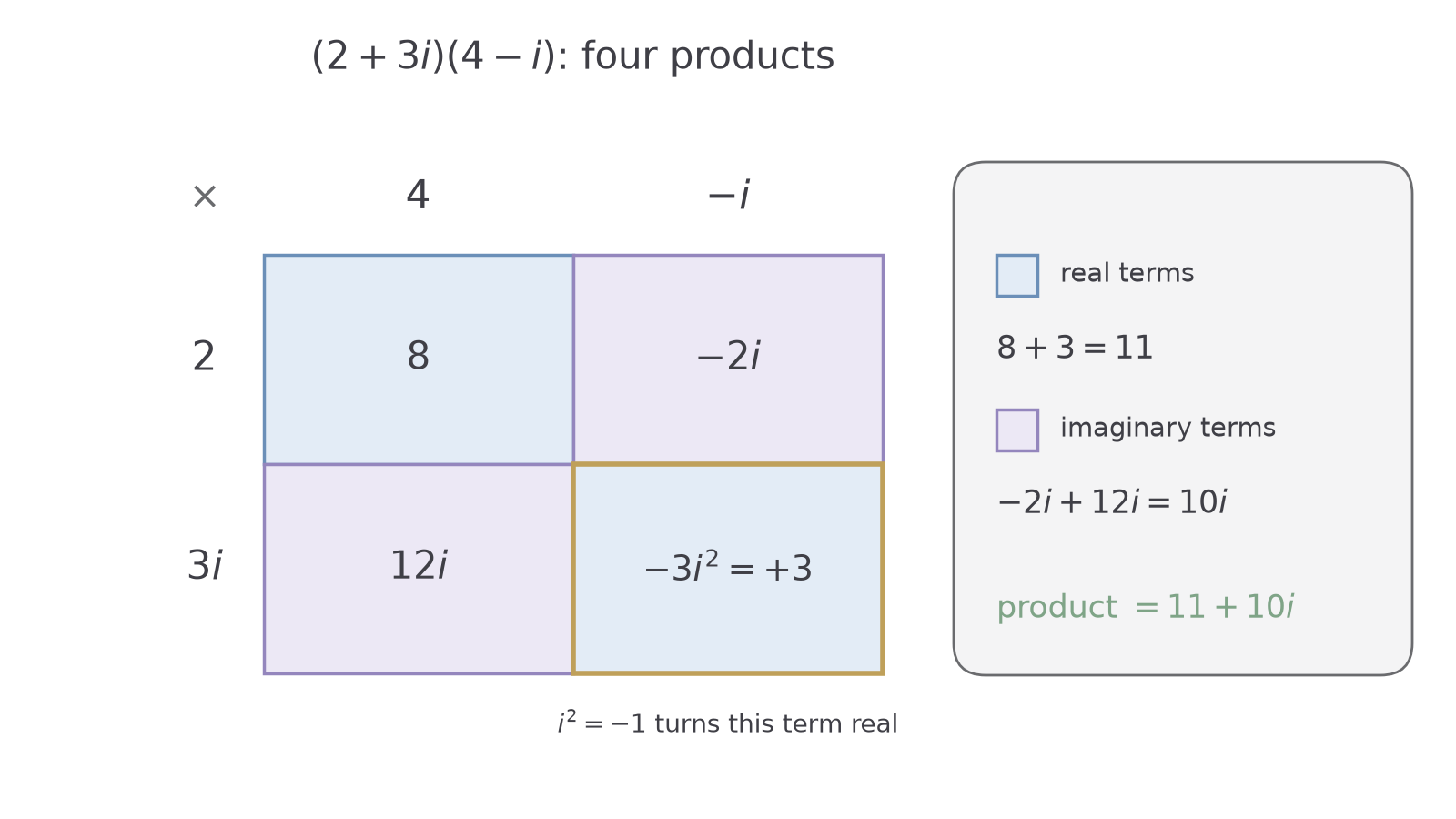
The same expansion tests a first guess at a square root of : . That is twice , so is close but not right.
Sum, difference and product
For real , , and :
In practice you expand the brackets and use ; the product formula is what that method always gives.
Not in the formula booklet: learn it.
Worked example 1: sum, difference and product
Question. Given and , find , and in the form .
Plan. Combine like parts for the sum and the difference. For the product, expand all four products, then use .
Why this step? The term is real. It equals , so it joins the real part.
Answer. , and .
Check. The product formula gives real part and imaginary part
Worked example 2 changes one feature: the number is raised to a power. A power is repeated multiplication of the whole number, so you multiply in stages.
Worked example 2: a cube, in stages
Question. Show that .
Plan. Square first, then multiply the result by once more.
Why this step? Cubing the two parts separately would give , which leaves out every cross term. Each stage must multiply the whole of one number by the whole of the other.
Answer. , as required.
Check. The binomial expansion gives
This exact calculation has a famous history. Cardano's formula for the cubic equation produces , even though the equation has the obvious root . In his book L'Algebra (1572), Rafael Bombelli saw that and , so the expression is just . A route through imaginary numbers had led to a real answer.
Watch out
The commonest slip is the sign of the term.
Wrong:
Right: , so the product is
Write the term on its own line before you simplify it.
Subtraction causes the other frequent error: the minus sign applies to both parts of the second number, so keep that number in brackets until you have removed them.
Exam tip
A one-mark “Find in the form ” part is marked B1 cao. There is no method mark, so one sign slip scores zero. Write the second number in brackets, for example , and simplify both parts fully.
Dividing complex numbers
To divide by a complex number, multiply the numerator and the denominator by the conjugate of the denominator, so that the denominator becomes a real number.
You already know
To rationalise a surd denominator, you multiply the top and bottom by the conjugate surd:
For a complex number , the product is real in the same way.
Multiplying the top and the bottom of a fraction by , the conjugate of the denominator, does not change the value of the fraction, because you are multiplying by . It does turn the denominator into the real number , and dividing by a real number is easy: divide each part.
A quick case first. To work out , multiply the top and bottom by . The denominator becomes , so .
Dividing by a complex number
For complex numbers and with :
where is a real number.
Not in the formula booklet: learn it.
Worked example 3: dividing two complex numbers
Question. Express in the form .
Plan. Multiply the top and bottom by , the conjugate of the denominator, then split the result into its real and imaginary parts.
Why this step? Multiplying by on the top and the bottom multiplies the fraction by 1, so its value is unchanged, and the denominator becomes the real number 5.
Answer.
Check. Multiply back:
Worked example 4 changes one feature: surds appear in the imaginary parts, and the question carries the instruction to show detailed reasoning. Take care when squaring a surd times : .
Worked example 4: division with surds, showing detailed reasoning
Question. In this question you must show detailed reasoning. Express in the form .
Plan. Multiply the top and bottom by , the conjugate of the denominator, and write out the expansion in full.
Why this step? The denominator is . In the numerator, .
Answer.
Check.
Watch out
You cannot divide the real parts and the imaginary parts separately.
Wrong:
Right:
Dividing part by part works only when the denominator is real.
The instruction “In this question you must show detailed reasoning” changes what earns marks, so it deserves its own habit.
Exam tip
Under detailed reasoning, write the multiplication by the conjugate as a line of working, then the expanded numerator over the real denominator, then the answer. Examiners withhold marks when that line is missing, and an answer read from a calculator's complex mode scores nothing.
Equating real and imaginary parts
A complex number is zero only when its real part and its imaginary part are both zero, so one equation between complex numbers gives two equations between real numbers.
Start with a concrete case. Suppose and are real and . A real part cannot cancel an imaginary part, so both brackets must be zero: and .
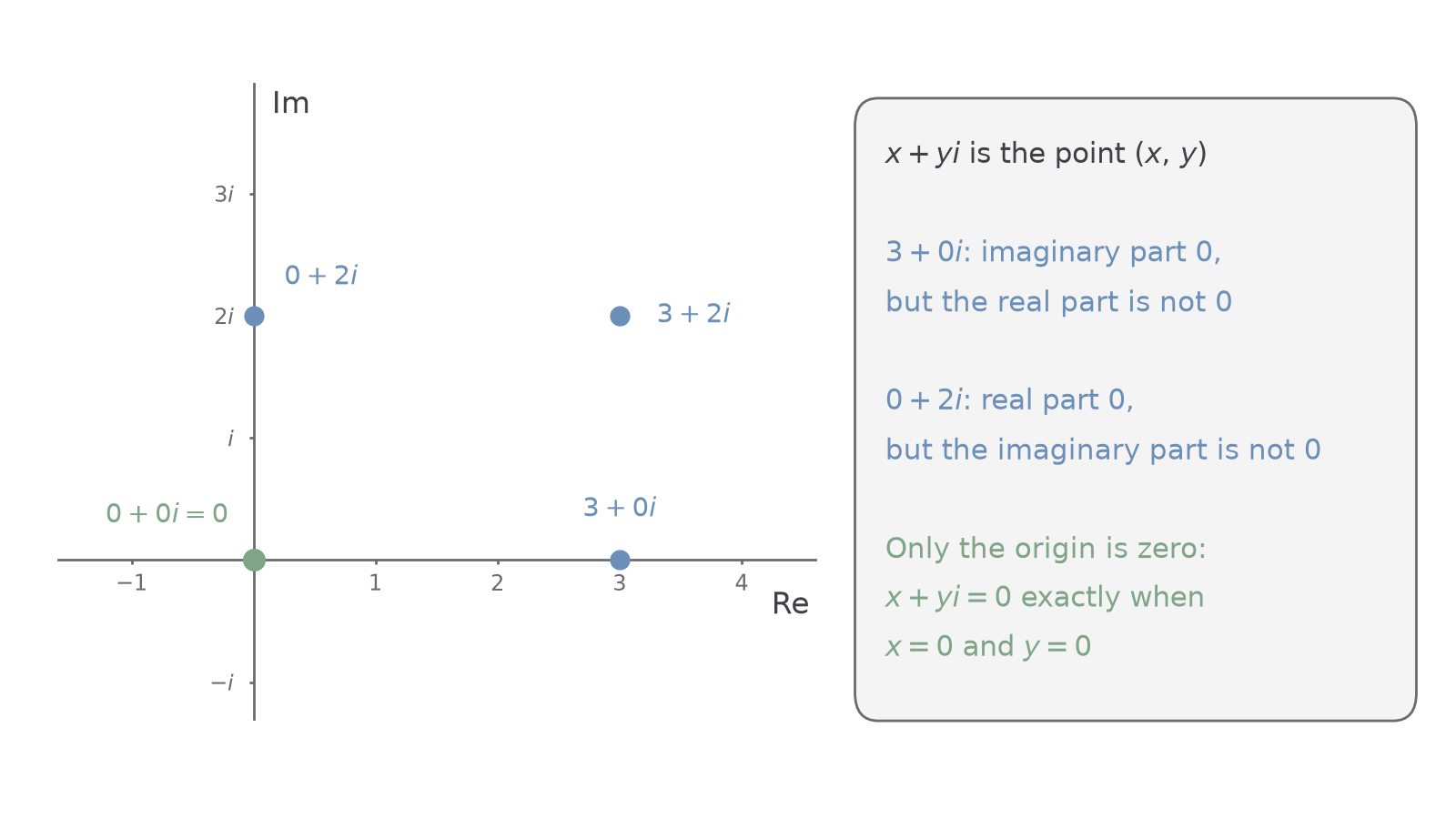
Why can a real part never cancel an imaginary part? Suppose , where and are real and . Then , which is a real number. The square of a real number is never negative, but . That is impossible, so , and then as well. On an Argand diagram the same fact is easy to see: the number is the point , and only the origin is zero.
[DIAGRAM: asset_name: Only the origin is zero; asset_slug: zero_only_at_origin; caption: A complex number is zero only at the origin, where both parts are 0; description: An Argand diagram with axes labelled Re and Im. The origin is marked in green and labelled 0 plus 0i equals 0. Blue points mark 3 plus 0i on the real axis, 0 plus 2i on the imaginary axis and 3 plus 2i. A side panel says that x plus yi is the point (x, y), that 3 plus 0i has imaginary part 0 but a real part that is not 0, that 0 plus 2i has real part 0 but an imaginary part that is not 0, and that only the origin is zero: x plus yi equals 0 exactly when x equals 0 and y equals 0.]
Zero and equal complex numbers
For real , , and :
The second line follows from the first, applied to . Every letter must be real.
Not in the formula booklet: learn it.
Using this is called equating real and imaginary parts. Write each side in the form , with and real, then write one equation for the real parts and one for the imaginary parts.
Worked example 5: real coefficients from a complex root
Question. Given that is a root of the equation , where and are real, find and .
Plan. Substitute , collect the real and imaginary parts, then set each one equal to 0.
Why this step? Because and are real, is the whole real part and is the whole imaginary part. If could be complex, would not be purely imaginary and this split would fail.
The expression equals 0, so both parts are 0:
Answer. and
Check. gives , so is a root
Worked example 6 changes one feature: the unknown is the complex number itself, and its conjugate appears too. Write first, so that the unknowns and are real and you can equate parts.
Worked example 6: an equation with a conjugate
Question. The complex number satisfies the equation . Determine , giving your answer in the form .
Plan. Write and , expand, equate real and imaginary parts, then solve the two equations simultaneously.
Why this step? The term equals , which is real, so it joins the real part even though it came from the imaginary part of .
Now equate parts with :
Answer.
Check. , so and
Watch out
Sort the terms by whether they contain , not by whether they contain or .
Wrong: from , real parts and imaginary parts
Right: real parts and imaginary parts
The that came from is real, and the in belongs to the imaginary part.
Questions like Worked example 6 usually say “Determine”, which means every step has to be visible.
Exam tip
Write on its own line, then the two equations labelled “real parts” and “imaginary parts”, before you solve them. The mark scheme for this type gives separate marks for , for using and for equating parts, and the final mark needs an equating step seen, so a correct answer with no working scores 0.
Back to the square root of i
Now the opening question has an answer. Suppose , with and real, and .
The number is , so equating parts gives
The first equation gives or . If , the second becomes , which has no solution because is real. So , and gives .
The square roots of are and . Check the first: . The first guess, , squared to ; dividing it by halves its square, which is exactly what this answer does.
Quick Recap
- Add and subtract by combining the real parts and the imaginary parts separately; multiply by expanding all four products and replacing by .
- Raise to a power in stages, multiplying the whole number each time.
- To divide, multiply the top and the bottom by the conjugate of the denominator, which makes the denominator the real number .
- For real and , only when and , so equal complex numbers have equal real parts and equal imaginary parts.
- For an equation in and , write and , then equate real and imaginary parts.
The square roots of are and .