Pv4–Pv6 - Intersections and angles of planes
Decide how three planes fit together, find their common point using an inverse matrix, and calculate the angle between two planes from their normals. You will distinguish a failed inverse calculation from a geometrical conclusion and see why the angle between planes needs no subtraction from a right angle.
The five arrangements of three planes
Three walls each meet the other two. Must all three share one point?
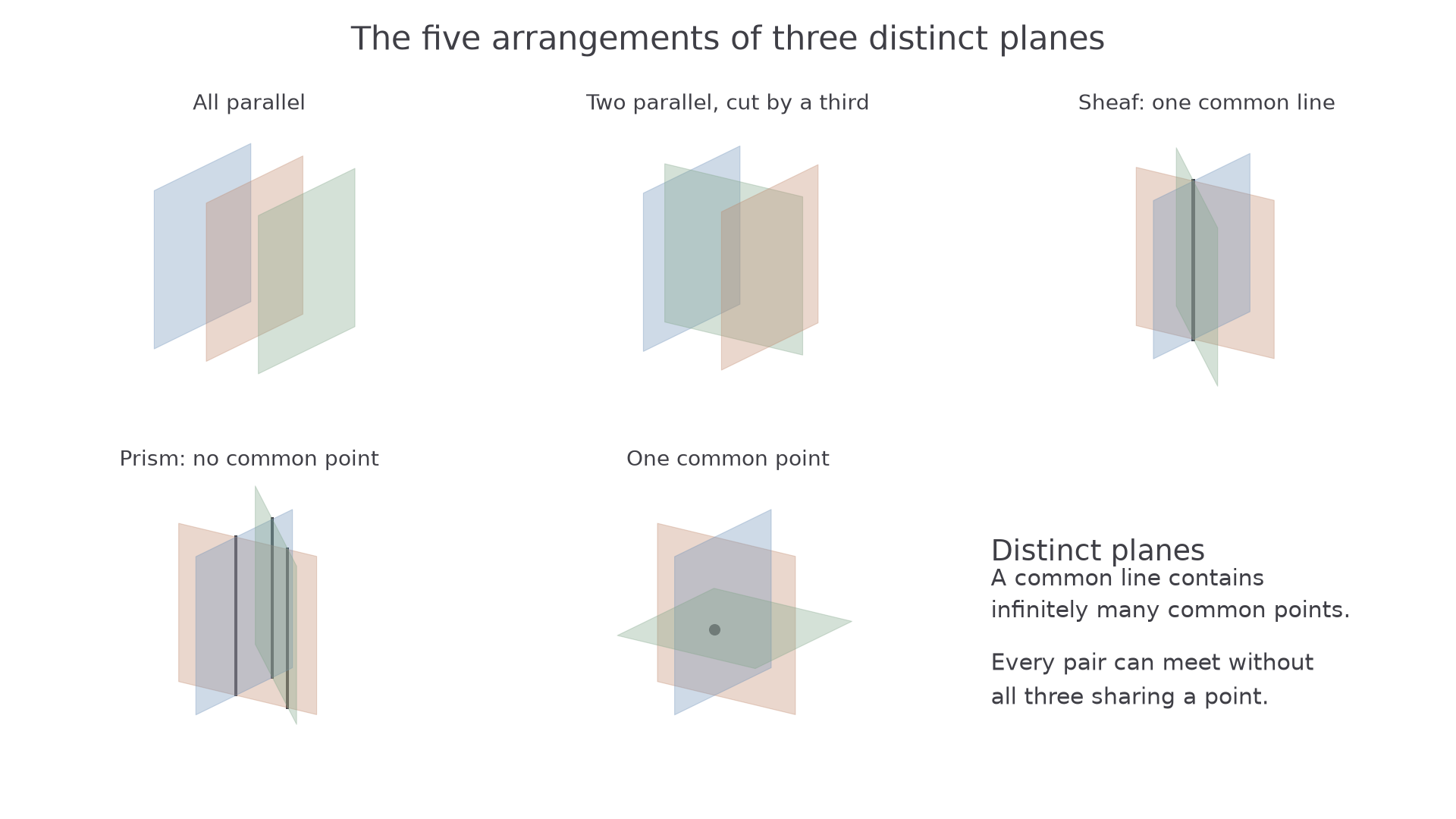
Imagine three vertical walls forming the sides of a triangular shaft. Every pair meets along an edge, yet no point belongs to all three walls. The pairwise intersections are three parallel lines. Pairwise meeting does not guarantee a common meeting: that is the trap in the opening question.
We consider distinct planes: no two equations describe the same plane. For example, and are two equations of one plane, so do not count as distinct planes.
[DIAGRAM: asset_name: Five arrangements of three planes; asset_slug: three_plane_arrangements; caption: Three distinct planes can have no common points, a common line, or one common point; description: Five labelled panels show three parallel planes, two parallel planes cut by a third, three planes meeting in a common line called a sheaf, three planes forming a triangular prism with parallel intersection lines, and three planes meeting at one point. Blue, clay and sage distinguish the three planes consistently.]
Sheaf and prismatic intersection
A sheaf consists of three distinct planes sharing a common line. A prismatic intersection has three pairwise intersection lines which are parallel and distinct; there is no point common to all three planes.
The complete list follows by asking first whether any pair is parallel. These simple equations give exact examples; in the vertical cases the free -coordinate extends the picture upwards and downwards.
| Arrangement | Example equations | Common to all three |
|---|---|---|
| All parallel | , , | Nothing |
| Two parallel, cut by the third | , , | Nothing |
| Sheaf; no parallel pair | , , | The whole -axis |
| Prism; no parallel pair | , , | Nothing |
| One point; no parallel pair | , , | The origin only |
For the sheaf, the third equation follows from the first two. For the prism, the first two force , contradicting the third. The normals alone are the same in these two cases; changing the constant changes the geometry.
Key idea
A non-zero coefficient determinant gives one common point. A zero determinant rules out a unique point, but does not by itself distinguish no common point from a common line.
This determinant criterion is not in the formula booklet: learn its geometrical meaning. If the matrix is singular, use the supplied information to distinguish the arrangements; never infer “parallel” simply because inversion fails.
Finding the common point by matrix inversion
A common point satisfies all three plane equations, so its coordinates are the solution of one matrix equation.
You already know
For a non-singular square matrix, gives . Matrix multiplication order matters. A singular matrix has no inverse.
Put the coefficients of each plane in one row, always in the same coordinate order. The constants go into a column in the matching equation order. This use of an inverse is not a further formula in the booklet; a calculator may obtain the inverse.
Worked example 1: a unique intersection
Question. Using an inverse matrix, find the point common to the planes
Plan. Form the coefficient matrix, obtain its inverse on a calculator, and multiply it by the constants column.
Why this step? Multiplying by the inverse on the left cancels . The expression has incompatible dimensions.
Answer. The planes meet at .
Check. The three left sides are , and .
Change only the constants. The planes move without changing their normals, and the same inverse gives their new meeting point.
Worked example 2: moving the planes
Question. Using an inverse matrix, find the intersection of
Plan. Keep the same coefficient matrix and multiply its inverse by the new constants column.
Why this step? Changing the constants does not change , so a unique intersection still exists.
Answer. The point is .
Check. , , and .
If instead the planes were , and , the first two would be distinct parallel planes. Their coefficient matrix is singular and the equations contradict one another. In the sheaf example from the table, the matrix is also singular, but infinitely many points satisfy the equations. These are different reasons an inverse cannot supply a unique point.
Watch out
Wrong: , therefore there is no solution. Right: there is no unique solution. The supplied plane relationships or a simple consistency check decide whether there are no solutions or infinitely many.
A conclusion should translate the calculation back into geometry. If a determinant is non-zero for every permitted parameter value, explicitly say that the planes meet at one point for every such value.
Exam tip
When asked for a point, finish with its coordinates. When asked to use a matrix method, display the matrix equation and the inverse multiplication; an isolated coordinate answer does not show the required method.
This final inverse calculation changes the constants again, so you can check all three coordinates independently.
Angles between planes
The angle between two planes is found from their normals because rotating each plane's cross-section through a right angle preserves the angle between them.
Each normal can point either way. The angle between a particular pair of normal arrows might therefore be obtuse, but the angle between non-perpendicular planes means the acute angle. Take the absolute value of the scalar product to select it directly.
Angle between planes
For planes with non-zero normals and , the smaller angle , with , satisfies
Parallel planes give ; perpendicular planes give .
Not in the formula booklet: learn it.
The constants in the plane equations move the surfaces but do not change their angle. Only their normals belong in this calculation.
Worked example 3: normals with a positive product
Question. Find the acute angle between and .
Plan. Read off the normals and use their scalar product.
Why this step? A missing coordinate term has coefficient zero; neither normal needs to be a unit vector.
Answer. .
Check. The ratio is positive and less than , giving an acute angle as requested.
Now reverse only the equation of the second plane. Its geometry stays unchanged, but its displayed normal points the other way.
Worked example 4: a negative normal product
Question. In this question you must show detailed reasoning. Find the acute angle between and .
Plan. Keep the normal signs, then use the absolute scalar product to choose the acute plane angle.
Why this step? Without the absolute value, inverse cosine gives , the angle between these particular arrows. Its supplement is the acute angle between the planes.
Answer. .
Check. Multiplying by recovers , so the answer must match the previous example.
The normal-to-plane right angle has already been accounted for by comparing both normals. Subtracting the answer from would turn a plane–plane calculation into a different geometry.
Watch out
Wrong: find the acute angle between the normals, then subtract it from . Right: that acute normal angle is already the plane angle. For the examples, the answer is , not .
Use all three normal components in this final calculation. The opening three walls need not share one point: the prismatic arrangement remains a counterexample, whatever the angles between its walls.
Quick Recap
- Three distinct planes can be all parallel, have one parallel pair, form a sheaf, form a prism, or meet at one point.
- A non-zero coefficient determinant guarantees one common point; a zero determinant needs further interpretation.
- Use to find the intersection coordinates when the inverse exists.
- The acute angle between the normals is the angle between the planes.
The opening walls can form a triangular prism: every pair meets, but no point lies on all three walls.