Pj18–Pj20 - Geometry on the Argand diagram
Pj18 turns multiplication into an enlargement and a rotation, while Pj19 places roots of unity on the Argand diagram. Pj20 combines these ideas with complex differences and moduli to solve geometrical problems, including the side and diagonal lengths of regular polygons.
Multiplication rotates and enlarges
Why is a regular pentagon's diagonal longer than its side by exactly ? Complex numbers can reveal that ratio without finding the Cartesian coordinates of all five vertices. First we need to see multiplication as a movement in the plane.
You already know
For non-zero complex numbers, moduli multiply and arguments add. The modulus is the distance between the points representing and , because is the vector displacement from the first point to the second.
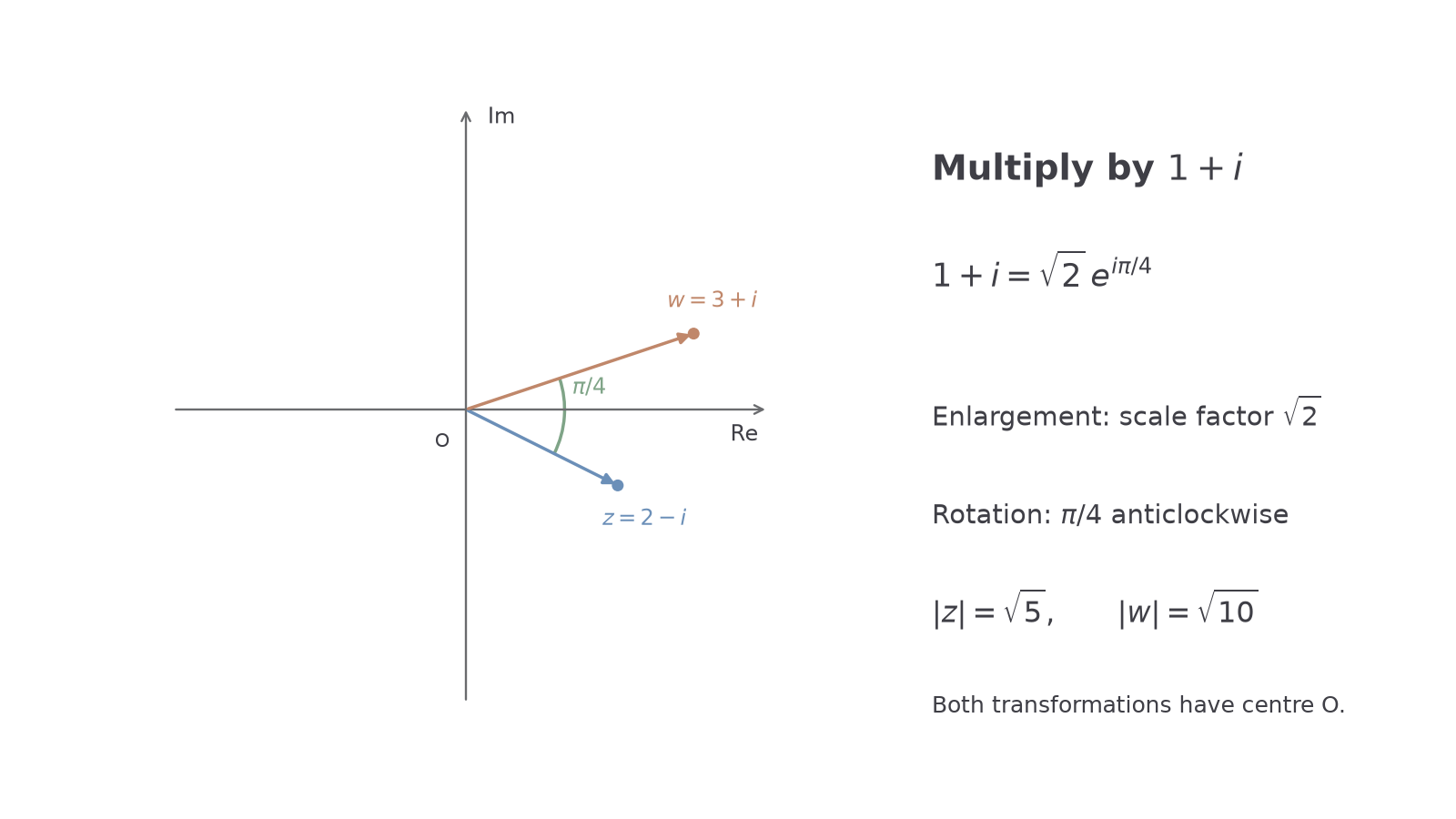
Multiplying any point by doubles its distance from the origin and turns its direction anticlockwise through . The same multiplier acts on every point, so it describes one transformation of the whole plane.
[DIAGRAM: asset_name: Multiplication by one plus i; asset_slug: h645_b011_multiplication; caption: Multiplying by one plus i enlarges distances by square root two and rotates by pi over four; description: An equal-scale Argand diagram shows z equals 2 minus i and its image w equals 3 plus i. Blue and clay arrows from the origin show their position vectors. A sage arc marks an anticlockwise angle pi over 4 between the vectors. A side panel gives q equals 1 plus i equals square root two times exp of i pi over 4, the input modulus square root five, and image modulus square root ten.]
Geometry of complex multiplication
Multiplication by , with , is an enlargement of scale factor and a rotation through , both about the origin:
A positive angle is anticlockwise. The origin is fixed.
Not in the formula booklet: learn it.
For this is a pure rotation; for it is a pure enlargement. Multiplication by turns through , by through , and by through . Multiplication by collapses every point to the origin and has no rotation angle.
Worked example 1: enlargement and anticlockwise rotation
Question. The transformation maps the point to . Find and specify the transformation geometrically.
Plan. Multiply in Cartesian form for the image, and express the multiplier in exponential form for the geometry.
Why this step? The transformation is determined by , not by the argument of the particular image .
Answer. . The transformation is an enlargement of scale factor and an anticlockwise rotation through , both about the origin.
Check. , , so their ratio is . Also .
Change only the sign of the multiplier's imaginary part. Its modulus is unchanged, but the direction of rotation reverses.
Worked example 2: a clockwise rotation
Question. Find the image of under , and specify the transformation.
Plan. Expand the product, then find the modulus and principal argument of .
Why this step? A negative argument means clockwise rotation. Conjugating the multiplier reverses the rotation, not the enlargement.
Answer. , with enlargement scale factor and clockwise rotation , both about the origin.
Check. , as before.
Complex differences let you use the same idea about a different centre. To rotate a point about , first form the displacement , multiply it, then add back: . This derived construction is not in the formula booklet: learn the displacement idea. For example, with , and , the image is .
Watch out
Wrong: multiplying by is an enlargement of scale factor with no rotation in the modulus-argument description.
Right: write : scale factor , rotation , about the origin. The modulus is always positive for a non-zero multiplier.
Specify the centre as well as the angle and scale factor; it is part of the transformation.
Roots of unity on the unit circle
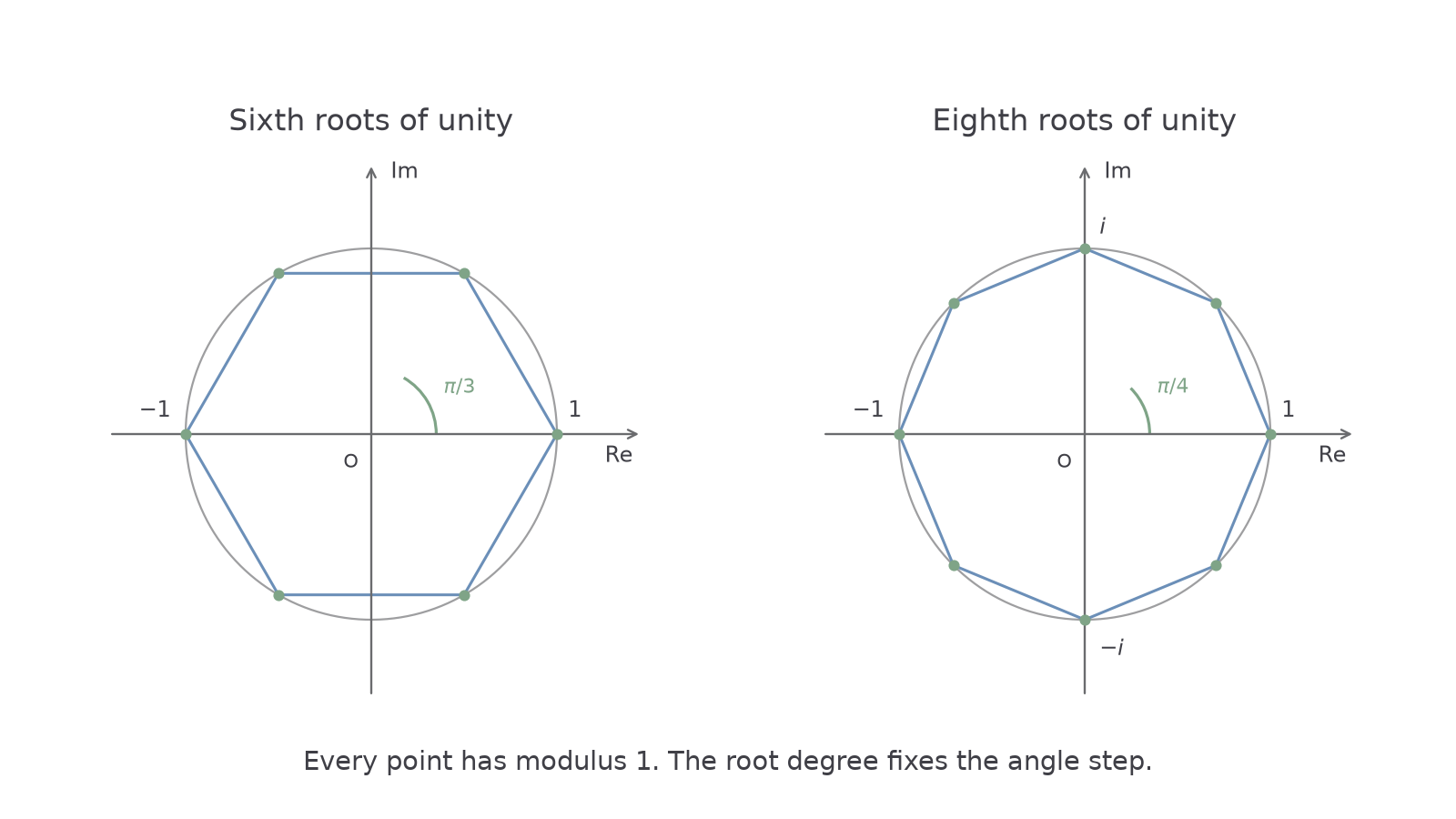
“Unity” means , so the -th roots of unity solve . Their modulus is , their first root is , and successive roots are separated by . They give a ready-made regular polygon on the unit circle.
Roots of unity
For a positive integer , the roots of are
In the formula booklet.
To represent them, draw equal-scale Re and Im axes, put on the positive real axis, and space all points round the unit circle. Label points on the axes explicitly; their positions alone do not communicate the scale.
Worked example 3: sixth roots of unity
Question. Find all sixth roots of unity in Cartesian form and describe their Argand-diagram arrangement.
Plan. Use angles , then evaluate the six unit-circle points.
Why this step? The exponent identifies the angle, not the point's imaginary part. Evaluate both cosine and sine to get each Cartesian number.
Answer. The six listed points form a regular hexagon centred at the origin, with circumradius and vertices at and on the real axis.
Check. Each modulus is ; multiplying each argument by gives a whole number of full turns, so every sixth power is .
Change the root degree from to . The circle remains the same size; only the angular spacing changes.
Worked example 4: eighth roots of unity
Question. Represent the eighth roots of unity by giving their exponential forms and identifying all roots on the axes.
Plan. Divide a full turn into eight equal angles, then identify multiples of .
Why this step? Every second vertex is an axis point. Including as a ninth root would repeat .
Answer. The points , , form a regular octagon on the unit circle. The axis roots are , , , .
Check. For an off-axis root, , so its eighth power is .
[DIAGRAM: asset_name: Sixth and eighth roots of unity; asset_slug: h645_b011_unity; caption: Changing the root degree changes the angular spacing but keeps every root on the unit circle; description: Two equal-scale Argand diagrams compare the sixth roots of unity, a regular hexagon with 1 and minus 1 labelled on the real axis and angle spacing pi over 3, with the eighth roots of unity, a regular octagon with 1, i, minus 1 and minus i labelled on the axes and angle spacing pi over 4.]
If , the vertices are in anticlockwise order. This notation is particularly useful when only relationships between vertices matter. An arbitrary non-real root need not generate all vertices by repeated multiplication: for example, successive powers of visit only and , although is an eighth root of unity.
Exam tip
An Argand sketch must show all the roots, their common circle centred at the origin, and enough exact labels to fix the scale and orientation. Label any real or imaginary axis roots rather than leaving them as unlabelled dots.
For a pentagon, most coordinates are less familiar. Exponential notation still describes every point exactly.
Watch out
Wrong: has nine distinct roots from . The last value repeats the first, since . The correct distinct list uses .
Stop before a full turn repeats the first vertex.
Polygon lengths from complex differences
A point's modulus measures its distance from the origin. To find the distance between two other points, subtract their complex numbers first. If the points are and , the required length is , not .
For consecutive vertices and on a unit regular polygon,
The length is positive, and for , so a side has length . Scaling to circumradius multiplies the length by . More generally, a chord joining vertices steps apart has length . These chord formulae are not in the formula booklet: learn the difference-and-modulus derivation.
[DIAGRAM: asset_name: Side and diagonal of a unit pentagon; asset_slug: h645_b011_pentagon; caption: Complex differences distinguish a pentagon side from a diagonal; description: An equal-scale Argand diagram shows the fifth roots of unity as a regular pentagon, with A at 1, B at omega, C at omega squared, D at omega cubed and E at omega to the fourth. The side AB is blue and labelled s equals modulus of omega minus 1. The diagonal AC is clay and labelled d equals modulus of omega squared minus 1. A side panel shows omega equals exp of 2 pi i over 5, side length 2 sin pi over 5 and diagonal-to-side ratio modulus of 1 plus omega equals the golden ratio.]
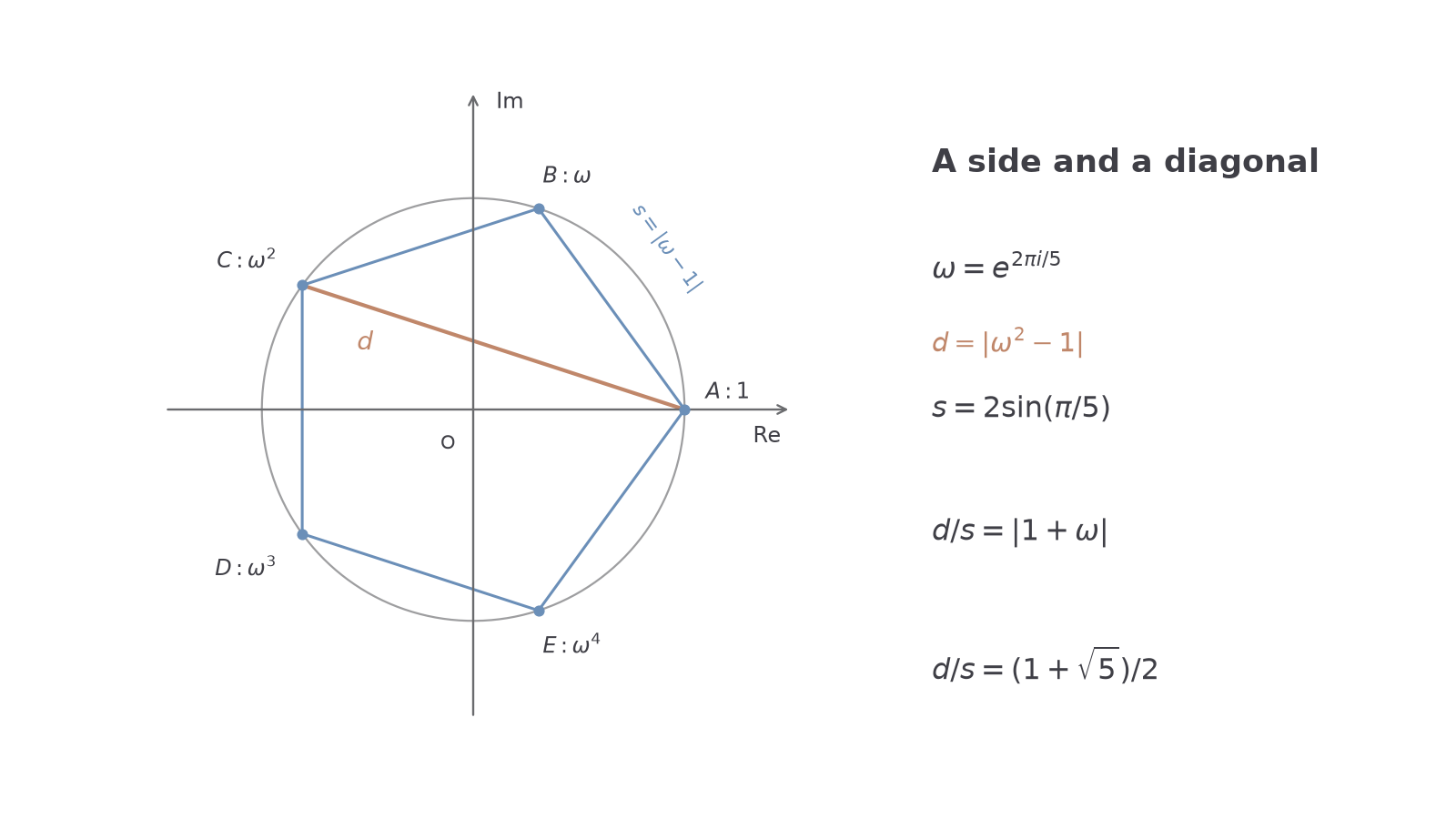
The highlighted side and diagonal share their starting vertex. That makes subtracting the natural first step in both calculations.
Worked example 5: a pentagon's side
Question. Let . The points , , , , form a regular pentagon. Show that its side length is .
Plan. Subtract the complex numbers of consecutive vertices and take the modulus.
Why this step? Both vertices have modulus , but their distance is not . Subtracting the complex numbers retains their different directions.
Answer. , as required.
Check. The central angle is . Bisecting the isosceles triangle gives half-side with hypotenuse , agreeing with the result.
Now change the second vertex from to . This replaces a side by a diagonal while keeping the same pentagon.
Worked example 6: the exact diagonal-to-side ratio
Question. For the same pentagon, determine the ratio of a diagonal length to the side length .
Plan. Factor the quotient of the complex differences, then use the zero sum of fifth roots of unity to evaluate it.
Why this step? Factoring cancels the side displacement before taking its modulus, so the required ratio depends on one short expression.
The five roots sum to zero. Divide their sum by :
Answer. , taking the positive square root because these are lengths.
Check. The chord formula gives , agreeing with the exact ratio.
The opening ratio is the golden ratio. Here it arises because a fifth-root relation becomes a quadratic after pairing reciprocal powers. A five-sided shape has hidden a quadratic equation inside its symmetry.
Problem-solving
For a length, form a difference and take its modulus. For an angle or a rotation, form a quotient of displacements. Factoring first often removes most of the algebra.
For example, an equilateral triangle on the segment from to can be constructed with third vertex , or the clockwise version. Both new sides have length because multiplication by preserves lengths; the angle at is . With and , the third vertices are . This is the same displacement idea used for polygon sides, now building a shape rather than measuring one.
Watch out
Wrong: . Modulus does not distribute over subtraction: the vertices have different directions. The correct side length is for the pentagon.
Subtract the complex positions before measuring the next distance.
Quick Recap
- Multiplication by enlarges by and rotates by , about the origin. Use displacements to work about another centre.
- The -th roots of unity are , forming equally spaced points on the unit circle, including .
- The distance from to is . For a regular polygon of circumradius , a side has length .
- Pairing reciprocal powers can turn polygon symmetry into a real algebraic equation.
The pentagon's diagonal-to-side ratio is , found by factoring complex differences and using the sum of fifth roots of unity.