Pm4 - Matrices of 2-D transformations
Two columns can describe what a transformation does to every point in the plane. You learn how to build and recognise matrices for reflections, rotations, enlargements, stretches and shears, and how to describe each transformation precisely. The images of just two unit vectors will do most of the work.
Building a matrix from two images
How can four numbers tell you where every point in an entire plane will go?
For example, . This matrix doubles the horizontal coordinate and leaves the vertical coordinate alone. It also tells you the image of every other point, because the same rule applies to any and .
You already know
A point has position vector . Multiply a matrix by this column using rows and columns, keeping the matrix on the left.
The image is the point after the transformation; the pre-image is the point before it. A transformation represented by a matrix has a special structure: it preserves addition and scalar multiplication of vectors.
Linear transformation
A linear transformation satisfies and . Every such transformation in two dimensions has a matrix. For example, is linear. A translation is not: it moves the origin, whereas every linear transformation sends to .
Let and . Every vector is . Linearity therefore gives . Knowing the images of these two unit vectors really does determine the whole plane: infinitely many point images are encoded by four entries.
Images become columns
If a linear transformation maps
then its matrix and coordinate rule are
Here primes label image coordinates, not derivatives.
Not in the formula booklet: learn it.
Finding both unit-vector images avoids memorising a large collection of disconnected matrices.
Worked example 1: assembling the columns
Question. A linear transformation maps to and to . Find its matrix and the image of .
Plan. Put the given images into columns, then multiply by the point's position vector.
Why this step? Multiplying by selects column , and multiplying by selects column . Their images must therefore be columns, not rows.
Answer. , and the image is .
Check. , using the decomposition into unit vectors.
The next example changes only the direction of the information: the coordinate rule is given, so you must extract the two unit-vector images yourself.
Worked example 2: reading a coordinate rule
Question. The linear transformation maps to . Find its matrix and the image of .
Plan. Substitute each unit vector into the rule, use their images as columns, then apply the matrix.
Why this step? Each output coordinate supplies a row of coefficients, while each unit-vector image supplies a column. Both routes give the same matrix.
Answer. , and the image is .
Check. Direct substitution gives .
A matrix can encode many transformations beyond the named ones in this lesson. The unit-vector method still works even when no familiar name fits.
Watch out
Wrong: putting the images and into rows gives . It sends to , contradicting the data. Right: put the images into columns and test one immediately.
Use the rule itself to check the following image after your matrix calculation.
Reflections in axes and diagonal lines
A reflection reverses the coordinate perpendicular to its mirror line and keeps points on the mirror line fixed.
Reflection in the -axis sends to : the height changes sign, while the horizontal position stays put. Reflection in instead exchanges the two coordinates, so becomes .
Reflection matrices
For column position vectors, the four reflection matrices are:
| Mirror line | Matrix |
|---|---|
| -axis | |
| -axis | |
| All four mirror lines pass through the origin. |
Not in the formula booklet: learn it.
You can rebuild any entry from the unit vectors. In reflection in , becomes , and becomes . These are the two columns.
Worked example 3: reflection in a coordinate axis
Question. Find the matrix for reflection in the -axis and the image of .
Plan. Keep the first coordinate and reverse the second, then apply the resulting matrix.
Why this step? The mirror is horizontal. Distances above it become equal distances below it, so it is , not , that changes sign.
Answer. Matrix ; image .
Check. The midpoint of the point and its image is , on the mirror, and the joining segment is vertical.
The next example changes the mirror from an axis to . Both an exchange and a sign change are needed.
Worked example 4: recognising a diagonal reflection
Question. Specify fully the transformation represented by , and find the image of .
Plan. Read the unit-vector images, identify their mirror, then calculate the point image.
Why this step? These two unit-vector images agree with reflection in ; agreement on both unit vectors determines the whole transformation.
Answer. Reflection in the line ; the image is .
Check. The midpoint is , on . The point-image segment has slope , perpendicular to the mirror.
Recognising a matrix is a geometric task: the final answer needs the transformation and its mirror line.
Watch out
Wrong: is a half-turn because it contains two minus signs. A half-turn has matrix . Here the off-diagonal entries exchange coordinates, producing a reflection in .
The positive off-diagonal entries in the next matrix change the mirror line.
Rotations about the origin
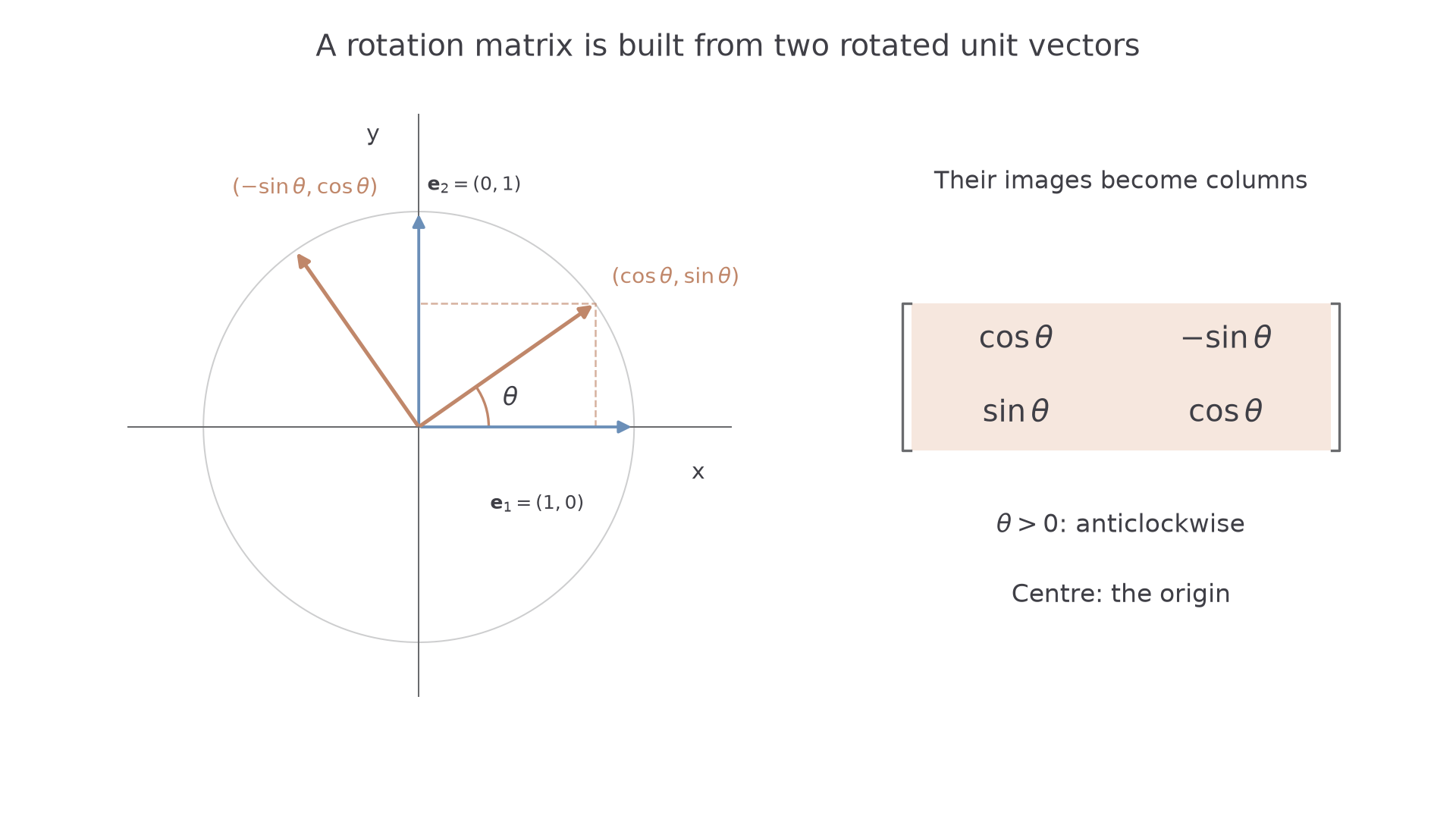
A rotation matrix records the new directions of the two unit vectors, with positive angles measured anticlockwise.
Rotate anticlockwise through . On the unit circle it reaches . The second unit vector starts a quarter-turn further round, so it reaches .
[DIAGRAM: asset_name: The columns of a rotation matrix; asset_slug: rotation_unit_vectors; caption: Rotating the two unit vectors gives the two columns of the rotation matrix; description: An equal-scale coordinate diagram shows a unit circle and the original unit vectors to 1,0 and 0,1 in blue. Their images after a 35 degree anticlockwise rotation are clay arrows ending at cos theta,sin theta and minus sin theta,cos theta. The first image has dashed projections onto the axes, and an arc marks theta from the positive x-axis. A side panel places these two image vectors into the columns of the standard rotation matrix.]
Rotation matrix
Rotation centre the origin through angle , positive anticlockwise, has matrix
Use a negative angle for a clockwise rotation. Degrees or radians work, provided your angle and calculator mode agree.
Not in the formula booklet: learn it.
The two sine entries have opposite signs because the second image's horizontal coordinate points left for a small positive angle.
Worked example 5: an anticlockwise quarter-turn
Question. Find the matrix for rotation centre the origin through anticlockwise, and the image of .
Plan. Substitute into the rotation matrix, then multiply the point's column vector.
Why this step? The image of must be . This checks the direction before you apply the matrix to anything else.
Answer. Matrix ; image .
Check. Both position vectors have squared length , and has turned anticlockwise into the first quadrant.
The next example changes the angle to a clockwise turn. The negative angle changes the sine signs; the cosines stay positive.
Worked example 6: a clockwise turn with exact values
Question. Find the matrix for rotation centre the origin through clockwise, and the exact image of .
Plan. Use , keeping the trigonometric values exact.
Why this step? “Clockwise” is handled by the angle, rather than by guessing which matrix entry to negate.
Answer. Matrix ; image .
Check. The image has length and argument , matching the specified turn.
When asked to specify a rotation fully, include its centre, angle and direction. “Rotation through ” leaves two possibilities.
Watch out
Wrong: use for an anticlockwise positive angle. This is the clockwise matrix. Right: check that the first column sends into the correct quadrant.
Change the clockwise angle once more, and use squared distance as your final check.
Enlargements and one-direction stretches
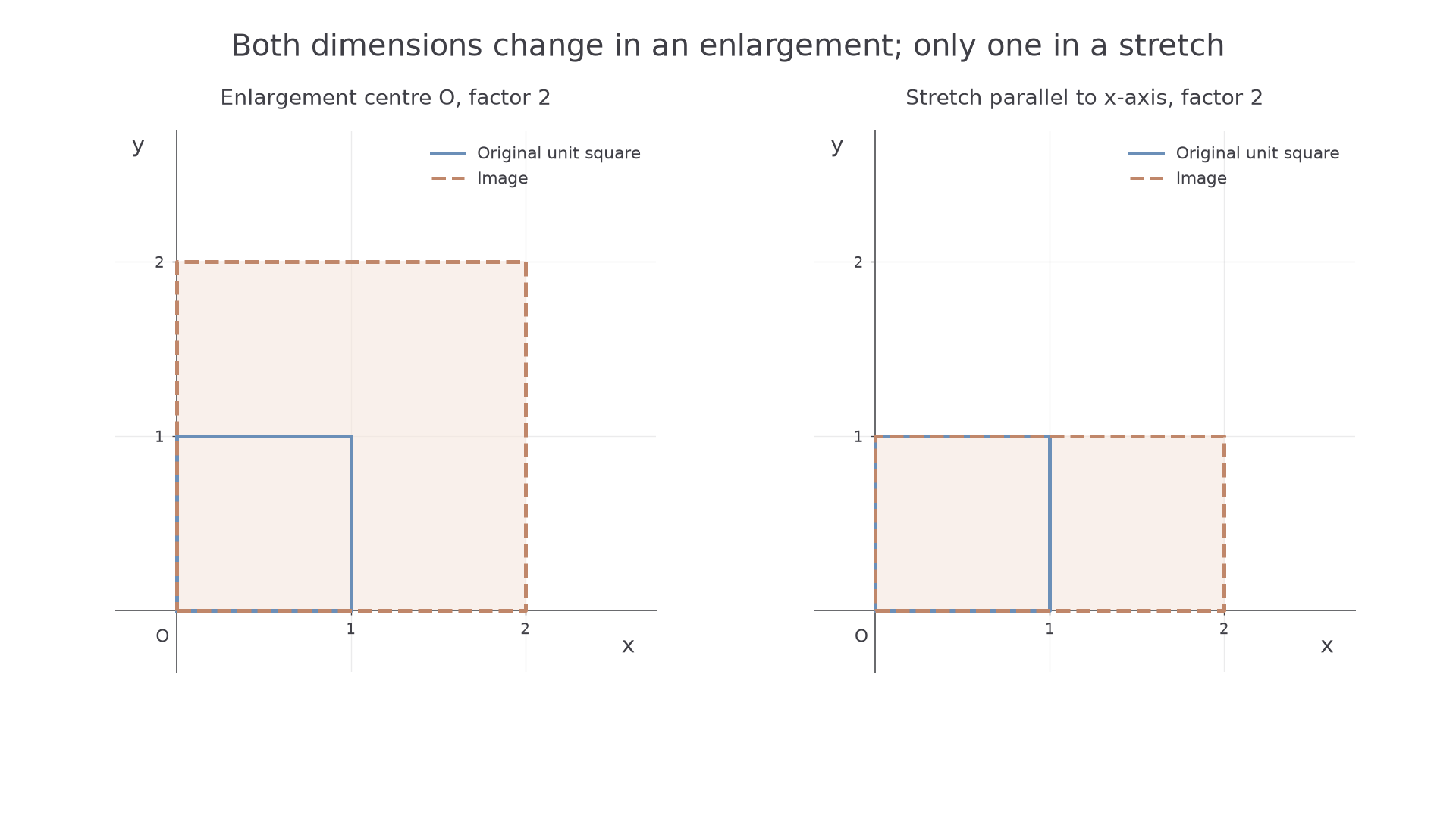
An enlargement scales both coordinates equally, while a stretch parallel to one axis scales only that coordinate.
The distinction is visible on a unit square. Multiplying both coordinates by produces a larger square. Multiplying only by produces a rectangle. The first is an enlargement; the second is a stretch parallel to the -axis.
[DIAGRAM: asset_name: Enlargement compared with a stretch; asset_slug: enlargement_stretch; caption: An enlargement doubles both dimensions; a stretch parallel to the x-axis doubles only the width; description: Two equal-scale coordinate panels show a blue unit square. In the first, its clay image is the square with vertices 0,0; 2,0; 2,2; 0,2, labelled enlargement centre O scale factor 2. In the second, its clay image is the rectangle with vertices 0,0; 2,0; 2,1; 0,1, labelled stretch parallel to x-axis scale factor 2. Dashed outlines make the overlapping edges readable.]
Enlargement and stretch matrices
For an enlargement centre the origin, scale factor , and stretches with the stated scale factors:
The unscaled coordinate stays unchanged. A factor between and compresses in the stated direction.
Not in the formula booklet: learn it.
For an enlargement with negative factor, the image lies on the opposite side of the centre as well as changing distance. Factor is the identity. The zero matrix is the limiting coordinate rule that collapses every point to the origin, rather than an ordinary enlargement of a shape.
Worked example 7: scaling both coordinates
Question. Specify fully the transformation associated with , and find the image of .
Plan. Compare both diagonal entries, then calculate the image.
Why this step? Equal diagonal scale factors multiply every position vector by the same number, so the centre is the origin.
Answer. Enlargement centre the origin, scale factor ; image .
Check. The image vector is twice the original, so it stays on the same ray and its distance from the origin doubles.
The next example changes just one entry: the vertical factor becomes . That removes the enlargement and leaves a one-direction stretch.
Worked example 8: scaling only one coordinate
Question. Specify fully the transformation associated with , and find the image of .
Plan. Identify the scaled coordinate and the unchanged coordinate, then apply the matrix.
Why this step? Naming the direction of a stretch tells us which coordinate changes. The -axis is fixed, but the stretch is parallel to the -axis.
Answer. Stretch parallel to the -axis, scale factor ; image .
Check. A point is unchanged, whereas horizontal distances from the -axis double.
The fixed axis and the direction of movement are perpendicular here. Distinguishing them makes the description much clearer.
Exam tip
For a stretch, give “stretch”, its parallel direction and its scale factor. Calling an enlargement loses the transformation's meaning: it changes width but leaves height alone.
The next matrix leaves the horizontal coordinate unchanged instead.
Watch out
Wrong: stretches parallel to the -axis because that axis is fixed. The rule is : movement is horizontal. The correct description is a stretch parallel to the -axis, factor .
Identify which coordinate changes before naming the next stretch.
Shears and their fixed axes
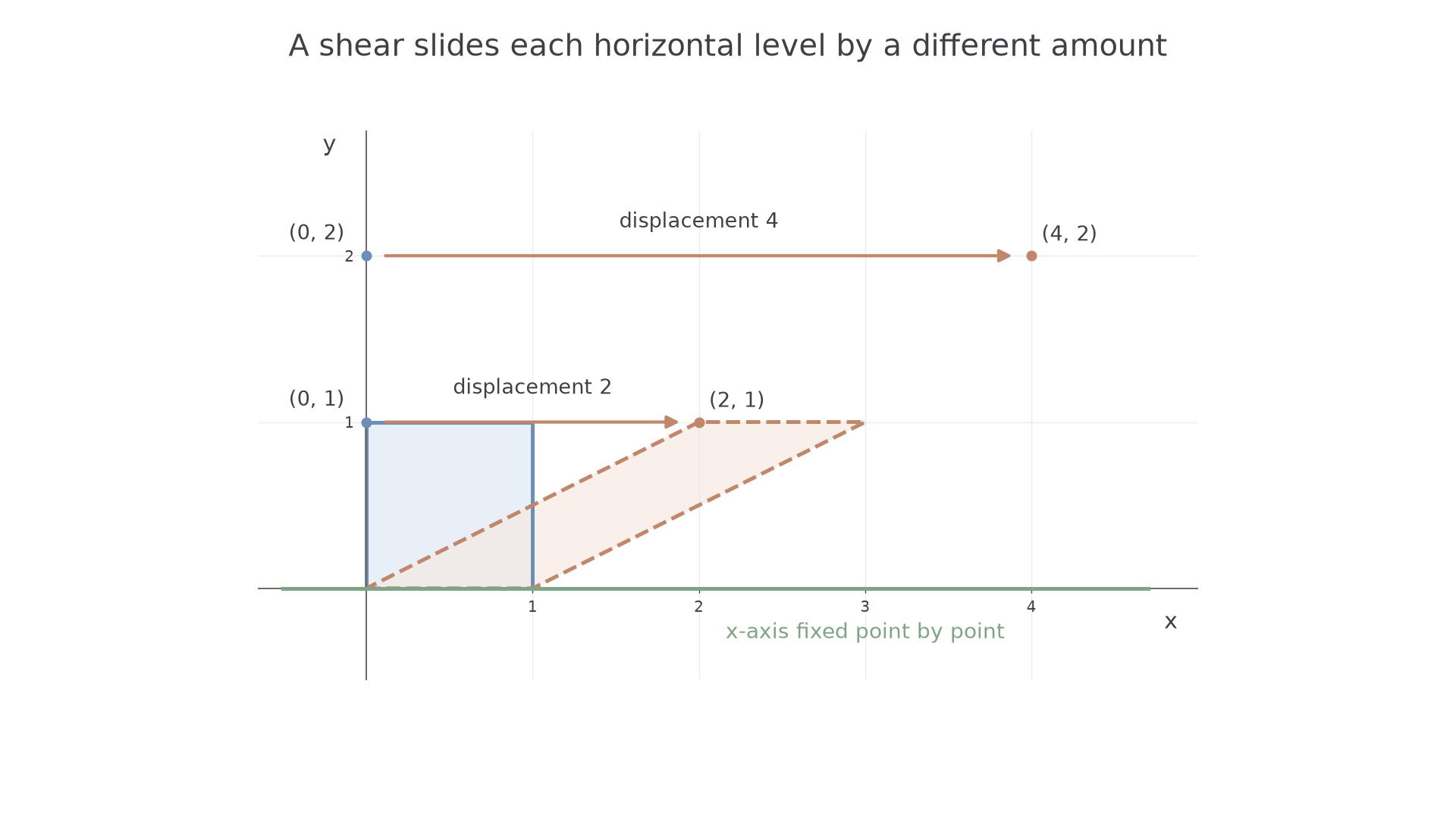
A shear slides points parallel to a fixed axis, with displacement proportional to their distance from that axis.
Imagine a stack of horizontal cards. Keep the bottom card fixed and slide each higher card further sideways. For the rule , every point on the -axis stays fixed, a point at height moves units right, and a point at height moves units right. Points below the axis move left.
[DIAGRAM: asset_name: A shear with the x-axis fixed; asset_slug: shear_fixed_axis; caption: The horizontal displacement is twice the height, while every point on the x-axis stays fixed; description: An equal-scale diagram shows a blue unit square with vertices O, 1,0; 1,1; 0,1 and its clay parallelogram image with vertices O; 1,0; 3,1; 2,1. The x-axis is emphasised and labelled fixed axis. A clay arrow maps 0,1 to 2,1 and a second arrow maps 0,2 to 4,2, showing displacement 2 at height 1 and displacement 4 at height 2.]
Shear
A shear with the -axis fixed has the form . A shear with the -axis fixed has the form . Specify a shear by its fixed axis and the image of a point off that axis. For example, “shear with the -axis fixed, mapping to ” specifies the rule above.
The shear factor is the distance a point moves divided by its perpendicular distance from the fixed axis. In the diagram this ratio is . This distance ratio does not record left versus right. Conventions for signed shear factors differ, so use the fixed axis and a point image to define a shear unambiguously.
Shear matrices
With the -axis fixed and :
With the -axis fixed and :
For a point off the fixed axis, the distance ratio is or , respectively. Zero gives the identity.
Not in the formula booklet: learn it.
The diagonal ones preserve the original coordinate, and the off-diagonal entry adds the sideways contribution from the other coordinate.
Worked example 9: a horizontal shear
Question. Find the matrix of the shear with the -axis fixed that maps to . Find the image of .
Plan. Use the fixed first unit vector and the given second unit-vector image as the columns.
Why this step? The first column is forced by the fixed -axis. Only the second column needs the extra point image.
Answer. Matrix ; image .
Check. The point moves units at height , giving distance ratio ; its -coordinate is unchanged.
The next example changes the fixed axis to the -axis. The displacement is now vertical, so the off-diagonal entry belongs in the other position.
Worked example 10: a vertical shear
Question. Specify fully the transformation associated with , and find the image of .
Plan. Inspect what happens on the -axis, then use to state the shear precisely.
Why this step? Saying only “vertical shear” does not identify the fixed line or the amount and direction of sliding. The point image supplies the missing information.
Answer. A shear with the -axis fixed, mapping to ; image of is .
Check. The displacement is down at perpendicular distance from the fixed axis; the distance ratio is .
All five transformation families have now come from the same four-number idea: describe the two unit-vector images, and every other image follows by linearity.
Exam tip
Specify a shear using its fixed axis and the image of an off-axis point. “Parallel to the -axis” or a shear factor alone is insufficient. A fixed axis means that each point on it stays where it is, a stronger statement than saying that the line maps onto itself.
Use an off-axis point whose perpendicular distance is to make the final description easy to check.
Watch out
Wrong: has the -axis fixed. It sends to , so that axis is not fixed. The correct fixed axis is the -axis, since .
Check an axis point before giving the next shear’s fixed axis.
Quick Recap
- The images of and form columns and of a linear transformation's matrix.
- Reflections change the appropriate signs or exchange coordinates; state the mirror line.
- An anticlockwise rotation has columns and ; give the centre, angle and direction.
- An enlargement scales both coordinates equally; a stretch scales one coordinate in the named direction.
- Define a shear by its fixed axis and the image of a point off that axis.
Four entries determine the whole plane because every position vector is a linear combination of the two unit vectors.