Pm7–Pm10 - Determinants and scale factors
A transformation can push a square sideways, make it much longer and still leave its area unchanged. Pm7 introduces the determinant and singular matrices; Pm8 and Pm9 connect its size and sign to area, volume and orientation. Pm10 lets you combine scale factors without multiplying every matrix entry.
Determinants and singular matrices
Can the transformation with matrix turn a unit square into a much wider parallelogram without increasing its area?
Its vertices become , , and . The image is wider, but its horizontal base and perpendicular height are still both , so its area is still . A single number extracted from the matrix will predict this, and much more.
You already know
A linear transformation acts on a column vector by multiplication on the left. Its matrix columns are the images of the coordinate unit vectors. A product applies first and second.
The number we need is called a determinant. It belongs to a square matrix; it is a scalar, not another matrix. For a matrix of order , multiply the downward diagonal and subtract the other diagonal product.
Determinant of a matrix of order 2
For real entries , , and ,
The notations and both mean the determinant. The vertical bars here do not mean “take a positive value”.
Not in the formula booklet: learn it.
A zero determinant is a structural warning. Some distinct points have the same image, so the transformation has lost information and cannot be undone uniquely.
Singular and non-singular
A square matrix is singular if it has no inverse; equivalently, its determinant is zero. It is non-singular if its determinant is non-zero. For example, is singular, although none of its entries is zero. The identity matrix is non-singular.
The next two examples differ in one feature: the second row becomes a multiple of the first. Watch what happens to the determinant.
Worked example 1: a non-zero determinant
Question. Find the determinant of and state whether is singular.
Plan. Calculate the two diagonal products in their correct order, then compare the result with zero.
Why this step? Singularity depends on whether the determinant is zero, not whether individual entries are zero.
Answer. , so is non-singular.
Check. The two column vectors and are not parallel, consistent with a non-zero area scale factor.
In Worked example 2, only the second row changes. Proportional rows make the two diagonal products equal.
Worked example 2: a determinant of zero
Question. Find the determinant of and state whether is singular.
Plan. Apply the same determinant calculation, then interpret a zero result.
Why this step? Every image has second coordinate twice its first, so all images lie on the line ; the transformation cannot preserve two-dimensional information.
Answer. , so is singular.
Check. Both and map to . There could be no unique reverse transformation.
Keep the determinant's sign until you have decided what it means geometrically.
Watch out
Wrong: . Right: the determinant is . Its magnitude is , but the negative sign carries information about orientation.
The following matrix has the same proportional-row feature as Worked example 2, with different entries.
Area and orientation in the plane
The determinant's magnitude tells you how much area changes, while its sign tells you whether the order of labelled vertices is preserved or reversed.
Start with the unit square. Its two edge vectors are the coordinate unit vectors, so their images are the two matrix columns. The resulting parallelogram makes the determinant's role visible. The same area multiplier applies to any region, wherever it lies in the plane; it is not restricted to squares or regions containing the origin.
[DIAGRAM: asset_name: Area and orientation under a shear and reflection; asset_slug: determinant_area_orientation; caption: A shear preserves area and an added reflection reverses orientation while preserving area; description: Three equal-scale coordinate diagrams show the unit square ABCD with vertices (0,0), (1,0), (1,1), (0,1), its image under the matrix with rows (1,2) and (0,1), and its image under the matrix with rows (1,2) and (0,minus 1). Labelled vertex order is anticlockwise in the first two panels and clockwise in the third. Each region has area 1. The determinants are 1, 1 and minus 1 respectively.]
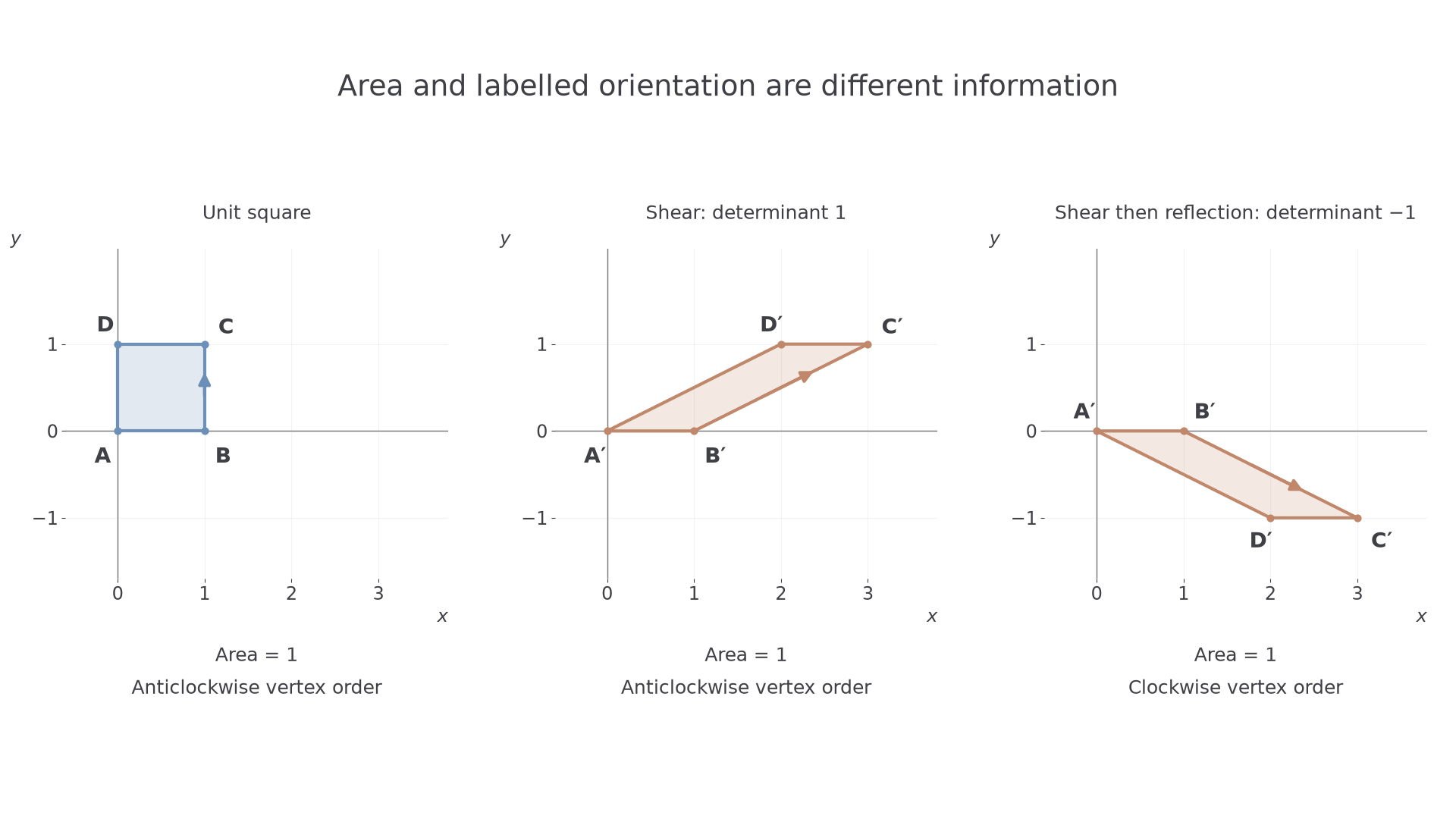
The parallelogram in the middle is slanted, yet its base and perpendicular height still give area . A determinant describes area change; it does not describe changes in individual lengths or angles.
Area scale factor and orientation
For a real matrix of order ,
If , orientation is preserved: clockwise vertex order stays clockwise, and anticlockwise stays anticlockwise. If , orientation is reversed. If , every region has image area zero: the plane collapses onto a line or a point, so clockwise order no longer applies.
Not in the formula booklet: learn it.
Use “area scale factor” explicitly. A determinant of does not make the image area unless the original area was .
Worked example 3: area increases and orientation stays
Question. A triangle has area square units and its vertices are labelled clockwise. It is transformed by . Find its image area and state the image's orientation.
Plan. Calculate the determinant, use its magnitude to scale the original area, and use its sign for orientation.
Why this step? The determinant gives a multiplier, so the original area must still be included.
Answer. The image has area square units. Its vertices remain clockwise because the determinant is positive.
Check. For a unit square the column vectors give a parallelogram with area , consistent with the multiplier.
Worked example 4 changes only the sign of the second row. This adds a reflection in the -axis after the first transformation, so the area should stay the same and orientation should reverse.
Worked example 4: the same area with reversed orientation
Question. The same clockwise-labelled triangle of area square units is transformed by . Find its image area and state the image's orientation.
Plan. Repeat the calculation, keeping the determinant's sign separate from its magnitude.
Why this step? Negative area is not the interpretation. The magnitude scales area; the sign reverses the labelled order.
Answer. The image has area square units and its vertices are labelled anticlockwise.
Check. : reflection changes the sign of every image's second coordinate but preserves its area.
A surprisingly large shear can preserve area. Replacing the in the opening matrix by gives , still with determinant . The top edge of a unit square moves units sideways, yet no area is gained.
Exam tip
State both conclusions precisely: “area is unchanged” and “orientation is preserved” when the determinant is . Area preservation does not imply that lengths, angles or the whole shape are unchanged.
Now change the magnitude as well as the sign, and apply both pieces of information.
Watch out
Wrong: the image area is . Area is non-negative; the determinant’s sign records orientation. The correct area is , with the vertex order reversed.
Use the magnitude for area and the sign for the next orientation decision.
Volume and handedness in three dimensions
For a transformation in three dimensions, replace area by volume and clockwise order by handedness.
A unit cube has three edges from the origin. Their image vectors are the three columns of its transformation matrix, and the cube becomes a parallelepiped. A reflection in a coordinate plane turns a right-handed arrangement into a left-handed one, just as a mirror changes a right glove into a left glove. A rotation preserves handedness.
[DIAGRAM: asset_name: A cube stretched reflected or flattened; asset_slug: determinant_volume_collapse; caption: Magnitude measures volume change while the sign distinguishes preservation, reversal or collapse; description: Three coordinate diagrams show the image of the unit cube under diagonal matrices with diagonal entries (2,1,1), (minus 2,1,1), and (2,1,0). The first is a cuboid of volume 2 with determinant 2, the second is its reflected cuboid of volume 2 with determinant minus 2, and the third is a rectangle in the xy plane with volume zero and determinant zero. The axes x, y and z and the transformed coordinate edges are visible.]
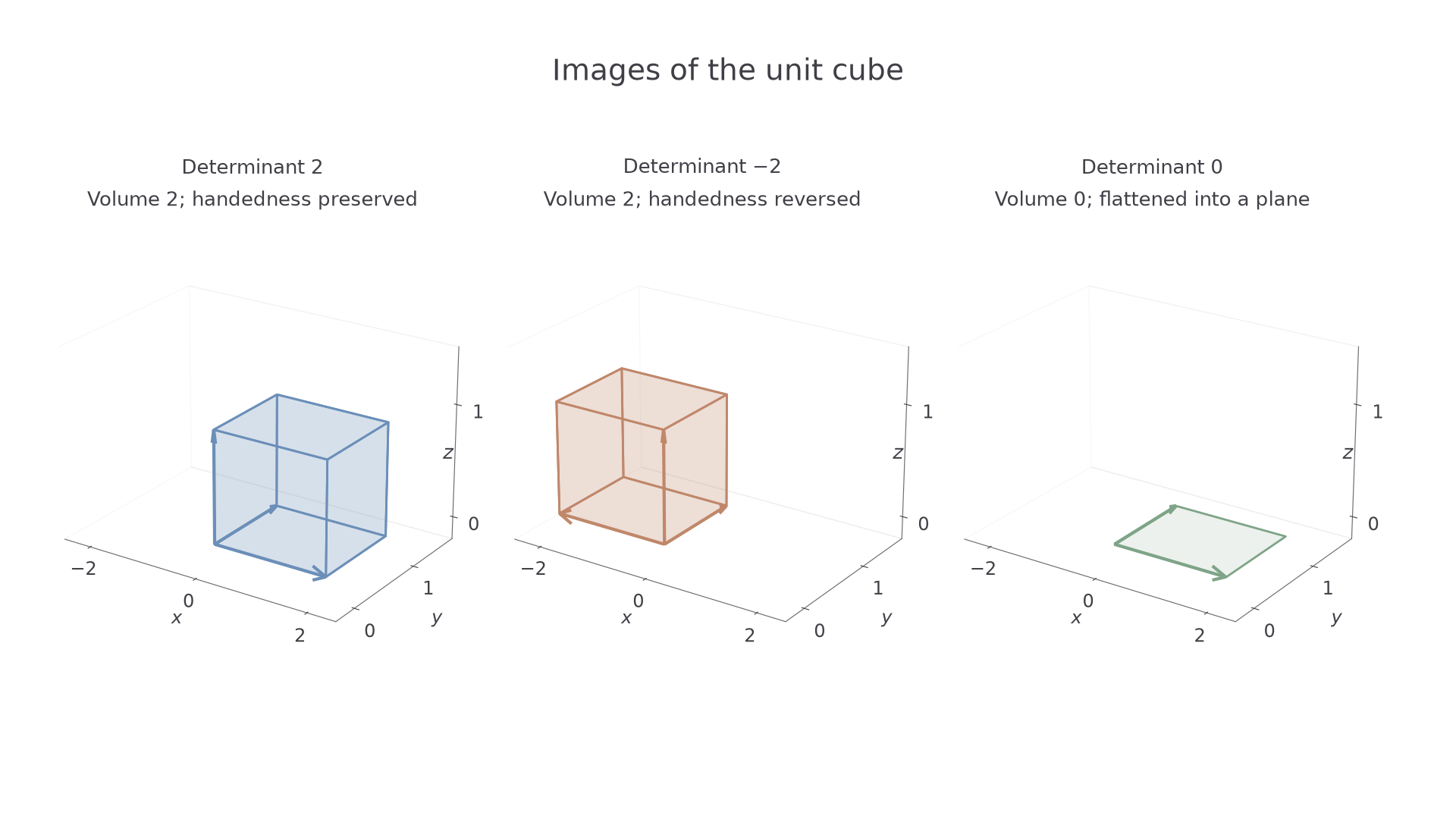
You may use a calculator to calculate numerical determinants and inverses of order . Enter the full matrix, select its determinant function and record the matrix and result in mathematical notation. A later lesson develops the hand method needed when algebraic entries prevent direct numerical evaluation.
Volume scale factor and handedness
For a real matrix of order ,
A positive determinant preserves handedness; a negative determinant reverses it. A zero determinant gives zero image volume: all images lie in a plane, a line or a point. For example, maps every to , flattening space onto the -plane.
Not in the formula booklet: learn it.
When a face is viewed from a point , compare its labelled order with the image face viewed from the image . With a negative determinant, clockwise becomes anticlockwise in that corresponding view. Keeping the viewing point fixed instead can give a misleading picture.
Worked example 5: a volume scale factor from a calculator
Question. A solid of volume cubic units is transformed by
Find the image volume and state whether handedness is preserved.
Plan. Evaluate the determinant of the entered matrix, then use its magnitude and sign separately.
Why this step? There are three coordinates, so the determinant scales volume, not area.
Answer. The image volume is cubic units and handedness is preserved.
Check. The images of the coordinate unit vectors are , and , matching the entered columns. This catches a common matrix-entry error before using the output.
Worked example 6 changes only the top-left entry from to . This is not a reflection of the whole previous image: changing a whole row would be needed for that. Recalculate rather than guessing the new determinant.
Worked example 6: a negative volume determinant
Question. The solid of volume cubic units is instead transformed by
Find the image volume and state whether handedness is preserved.
Plan. Enter the changed matrix afresh, then interpret its determinant.
Why this step? A change to one entry can change the determinant's magnitude as well as its sign.
Answer. The image volume is cubic units and handedness is reversed.
Check. The first unit vector now maps to ; the other two images are unchanged. Re-entering those three columns gives the same determinant .
Zero volume describes a collapse, not necessarily the disappearance of every point.
Watch out
Wrong: “A determinant of zero sends every point to the origin.” Right: it sends space into a lower-dimensional set. The matrix leaves every point of the -plane fixed while giving every solid zero image volume.
The next matrix changes the entries again, so its determinant must be found rather than inferred from its appearance.
Determinants of successive transformations
Successive transformations multiply their area scale factors, so determinants let you predict the combined effect before doing the full matrix multiplication.
If a region's area is first multiplied by and then by , its final area is times the original. Orientation behaves similarly: one reversal reverses the order, while two reversals restore it.
Determinant of a product
For square matrices and of the same order,
For transformations in the plane, the combined area scale factor is . Either order of the two transformations has the same determinant, even when the transformation matrices do not commute.
Not in the formula booklet: learn it.
Equal determinants do not mean equal matrices. They only mean equal signed scale factors, so they do not remove the need to keep matrix multiplication in order.
Worked example 7: a stretch followed by a reflection
Question. A region of area square units is transformed first by , then by . Find the determinant of the combined matrix, the final area and the effect on orientation.
Plan. Use the product rule for , then interpret its sign and magnitude.
Why this step? The second transformation is on the left in the combined matrix, even though the scalar determinants may be multiplied in either order.
Answer. The combined determinant is , the final area is square units and orientation is reversed.
Check. Direct multiplication gives , whose determinant is .
Worked example 8 changes only the second transformation: a singular map replaces the reflection. Once area has collapsed, another linear transformation cannot recover it.
Worked example 8: a singular factor
Question. The same region is transformed first by , then by . Find the determinant of the combined matrix and describe the image.
Plan. Check the new factor's determinant, use the product rule, then inspect the image coordinates.
Why this step? A zero determinant tells you the area is zero; the coordinates identify the particular line containing the image.
Answer. The combined matrix is singular. The image lies on , has zero area and has no clockwise or anticlockwise orientation.
Check. , with determinant .
Return to the opening shear. Its determinant is , so it preserves area and orientation. Repeating it any positive number of times still gives determinant , even though the top of the square keeps sliding farther sideways. Area preservation allows a dramatic change of shape.
Watch out
Wrong: “, so .” Right: many different matrices share a determinant. A determinant records only a signed scale factor, not the complete transformation.
In the final check, the singular factor comes first. The product rule still detects the lost area.
Quick Recap
- A matrix of order has determinant . A zero determinant means singular; a non-zero determinant means non-singular.
- In the plane, scales area. In three dimensions, it scales volume.
- A positive determinant preserves orientation or handedness; a negative determinant reverses it. Zero means collapse into fewer dimensions.
- , even when the matrices do not commute.
The opening shear has determinant : it can make the square much wider while keeping its area exactly .