Mw1–Mw5 - Work done and mechanical energy
Work measures energy transferred by a force acting through a displacement. You learn the language in Mw1, calculate work along and at an angle to a force in Mw2–Mw3, and calculate kinetic and gravitational potential energy in Mw4–Mw5. Signs, directions and the chosen zero height matter throughout.
What work and mechanical energy mean
You carry a bag horizontally at constant height. Does your upward supporting force do mechanical work on it?
It may take effort to carry the bag, but the supporting force and the bag's displacement point in perpendicular directions. In this model that force does zero work. Mechanical work has a precise meaning; it is not a measure of how tiring an action feels.
You already know
A force has a magnitude and direction; a displacement describes the change in position. Resolve a force along the direction you need. Use and SI units unless the question states otherwise.
Energy can be stored in motion or in the position of a body. Work transfers energy into or out of these mechanical stores. A force may act without transferring energy if the body has no displacement in that force's direction.
Work and mechanical energy
Work done by a force is the energy transferred by that force as its point of application moves. Kinetic energy is energy associated with motion; potential energy is associated with configuration or position. Mechanical energy is the sum of kinetic and potential energies. Work and energy are scalar quantities measured in joules, with .
Forces have different roles in an energy calculation. Gravity transfers energy between kinetic and gravitational potential energy. Friction usually transfers mechanical energy into internal energy, so mechanical energy is dissipated even though energy has not been destroyed.
Conservative, dissipative, driving and resistive forces
A conservative force does work that depends only on the initial and final positions, not on the route between them; gravity in a uniform field is an example. A dissipative force, such as sliding friction, transfers mechanical energy into other forms. A driving force acts to propel a body; a resistive force opposes its motion.
A force's role can change with the motion. An upward tension can drive a rising crate but resist a falling one. Likewise, power describes how quickly work is done. The power developed by a vehicle means the useful power of its driving force, after losses in transmitting the engine's output. We will calculate power in its own lesson.
Key idea
Identify the force whose work is being calculated. Zero work by one force does not mean that no forces act or that every other energy transfer is zero.
For the carried bag, the upward support and downward weight both act perpendicular to the horizontal displacement.
Calculating work and choosing its sign
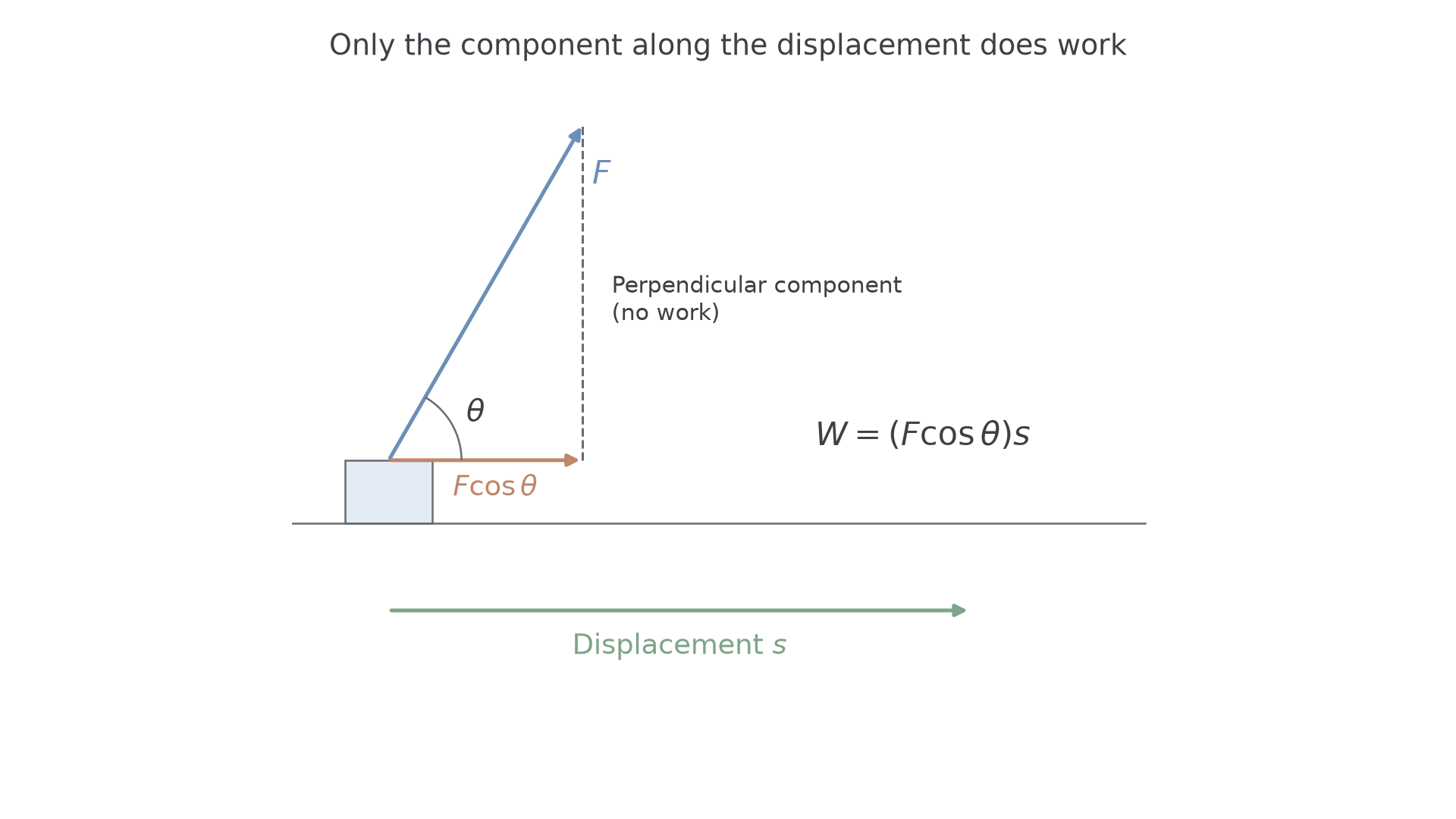
For a constant force, only the component along the displacement contributes to work.
If the force acts along the motion, every newton contributes. If it acts obliquely, resolve it along the displacement first. A force at right angles contributes nothing, which settles the bag question.
[DIAGRAM: asset_name: Work uses the force component along the displacement; asset_slug: work_force_component; caption: The parallel component F cos theta does work; the perpendicular component does none; description: A block moves horizontally to the right through distance s. A blue force F acts at 60 degrees above the horizontal. A clay horizontal component F cos theta points right, while the vertical component is grey dashed and perpendicular to the displacement. A separate sage displacement arrow is drawn below the block. The angle theta is marked between the force and displacement directions, not between the force and the vertical.]
Work by a constant force
For a constant force of magnitude , displacement of magnitude , and angle between their directions:
For motion along the force, and . Perpendicular force gives . A component opposite the displacement gives negative work.
Not in the formula booklet: learn it.
Here and are non-negative magnitudes; the cosine supplies the sign. In particular, a constant resistance of magnitude does work . The positive phrase “work done against resistance” means , the amount of energy transferred away from the body's mechanical stores.
Worked example 1: force along the displacement
Question. A constant force of acts along a particle's displacement of . Calculate its work.
Plan. Use the zero angle between force and displacement.
Why this step? “Along the displacement” identifies the contributing component as the whole force, so no reduction is needed.
Answer. The force does of work.
Check. The work is positive because the force acts in the direction of movement.
The next example changes only the angle. The force and distance remain the same, but only part of the force contributes.
Worked example 2: an oblique force
Question. A constant force of acts at to a particle's displacement of . Calculate its work.
Plan. Resolve the force along the displacement, then multiply by the distance.
Why this step? The distance is along the motion, so it pairs with , not with the perpendicular component .
Answer. The force does of work.
Check. The contributing component is half the original force, so the work is half of .
If the same force acted at , its parallel component would be negative and its work would be . The force would remove mechanical energy rather than add it.
Watch out
Wrong: use when is measured between force and displacement. Right: use . First mark that angle on a sketch; using the complementary angle changes which trigonometric function is appropriate.
The next angle is obtuse, so choose the sign before you calculate.
Kinetic energy and changes of speed
Kinetic energy depends on the square of speed, so an equal increase in speed does not give an equal increase in energy.
Doubling speed multiplies kinetic energy by four. Reversing velocity without changing its magnitude leaves kinetic energy unchanged, because energy is a scalar and speed is non-negative.
Kinetic energy
For a particle of mass moving with speed :
Here and are the initial and final speeds. With mass in kilograms and speed in metres per second, energy is in joules.
Not in the formula booklet: learn it.
Continue this lesson.
You’re previewing NovaLearn without an account. Create a free account to read the rest.
Create free account