Pv7, Pv8 - The vector product
Produce a vector perpendicular to two given directions, rather than a single scalar. You will calculate the vector product, interpret its direction and zero cases, and use its magnitude to find an angle when the acute or obtuse choice is known.
Calculating a perpendicular vector
A drone must climb perpendicular to both ground directions and . Can one calculation produce the climb direction?
Both directions lie in the horizontal plane, so an upward vector is an obvious answer here. In a tilted plane, you would want a method that finds the answer without relying on a picture. The vector product does just that.
You already know
The scalar product is a number. To check that a proposed non-zero vector is perpendicular to two non-zero vectors, check .
The cross symbol signals a different operation from the scalar product. Its output has three components.
Vector product in components
For numerical three-dimensional vectors and ,
It is perpendicular to both inputs; if the result is zero, it supplies no perpendicular direction.
In the formula booklet.
The determinant arrangement is another way the booklet displays the same rule. The middle component is especially easy to reverse accidentally. For a numerical calculation you may use your calculator, but name the operation you are using.
Worked example 1: a common perpendicular
Question. Use the vector product to find a vector perpendicular to and .
Plan. Calculate in the stated order and check its scalar products.
Why this step? The vector product gives a vector, so no inverse trigonometric function or division by lengths is needed to find a perpendicular direction.
Answer. One suitable vector is .
Check. and .
Change only the sign of the last component of . Follow the component formula carefully rather than trying to guess which signs in the answer will change.
Worked example 2: one negative input component
Question. Use the vector product to find a vector perpendicular to and .
Plan. Substitute the new signed component into each place it occurs in the vector-product formula.
Why this step? The middle component contains a subtraction of , so it becomes positive.
Answer. is a suitable perpendicular vector.
Check. for the first scalar product and for the second.
If only a perpendicular vector is requested, any non-zero multiple of the result also works. A unit perpendicular needs one further step: divide the result by its magnitude. For example, the first result has magnitude , so its corresponding unit vector is .
Watch out
Wrong middle component: . Right: . Copy the booklet's order rather than relying on a half-remembered sign pattern.
When asked for a perpendicular vector using the vector product, stating identifies the method. Expanding all three components is useful for learning and checking, but is not required merely to establish that you used the vector product.
Direction, order and a zero product
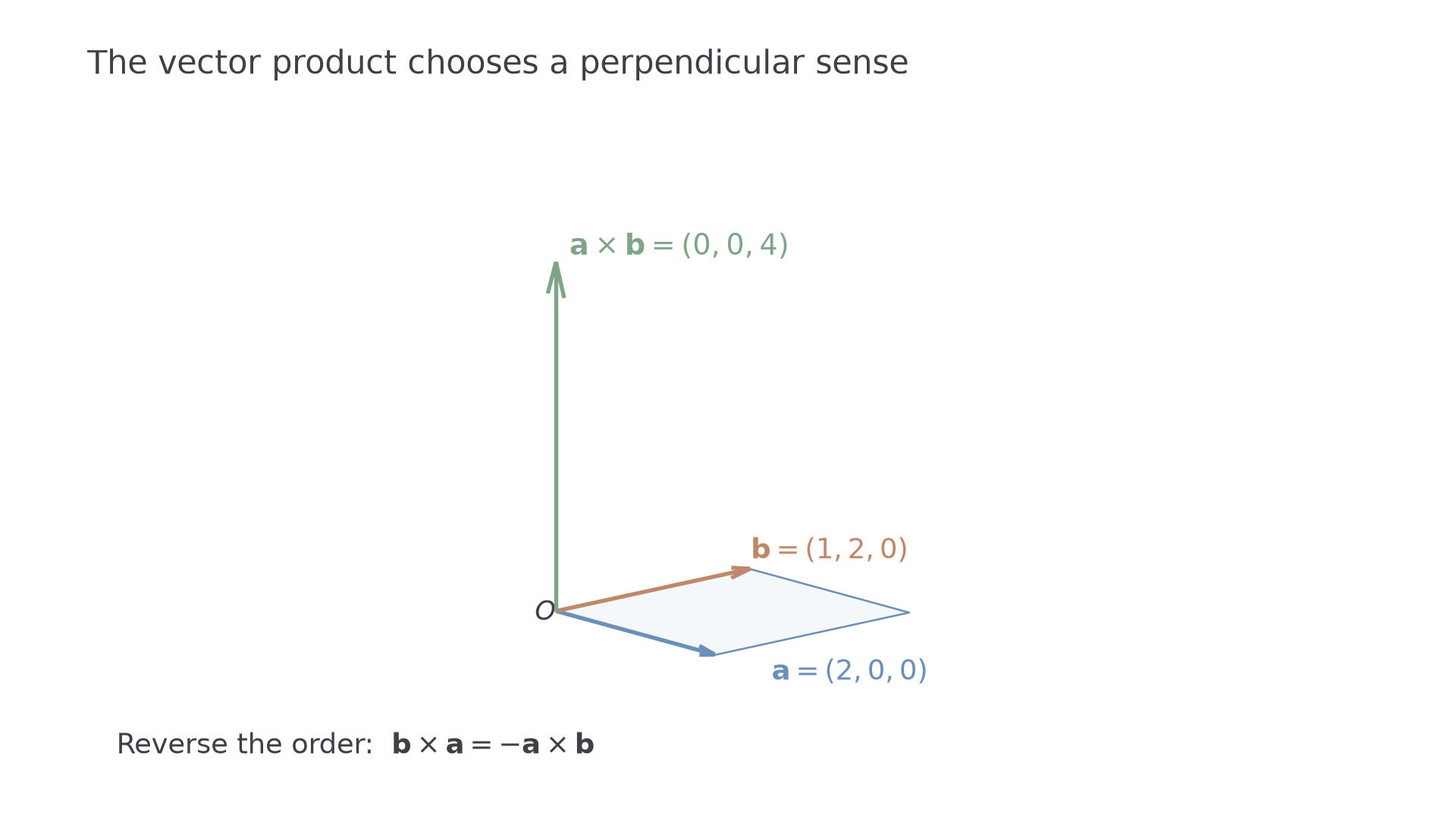
A vector perpendicular to two directions can point either way; the order of the vector product selects one of them.
For the drone, points up, while points down. Both are perpendicular to the ground, but they are different vector products.
[DIAGRAM: asset_name: Right-handed vector product; asset_slug: right_handed_product; caption: The order a, b, a cross b forms a right-handed triple; description: A three-dimensional coordinate view shows blue a=(2,0,0), clay b=(1,2,0), and sage a cross b=(0,0,4) rising vertically from their common origin. A pale parallelogram spans a and b in the horizontal plane. A note shows that reversing the input order reverses the upward arrow.]
Right-handed triple
For non-parallel non-zero vectors, , and the unit vector in the direction of , in that order, form a right-handed triple. Curl the fingers of your right hand from towards through the smaller angle; your thumb gives . In particular, .
Reversing the order reverses every component in the formula: . This order rule is not separately printed in the booklet; learn it from the component formula. It is a striking difference from .
If two non-zero vectors are parallel, either in the same direction or in opposite directions, their vector product is . For example, . There is no single chosen perpendicular direction. A zero input also makes the product zero, so include that possibility unless the inputs are stated to be non-zero.
Key idea
For non-zero vectors, a zero vector product means parallel directions. A zero scalar product means perpendicular directions. Check which product you have before interpreting the zero.
The zero-product criterion is not in the formula booklet as a separate statement; it follows from the magnitude form in the next section.
Using the magnitude to find an angle
The length of the vector product measures how far the two directions are from being parallel.
Its magnitude is also the area of the parallelogram spanned by the vectors: base times perpendicular height . This explains why a parallel pair gives zero and why a perpendicular pair gives the largest product for fixed lengths. The area interpretation is a consequence of the formula, not a separate booklet result.
Geometric form of the vector product
For non-parallel non-zero vectors with angle ,
where , , , in that order, form a right-handed triple. In particular,
The magnitude identity also holds for parallel vectors, with value zero; no unique is then selected.
In the formula booklet.
Since , the magnitude alone does not distinguish acute and obtuse angles. Use the given angle information, or the sign of the scalar product, to select the right one.
Worked example 3: an acute angle from the vector product
Question. Using the vector product, determine the angle between and , given that the angle is acute.
Plan. Find the magnitude of the vector product, divide by both lengths, and select the acute inverse-sine value.
Why this step? The instruction to use the vector product determines the method; a scalar-product calculation alone would not answer that instruction.
Answer. .
Check. The scalar product is , consistent with an acute angle.
Reverse only and specify an obtuse angle. The sine ratio stays unchanged, so the angle information now does essential work.
Worked example 4: choosing the obtuse angle
Question. Using the vector product, determine the angle between and , given that it is obtuse.
Plan. Calculate the sine ratio, then take the supplement of the acute inverse-sine answer.
Why this step? Inverse sine returns , but both and have the required sine.
Answer. .
Check. The scalar product is , so the selected obtuse angle is correct.
The opening drone can use the upward direction , or any positive multiple, for its climb. The vector product has supplied both perpendicularity and a chosen sense.
Watch out
Wrong: , therefore the vector angle must be . Right: for , it can be or . Use the stated acute or obtuse condition.
This matched problem changes the sine ratio while keeping the obtuse choice.
Quick Recap
- The vector product gives a vector perpendicular to both inputs.
- Reversing the inputs reverses the result.
- For non-zero inputs, a zero vector product means parallel directions.
- Its magnitude is ; select the acute or obtuse angle using the available information.
The drone's upward perpendicular direction is given by .