Ps3, Ps4 - Maclaurin series and their validity
Build a function's expansion from its derivatives at zero. You will find initial terms and a general term, use a short polynomial for a nearby numerical value, and distinguish a function's domain from the values where its Maclaurin series represents it.
Derivatives determine the coefficients
Can information at just predict ?
For , the value and first three derivatives at zero are . Those four numbers will produce a cubic polynomial that estimates . The remarkable idea is that derivatives at one point can encode a function throughout an interval, sometimes throughout the whole real line.
You already know
The derivative of is , and the chain rule introduces the inner derivative. Factorials satisfy , with .
Suppose an expansion begins . At zero, the function gives , its first derivative gives , its second gives , and its third gives . Division by the factorial reverses those multipliers.
Maclaurin series
When a function is represented by its Maclaurin series,
The coefficient of is . Equality is valid only where this infinite series converges to the function. A finite truncation is generally an approximation.
In the formula booklet.
Substitute derivative values visibly. A list of derivatives is useful working, but is not yet an expansion.
Worked example 1: a cubic from four derivative values
Question. Find the first four terms of the Maclaurin series for . Hence approximate .
Plan. Differentiate three times, evaluate at zero, divide by the factorials, and use .
Why this step? The desired exponent is , so substitute , not .
Answer. The four terms are ; the approximation is .
Check. A calculator gives , close to the polynomial value. This exponential series is valid for every real .
Change only the exponent's sign. Odd-powered coefficients change sign; even-powered coefficients do not.
Worked example 2: a negative inner coefficient
Question. Find the first four terms for . Hence approximate .
Plan. Use the signed derivative values at zero and again substitute .
Why this step? The cube of is negative, while its square is positive; the sign belongs inside the power.
Answer. , giving .
Check. . The expansion is valid for all real .
The function's value at zero supplies a constant term, even when the requested expression contains no visible constant at first glance.
Watch out
Wrong: use as the quadratic term. Right: use . Likewise, the cubic coefficient is divided by .
Change the exponent coefficient and choose the substitution from the exponent, just as before.
Finding and using a general term
An infinite expansion needs a rule for every coefficient, not just several correct initial terms.
For , where and ,
For integer , the pattern is
Here is why the pattern continues: differentiation multiplies by and raises the denominator power by one. This changes the sign, replaces by , and replaces by , giving exactly the next case. The first derivative starts the argument.
This derivative formula is not printed in the booklet: derive or establish it when needed. The Maclaurin coefficient then simplifies using .
Worked example 3: an infinite logarithm expansion
Question. Use the general derivative to obtain the Maclaurin series for , including its general term.
Plan. Evaluate the general derivative at zero, divide by , and include the constant value separately.
Why this step? explains why there is no constant term. The upper limit , or a final ellipsis, shows that the general term is not the last term.
Answer. The displayed infinite series, valid for .
Check. At , the coefficient is , agreeing with .
Change only to . The sign from the input now combines with the alternating coefficient.
Worked example 4: every term becomes negative
Question. Obtain the Maclaurin series for from the general derivative, including its general term.
Plan. Set , simplify the signs, and retain the infinite summation.
Why this step? There are two sign sources: the alternating derivative and the negative inner coefficient. Together they make every coefficient negative.
Answer. , valid for .
Check. , so the quadratic coefficient is .
The logarithm series itself is in the formula booklet. The derivative-based arguments establish it from the general Maclaurin formula, which matters when a question asks “hence prove”.
Exam tip
To establish a whole series from a general derivative, show the coefficient for arbitrary , include , and make the infinite continuation explicit. A few initial terms do not establish every coefficient.
Keep the negative inner sign and change its numerical coefficient.
Watch out
Wrong: for . The factorials leave a divisor: . The correct general term is .
Cancel the factorials before writing the next infinite sum.
Where an expansion is valid
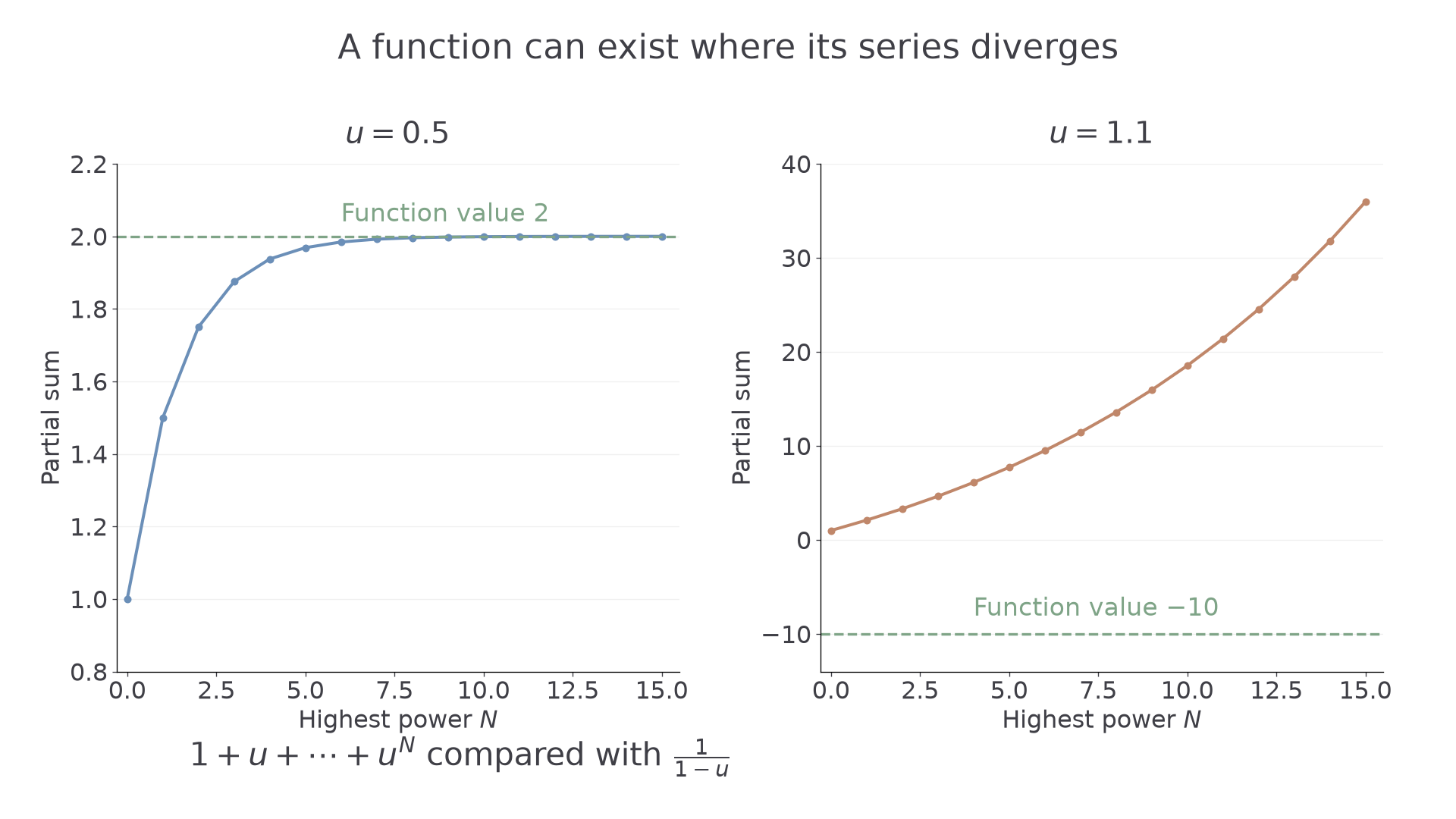
A function may exist where its Maclaurin series fails. Convergence is a condition on the infinite expansion, not just on the function's formula.
For example, exists at , but grows without bound there. At , its partial sums approach .
[DIAGRAM: asset_name: A function can exist beyond its series validity; asset_slug: series_validity_partial_sums; caption: Geometric partial sums converge at u=0.5 but fail at u=1.1; description: Two panels plot the sums from power 0 through power N of u to that power. At u=0.5, the values approach the function value 2. At u=1.1, the positive sums grow while the function value 1 over 1-u is minus 10. The panels distinguish the existing function from the divergent series.]
Logarithm validity after substitution
The booklet gives
After a substitution , impose . The endpoint is included; is excluded.
In the formula booklet.
At , the alternating series has sum . At , the logarithm itself is undefined. Use the stated range; a proof of convergence is not needed to apply it.
Worked example 5: a linear substitution's range
Question. State the set of -values for which the Maclaurin expansion obtained by substituting into the logarithm series represents .
Plan. Apply the complete logarithm condition to the substituted expression.
Why this step? The condition applies to , so using would give the wrong interval.
Answer. .
Check. At , the series is the convergent alternating expansion of ; at , the logarithm is undefined.
Change only the input from to . It is now non-negative, so the lower condition adds no restriction.
Worked example 6: a squared input
Question. State the validity set for the expansion of obtained from the logarithm series.
Plan. Impose and solve the resulting square inequality.
Why this step? Both signs of give the same input. At either endpoint the input is , so both endpoints are included.
Answer. .
Check. The function exists for every real , since , but its Maclaurin series has this smaller validity set.
The opening approximation used a function whose series is valid everywhere. A short truncation is still an approximation; convergence of the infinite series does not make a finite polynomial exact.
Watch out
Wrong: all standard series require . Right: read the specific condition. Exponential and trigonometric series hold for every real input, while the logarithm includes one endpoint and excludes the other.
The final input changes the coefficient inside the square. Keep both endpoint decisions.
Quick Recap
- The coefficient of is .
- Find and simplify a general coefficient when an entire infinite series is required.
- Include the constant term and an explicit infinite continuation.
- Apply validity to the substituted expression, retaining the correct endpoints.
Four derivatives at zero give the opening estimate .