PP3 - Areas enclosed by polar curves
Find exact areas by adding narrow polar sectors. You will choose limits that trace the required region once, handle a given expression for , and combine curves by selecting the correct inner and outer radii.
Add sectors and count each region once
What is the area of the lower petal of , even though that petal has ? Its radial coordinate is signed, but its area is positive. The square in the area formula handles the sign; your limits must handle which petal is counted.
You already know
For a circle, a sector of radius and angle radians has area . A polar curve may have negative , when its points lie opposite the indicated direction and its distance from the pole is .
Split an angular interval into narrow pieces. In a sufficiently narrow piece, the radius of a continuous curve changes very little, so the area is approximately . Adding the sectors and taking the limit gives an integral. For negative , the distance is , whose square is still .
[DIAGRAM: asset_name: Polar area adds narrow sectors; asset_slug: b042_043_area_sectors; caption: Each narrow piece contributes approximately one half r squared times its angle; description: A positive-radius polar curve is drawn between two rays labelled alpha and beta. Its swept region is shaded and one narrow sector is highlighted. That sector has radius r and angular width delta theta, with approximate area one half r squared delta theta. A separate annotation states that the chosen angular interval must sweep the required region once.]
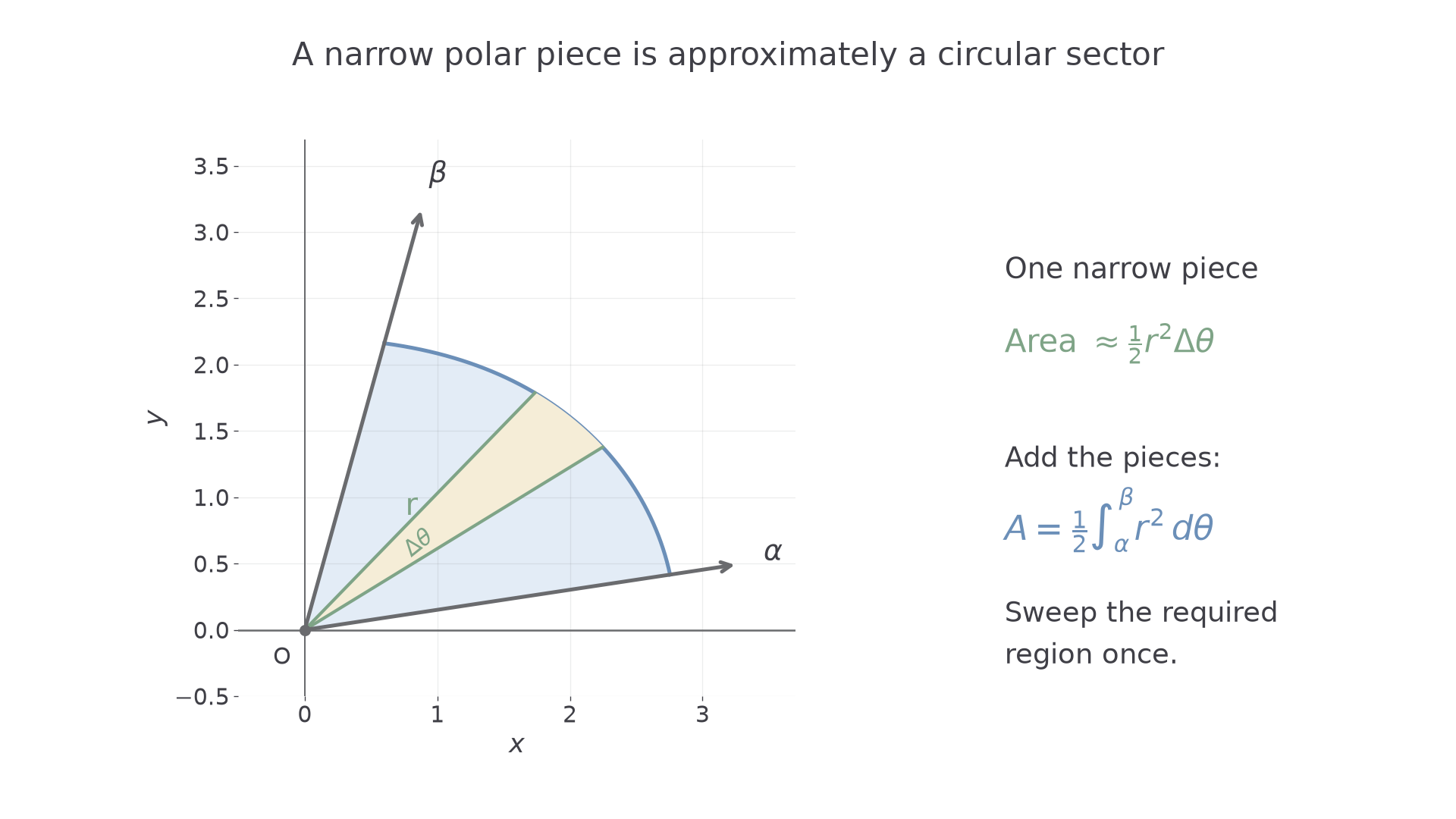
Area enclosed by a polar curve and two rays
If a continuous polar arc , from to , sweeps the required region once without overlap, its area with the two bounding rays is
For a loop that starts and finishes at the pole, use those pole angles as limits. A closed curve surrounding the pole may instead require a full turn; always check that it is traced once. Negative values of are allowed, but identify their actual positions before choosing the limits.
In the formula booklet.
The formula counts every sweep. Here is a useful trap: describes a circle of radius , so its area is . Integrating over gives
because that interval traces the circle twice. The single-pass interval gives , as it should. A correct integrand cannot repair incorrect limits.
Key idea
Find the region on a sketch before integrating. The formula needs , the appropriate angular interval and any justified symmetry factor; it does not automatically know which enclosed region you meant.
Sometimes the question gives directly. Substitute that expression once, rather than square it again.
Use a given expression for r squared
An equation for is especially convenient for area: there is no need to take a square root. First find the allowed interval and the zeros at the pole. For a non-negative radial branch, these determine the visible loop.
Worked example 1: a loop with r squared supplied
Question. For , a curve has equation . Determine the area of its loop in the first quadrant.
Plan. Use the zeros and as limits, substitute directly, and integrate.
Why this step? The equation already gives the square required by the formula. Taking a square root and then squaring it would add work without changing the integrand.
Answer. The area is square units.
Check. The largest radius is . A quarter-circle sector with that constant radius would have area , so the smaller value is reasonable.
Change only sine to cosine. The loop turns to lie around the initial line, so its zero-to-zero interval changes.
Worked example 2: a loop centred on the initial line
Question. For , a curve has equation . Determine the area of its right-hand loop.
Plan. Find the consecutive zeros on either side of , then integrate over that interval.
Why this step? throughout this interval. The next interval would give a negative , rather than a continuation of this real branch.
Answer. The area is square units.
Check. Rotating the first loop through preserves its area, so the two answers agree.
The maximum of is not the maximum of . Taking that final square root matters when checking the curve's size.
Watch out
Wrong: from , use in the area integral, or say the maximum radius is . Right: use directly, and the maximum non-negative radius is .
Scale the second curve's squared radius for the next check.
Expand the square before integrating
When , rather than , is given, square the whole expression. For a curve such as , the cross term matters, and a double-angle identity removes the squared cosine.
Reducing a squared trigonometric function
For every real ,
These follow from the compound-angle identities in the formula booklet and .
Not in the formula booklet: learn it.
The integration is ordinary trigonometric integration once the square is expanded. The region decides the limits; the formula does not require a whole loop if two rays bound the requested region.
Worked example 3: part of a cardioid
Question. Find the area bounded by and the rays , .
Plan. Square the radius, expand, replace by a double-angle expression, and integrate between the rays.
Why this step? contains ; omitting it would lose the in the answer.
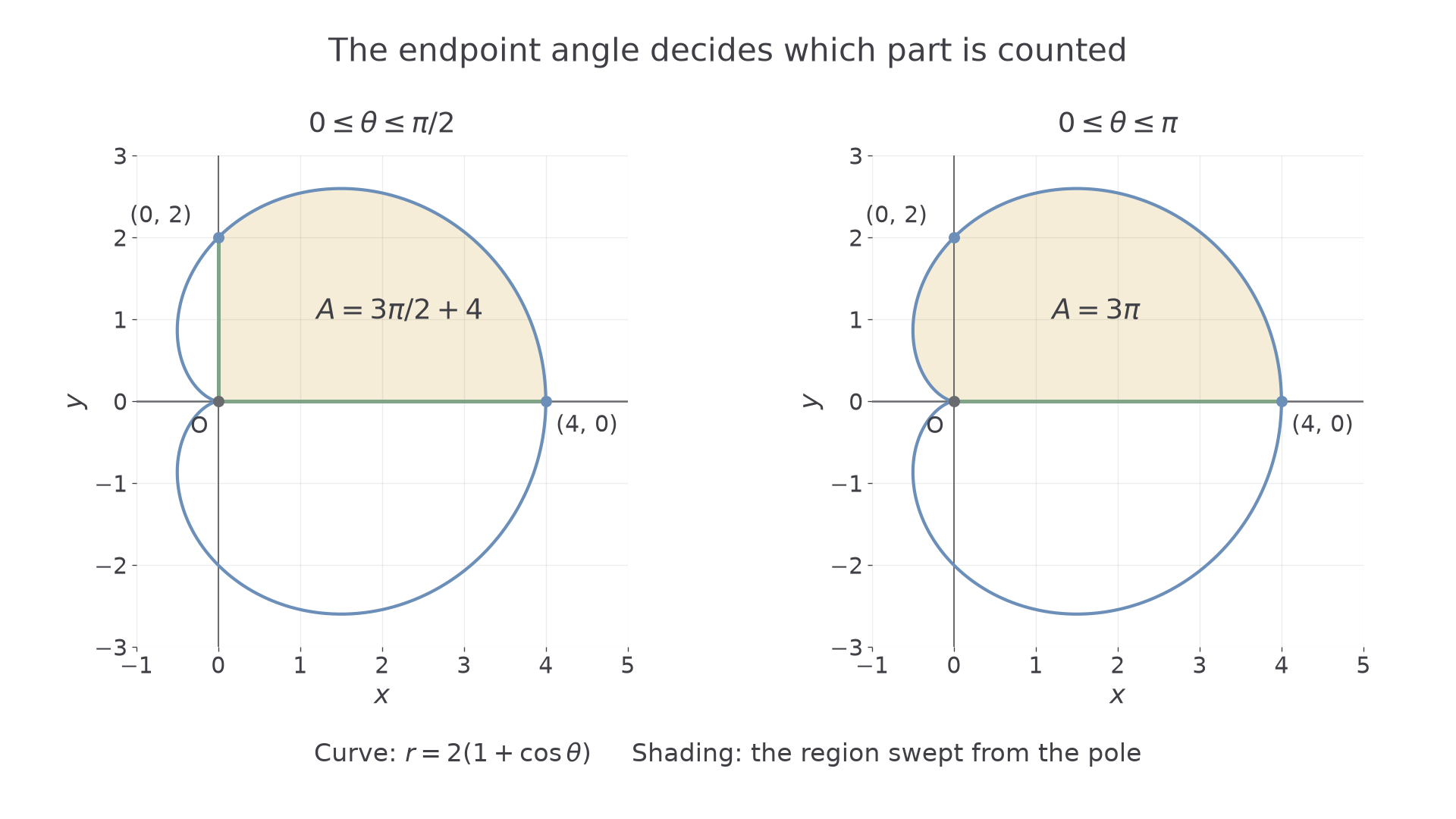
Answer. square units.
Check. On this interval , so the area lies between the sector areas and , as the answer does.
Change only the final ray to . This asks for the whole upper half of the same cardioid.
Worked example 4: a larger angular region
Question. Find the area bounded by and the initial line in the upper half-plane.
Plan. Use the same antiderivative, now from to , where the curve reaches the pole.
Why this step? The interval includes the small part of the upper cardioid to the left of the pole; does not.
Answer. square units.
Check. The extra area is . Reflection in the initial line gives whole-cardioid area .
The sketches show why these two limits describe different regions of the same curve.
[DIAGRAM: asset_name: Rays determine which cardioid area is counted; asset_slug: b042_043_cardioid_areas; caption: Ending at pi over 2 gives the first-quadrant part; ending at pi gives the whole upper half; description: Two panels show r equals 2 times (1 plus cosine theta). The first shades the region swept from zero to pi over 2 and labels its area 3 pi over 2 plus 4. The second shades the upper half swept from zero to pi and labels area 3 pi. Each includes the pole, initial line and the relevant ending ray.]
Exam tip
Under detailed reasoning, show the area integral, the square expanded, the trigonometric reduction and the antiderivative before substituting the limits. A calculator's area value alone does not supply that chain of reasoning.
The next curve scales every length in Worked example 3 by . Its area must therefore scale by .
Watch out
Wrong: . This loses the cross term. The correct expansion is ; in Worked example 3 that middle term contributes to the area.
Expand the entire squared radius before reducing the squared cosine.
Continue this lesson.
You’re previewing NovaLearn without an account. Create a free account to read the rest.
Create free account