Pv14, Pv15 - Line–plane intersections and angles
A line can pierce a plane, run alongside it or lie entirely in it. Pv14 lets you distinguish these cases and locate an intersection; Pv15 gives the angle of the line to the surface. You will use a direction vector for the line and a normal vector for the plane, keeping their different roles clear.
Finding where a line pierces a plane
A drill travels from in direction . Where does its straight path meet the sheet , and how steeply does it enter?
The path is . At , the left side of the sheet equation is ; at , it is . One substitution suggests an intersection. The calculation below establishes it and explains when the intersection is unique.
You already know
For , use the same in all three component equations. The plane has normal , with .
Substitute the line's three coordinates into the plane equation. When the coefficient of the parameter is non-zero, the resulting linear equation has one solution. Substitute that value back into the line to obtain the point, then check it in the plane.
Worked example 1: the drill meets the sheet
Question. Find the coordinates of the intersection of and .
Plan. Substitute the component equations into the plane, solve for , then find all three coordinates.
Why this step? The parameter controls movement along the line. Imposing the plane equation selects the parameter at which the path reaches the surface.
Answer. The intersection is .
Check. , so the point satisfies the plane as well as the line.
The next example changes only the plane's constant, moving the sheet without changing its normal. The intersection parameter becomes negative; that is allowed for a complete line.
Worked example 2: the intersection lies behind the chosen point
Question. Find where the same line meets .
Plan. Use the unchanged line components in the new plane equation and retain a negative parameter if it occurs.
Why this step? A line includes both senses of travel. A negative parameter means the point lies on the opposite side of the chosen starting point, not that no intersection exists. A physical ray restricted to would need that extra restriction checked.
Answer. The complete line meets the plane at .
Check. .
There is no separate line–plane intersection formula to look up in the booklet: use the line and Cartesian plane equations already taught. If the line is given in Cartesian ratio form, set its common ratio equal to one parameter first.
Watch out
Wrong: give only as the point of intersection. Right: substitute it into the line and give . When the question asks for coordinates, finish in coordinate form rather than stopping at a position vector.
This new line and plane give a different substitution, but the route is unchanged.
Recognising no intersection or infinitely many
Sometimes substitution removes the parameter completely, because moving along the line never changes the plane's left side.
Write the plane as . Substituting gives
This relation follows by expanding the scalar product; it is not separately printed in the formula booklet. The coefficient measures whether movement along the line has a component towards the plane or away from it.
| What substitution gives | Geometry |
|---|---|
| A non-zero coefficient of | One intersection |
| A true constant equality, such as | Every point of the line lies in the plane |
| A false constant equality, such as | The line is parallel to the plane and separate from it |
For example, the line through in direction satisfies for every real , so it lies in . Moving only the starting point to makes the left side always , so that parallel line never meets the same plane.
A line parallel to a plane
A line has direction parallel to a plane when its non-zero direction vector is perpendicular to the plane's normal, so . Its position then decides whether it is contained in the plane or is a separate parallel line.
This gives a useful surprise: one point and one scalar product can establish that infinitely many points lie in a plane. If the starting point is on it and the line's direction is perpendicular to its normal, every displacement along the line stays in the plane.
Key idea
A vanished parameter is information, not a failed calculation. Decide whether the remaining equality is true or false before interpreting the geometry.
The following check asks for the whole line, rather than just its displayed point.
The angle to the surface
The angle between a line and a plane is measured to the surface, so it is complementary to the smaller angle between the line's direction and the plane's normal.
Imagine the line's shadow on the plane when the light shines perpendicular to the surface. The required angle is the smaller angle from that shadow to the line. Unless the line is perpendicular to the plane, this is acute or zero. A perpendicular line has angle , while a parallel or contained line has angle .
[DIAGRAM: asset_name: Line angle and normal angle; asset_slug: b027_line_plane_angle; caption: The angle to the plane and the angle to the normal add to a right angle; description: A cross-section shows a horizontal grey line representing the plane, a vertical clay normal through the intersection, and a rising blue line. A sage arc between the surface and blue line is labelled alpha, the line–plane angle. An arc between the blue line and the normal is labelled beta. A right-angle marker and the equation alpha plus beta equals 90 degrees distinguish the two angles.]
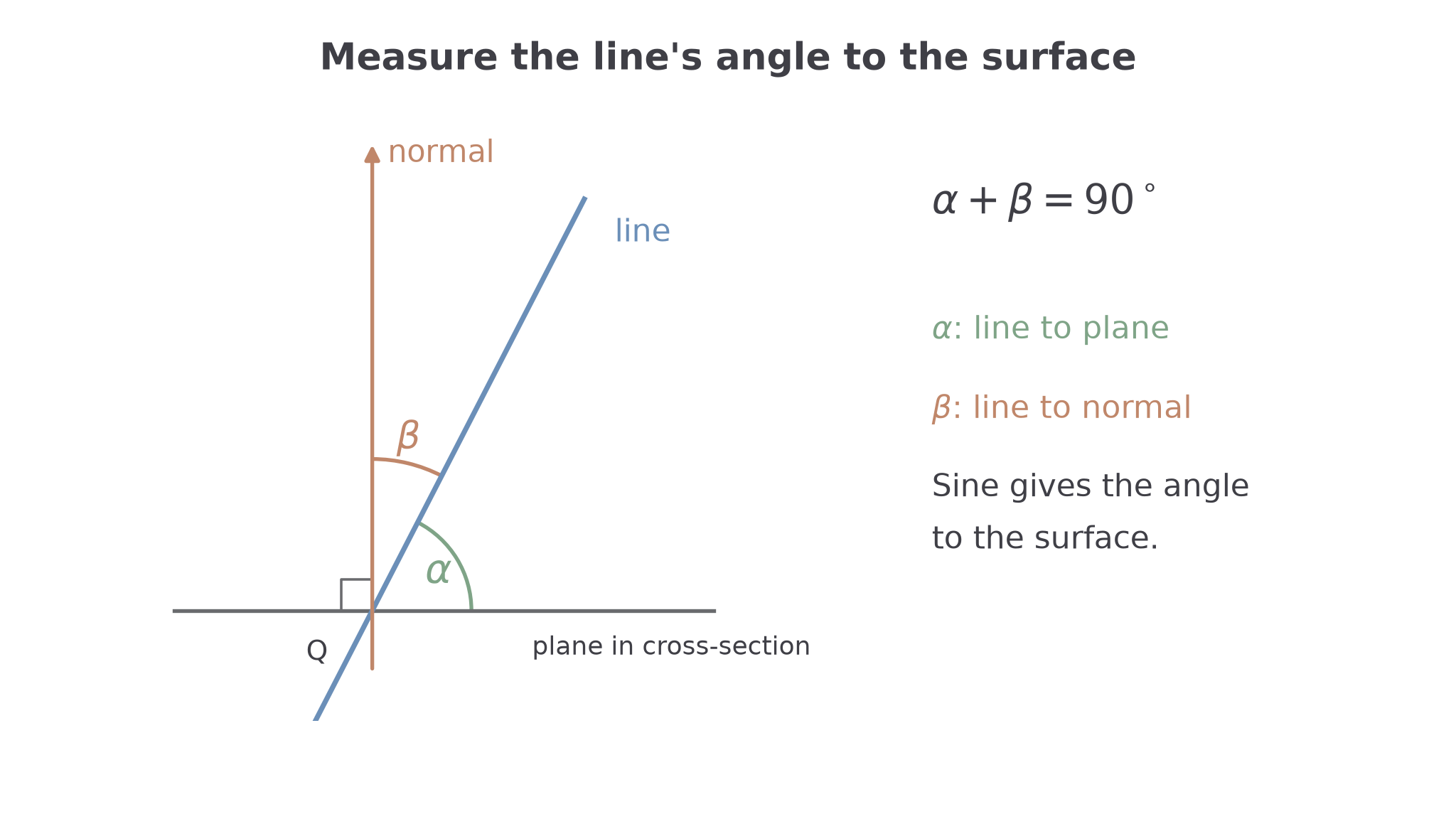
If is the smaller angle to the normal, the scalar product gives . Since , use sine for the angle to the plane.
Angle between a line and a plane
For a non-zero line direction and non-zero plane normal , the angle , with , satisfies
Not in the formula booklet: learn it.
The absolute value removes the arbitrary choice of arrow direction. Reversing the line or the normal cannot change the angle between the geometric objects.
Worked example 3: the drill's entry angle
Question. Determine the acute angle between the line with direction and . Give your answer in degrees to one decimal place.
Plan. Read the normal from the plane coefficients, calculate its scalar product with the direction and use inverse sine.
Why this step? Inverse cosine of gives the angle to the normal, approximately . The question asks for its complement.
Answer. The angle to the plane is .
Check. The direction is close to the normal: their scalar-product ratio is close to . A steep entry angle is consistent with that geometry.
The next example reverses only the line's direction vector. Its displayed scalar product changes sign, but its geometric angle stays the same.
Worked example 4: reversing the direction arrow
Question. Determine the acute angle between a line with direction and , in degrees to one decimal place.
Plan. Keep the signed scalar product, then take its absolute value in the sine ratio.
Why this step? The line has no preferred forward sense. A negative answer from using would describe an arrow convention, not the requested line–plane angle.
Answer. .
Check. Negating the direction leaves the complete line unchanged, so the answer agrees with Worked example 3.
The constants in the plane and line equations locate the intersection but do not enter the angle calculation. The opening drill therefore meets the sheet at and enters at .
Watch out
Wrong: as the line–plane angle. Right: , or subtract the normal angle from . Label the angle before choosing sine or cosine.
Use the direction, rather than the line's chosen point, in this last calculation.
Quick Recap
- Substitute one parameter's three coordinates into the plane, then substitute back to get the intersection coordinates.
- A vanished parameter leaves either a true equality (contained line) or a false equality (separate parallel line).
- Use the line's direction and the plane's normal; the surface angle uses the sine ratio.
- Parallel directions to the plane give ; a normal direction gives .
The drill meets the sheet at , at an angle of to its surface.