SR16–SR18 - The geometric distribution
Model the number of trials up to and including a first success. SR16 checks the stopping rule and assumptions, SR17 turns event wording into point and cumulative probabilities, and SR18 uses the supplied mean and variance to interpret or recover the success probability.
Count through the first success
A machine succeeds on each attempt with probability . After three failures, is success now more likely on the next attempt? Under independent trials, the machine has no memory of being “due” a success.
You already know
A Bernoulli trial has two outcomes, with a specified success probability. A binomial variable counts successes in a fixed number of independent trials. Independent event probabilities multiply.
Here the experiment stops at the first success. The number of trials is random, rather than fixed. For example, the sequence failure, failure, success gives a trial count of three.
Geometric distribution
Write when counts independent Bernoulli trials up to and including the first success, with the same success probability on every trial. Here , and the possible values are .
Use this trials-counting convention throughout. Counting only the failures gives a different variable and is not the convention here. Also identify the event called success: when testing stops at the first rejected item, rejection is the statistical success, however unwelcome it is.
In context, state that the outcome of one attempt is independent of the outcomes of the others, and that the chance of the stopping event stays constant. Learning, fatigue or depletion without replacement can invalidate those assumptions.
Key idea
Binomial fixes the number of trials and counts successes. Geometric stops at the first success and counts trials, including that success.
Check the stopping event before selecting its probability.
Calculate the probability of a first success
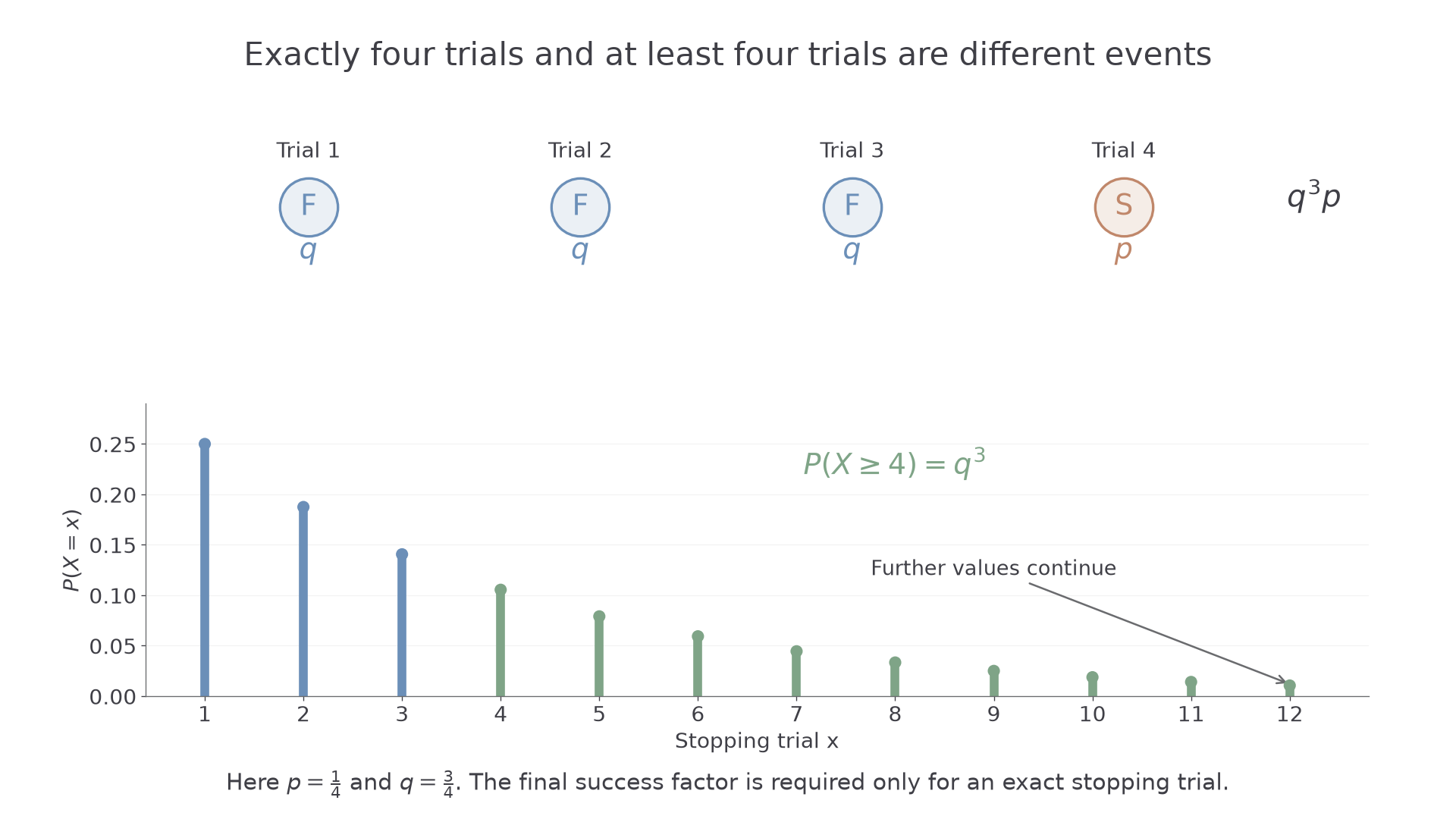
For the first success to occur on trial four, the first three trials must fail and the fourth must succeed. The order is already specified, so there is no binomial coefficient.
Geometric probability function
For , put . Then
There are failures before the single stopping success.
In the formula booklet.
Picture the trial sequence first if the power is unclear. The count includes a final success, so the number of preceding failures is one smaller.
[DIAGRAM: asset_name: First success and geometric probabilities; asset_slug: geometric_trials_and_tail; caption: First success on trial four requires three failures and one success; needing at least four trials requires only the first three failures; description: A top sequence shows trials one through four as failure, failure, failure, success, with factors q, q, q, p and total q cubed p. A lower discrete graph for geometric p one quarter shows separate probabilities at trials one through twelve, with values four onwards highlighted for X at least four and an arrow showing that the tail continues. A label gives P of X at least four equal to q cubed.]
Worked example 1: first success on trial three
Question. Independent attempts succeed with constant probability . Find the probability that the first success occurs on attempt three.
Plan. Require two failures followed by a success.
Why this step? Allowing a success on either earlier attempt would have stopped the experiment too soon.
Answer. .
Check. There is one required ordering, so no factor counting alternative positions is needed.
Change only the stopping trial from three to four. This adds one required initial failure.
Worked example 2: one extra failure first
Question. Under the same model, find the probability that the first success occurs on attempt four.
Plan. Require three failures, then the stopping success.
Why this step? Trial four is the success trial, so only three trials contribute failure factors.
Answer. .
Check. , the probability of the one extra required failure.
The probability graph falls geometrically: each next height is times the preceding height. Its values continue indefinitely when ; a diagram showing ten bars has not imposed a ten-trial limit.
Watch out
Wrong: . Trial four is the success, so only three earlier trials are failures. Correct: ; multiplying by a binomial coefficient would also count orderings that stop too early.
Count the failures before the stopping success in the next event.
Translate tails and intervals into failed trials
The event says that no success occurs in the first trials. There is no requirement for success on trial ; it could occur still later. Therefore the probability is just .
Continue this lesson.
You’re previewing NovaLearn without an account. Create a free account to read the rest.
Create free account