Pp19–Pp22 - Forming differential equation models
A differential equation describes how a quantity changes, rather than giving its value directly. Pp19 defines the variables; Pp20 translates rates and changing rates into derivatives; Pp21 supplies the language of motion; Pp22 uses these ideas to build and interpret models. You will turn physical statements into equations, with units, initial conditions and a sensible range of use.
Defining quantities before differentiating
A tank is losing liquid while salty water is still entering. Must the mass of salt in the tank fall straight away?
Volume and salt mass are different quantities. If the tank begins with pure water, there is initially no salt to leave, but the incoming water can already bring salt in. A model must keep those quantities separate before it can answer the question.
Dependent and independent variables
The independent variable is the quantity against which change is measured, often time. A dependent variable changes with it. For example, let be time in minutes and the mass of salt in a tank in grams. Then is a mass rate in ; it is neither the mass nor the concentration.
Define the origin as well as the unit: “ minutes after the tap is opened” is clearer than “ is time”. If , the initial mass is zero; it does not say that its initial rate is zero.
| Words about a quantity | Mathematical meaning |
|---|---|
| Its rate of increase is | |
| Its rate of decrease is | |
| Its rate of increase is itself increasing | |
| Its rate of increase is proportional to its value | , with a constant |
The derivative describes change in the rate, not the square of . For a height in metres and time in years, has units , while has units . A height can be increasing while its rate of increase decreases.
Key idea
Name each quantity and its unit before forming an equation. Distinguish a value, its first derivative and its second derivative.
This distinction is what the following check tests; no solution of an equation is needed.
Balancing input and output rates
For a stored quantity, its rate of change is the input rate minus the output rate, with both rates expressed in the same units.
In a well-mixed tank, the outgoing liquid has the same concentration as the liquid in the tank. If the mass is grams and the volume is litres, that concentration is grams per litre. Multiply by an outflow in litres per minute to get a salt loss in grams per minute.
A quantity balance
For a stored quantity , measured consistently,
For a well-mixed liquid,
These statements apply only while the stated flow and mixing assumptions hold and .
Not in the formula booklet: learn it.
The volume has its own balance. Calculate it first; a changing volume makes the outgoing concentration change even if the salt mass were momentarily fixed.
Worked example 1: equal liquid flows
Question. A tank initially contains litres of pure water. Solution containing of salt per litre enters at , and well-mixed liquid leaves at the same volume rate. Form a differential equation for the salt mass grams after minutes, and state its initial condition.
Plan. Find the constant volume, calculate both salt rates and subtract outflow from inflow.
Why this step? The outflow rate of liquid is not the outflow rate of salt. Multiplying concentration by liquid flow converts it to the required mass rate.
Answer. , with . The model assumes constant flows and instantaneous uniform mixing.
Check. At , the salt rate is . At , the concentration is , so salt input and output rates match.
The next example changes only the liquid outflow, from to . Now the tank drains, and the volume cannot be left at .
Worked example 2: a draining tank
Question. The tank and inflow are unchanged, but well-mixed liquid leaves at . Form the salt-mass equation, state its initial condition and give the time range for which the volume is positive.
Plan. Use the net liquid loss to find , then use that volume in the outgoing concentration.
Why this step? The mass rate depends on the current concentration , not the initial concentration or the initial volume.
Answer. , with , for . The idealised model stops before the tank is empty.
Check. At , the volume is litres. If grams at that instant, the concentration is , so the salt rate is .
The opening tank can lose volume while gaining salt mass: its initial salt rate is still positive. This is a useful modelling surprise, not a contradiction; two different balances describe two different quantities.
[DIAGRAM: asset_name: Separate volume and salt balances; asset_slug: b047_tank_balance; caption: The liquid flows and salt flows give different rates of change; description: A balance diagram for the draining tank shows input 2 litres per minute at 3 grams per litre, giving salt input 6 grams per minute. The central tank has volume V=100-t litres and salt mass S grams. Output is 3 litres per minute at concentration S/(100-t) grams per litre, giving salt output 3S/(100-t) grams per minute. Beneath the tank, separate equations show dV/dt=-1 and dS/dt=6-3S/(100-t), with their respective volume and mass units.]
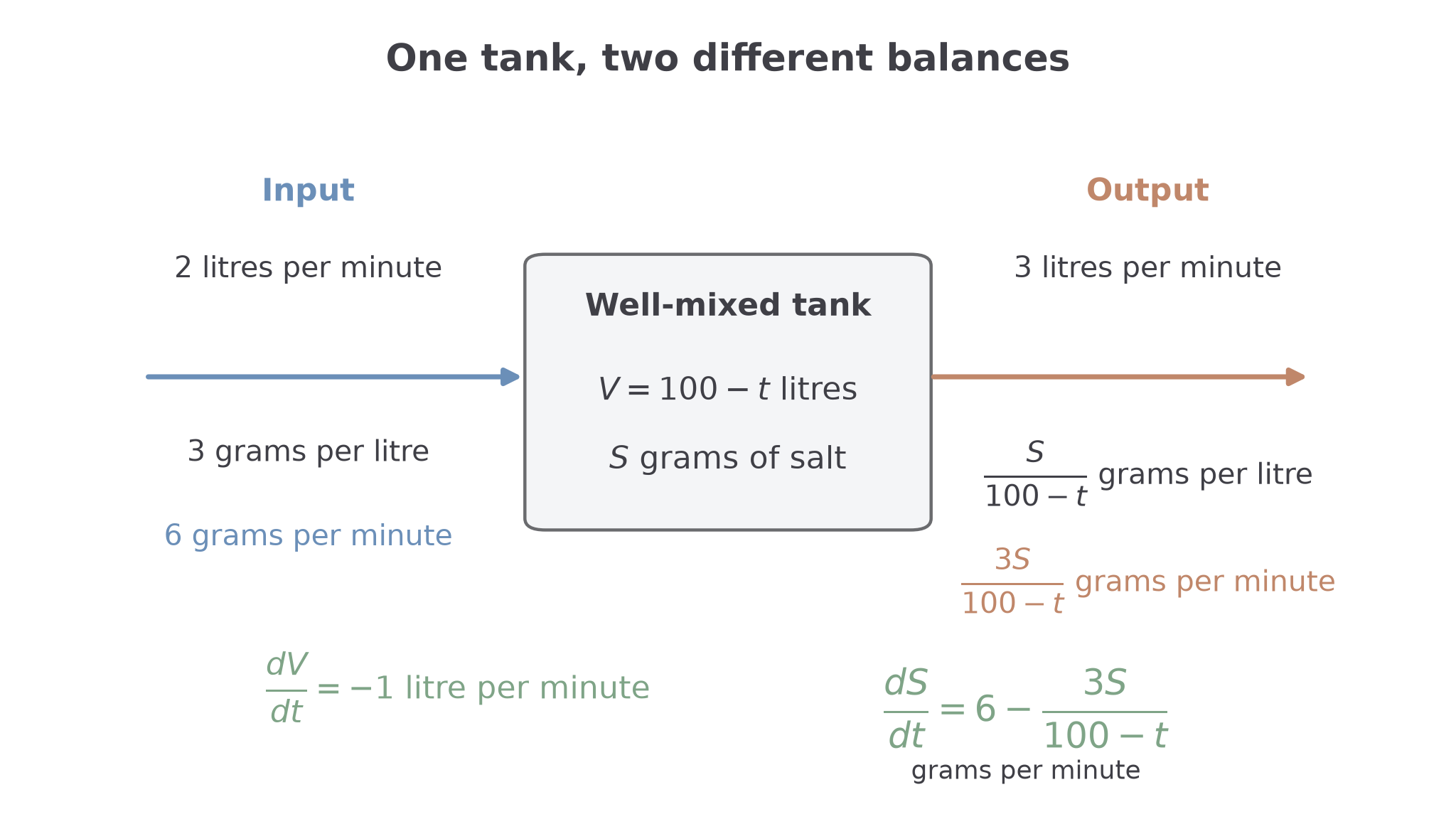
The two arrows carry liquid, but each salt rate needs a concentration as well. That conversion is what keeps the balances consistent.
Watch out
Wrong: for the draining tank. That is the liquid-volume rate, in litres per minute. Right: the salt-mass rate is , in grams per minute.
Use both balances in the next question. The time interval is part of the model, not an optional extra.
Continue this lesson.
You’re previewing NovaLearn without an account. Create a free account to read the rest.
Create free account