Pj6–Pj8 - Modulus-argument form
Describe a complex number by its size and direction, then use those two pieces of information to multiply and divide. Pj6 supplies exact radian angles, Pj7 connects Cartesian and modulus-argument forms, and Pj8 turns a long expansion into a short calculation with lengths and angles.
Size, direction and the right quadrant
Can two complex numbers each have a negative real part, yet their product be positive and real? Try : the product is . Size and direction will explain this without expanding the brackets.
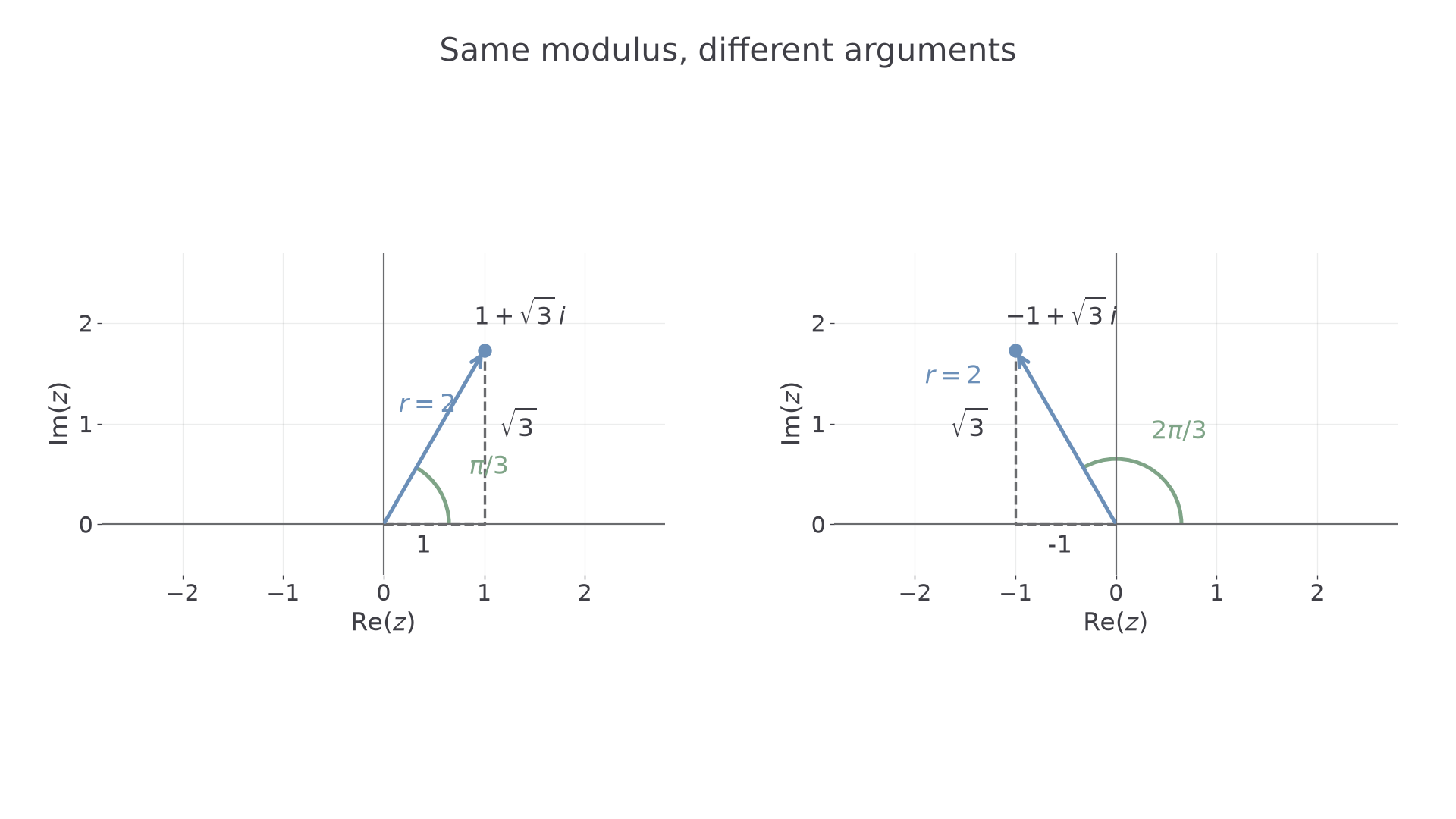
For , a right-angled triangle has horizontal side , vertical side and hypotenuse . Its direction is , since and . The same length with a negative horizontal side points in a different direction.
You already know
For , where and are real, . Exact trigonometric values and the signs of sine and cosine identify an angle's quadrant. A full turn is radians.
Here are the reference angles you will use repeatedly. Their values come from an equilateral triangle split in half and an isosceles right-angled triangle. Extend them to other quadrants using signs, rather than memorising a separate table for every angle.
These exact values are not listed in the formula booklet: learn them. In this topic, give arguments in radians.
[DIAGRAM: asset_name: Equal lengths in different quadrants; asset_slug: b003_007_modarg_quadrants; caption: The numbers 1 plus square root 3 i and minus 1 plus square root 3 i both have modulus 2 but different arguments; description: Two equal-scale Argand panels show the vectors from the origin to (1, square root 3) and (-1, square root 3). Right triangles label the signed horizontal components, the positive vertical component and length 2. Counterclockwise arcs label pi over 3 and 2 pi over 3 respectively.]
Modulus and principal argument
The modulus is the non-negative distance of from the origin. For , the principal argument is its direction measured anticlockwise from the positive real axis, chosen in the interval
For example, , not . The number has modulus , but its argument is undefined.
Any angle differing by a whole number of turns gives the same direction. The principal interval selects one of them. Negative angles turn clockwise: the direction has principal value .
Finding modulus and argument
For , put and . Then
Use the signs of both coordinates to choose . The relation , when , does not identify the quadrant by itself.
Not in the formula booklet: learn it.
Find the length first, then choose the angle from its sine and cosine. This avoids a calculator's inverse tangent returning a direction on the opposite side of the origin.
Worked example 1: a first-quadrant number
Question. Find the modulus and principal argument of .
Plan. Calculate the distance, then identify the angle from both trigonometric ratios.
Why this step? Both ratios are positive, so the direction must be in the first quadrant.
Answer. and .
Check. .
The second example changes only the sign of the real part. The distance and reference angle stay the same; the quadrant changes.
Worked example 2: the same length in the second quadrant
Question. Find the modulus and principal argument of .
Plan. Calculate the modulus, then use the negative cosine and positive sine to select the angle.
Why this step? points into the fourth quadrant and has the wrong signs for this number.
Answer. and .
Check. and , recovering both parts.
The negative real axis is the one place where the choice of endpoint in the principal interval matters.
Watch out
Wrong: , because its imaginary part is zero. Right: , because it lies on the negative real axis. Also, : a modulus is never negative.
Now change the sign of the imaginary part as well, and express the direction in the required interval.
Moving between the two forms
A point with length and direction has horizontal component and vertical component . This gives a second way to write exactly the same complex number.
Modulus-argument form
For , with ,
where and . Use when a principal argument is required; angles differing by , for integer , represent the same number.
Not in the formula booklet: learn it.
The brackets matter: multiplies both components. For example, the previous part gives . To go in the other direction, evaluate the sine and cosine exactly.
Worked example 3: converting to Cartesian form
Question. Express in the form .
Plan. Substitute the two exact trigonometric values, then multiply both terms by .
Why this step? The factor is the full length; each coordinate is the corresponding fraction of that length.
Answer. .
Check. , and both parts are positive, as the angle requires.
Change only the angle to . The horizontal component changes sign, while the vertical component stays the same.
Worked example 4: converting a second-quadrant direction
Question. Express in the form .
Plan. Use the reference angle , applying the signs of the second quadrant.
Why this step? is short of the negative real axis, rather than above the positive real axis.
Answer. .
Check. , and , , matching its quadrant.
An exact-form answer should preserve exact lengths and angles, rather than replace them by rounded decimals.
Exam tip
“Express in exact modulus-argument form” needs the complete expression , with the same angle in both places. Giving only and , omitting , or using a different requested form loses credit.
The next number has a clockwise direction. Use the signs of sine and cosine before multiplying.
Watch out
Wrong: . The outside factor multiplies both components. The correct result is .
Apply that same distribution to both coordinates below.
Multiply lengths and add directions
There is a surprisingly neat multiplication rule hiding inside the brackets. Put and . Expanding gives
The angle-addition identities turn the expanded real and imaginary parts into one new direction. Those trigonometric identities are in the formula booklet; the complex multiplication rule itself is not.
Product in modulus-argument form
For non-zero and ,
The moduli multiply and the directions add. If necessary, add or subtract a multiple of to obtain the principal argument of the product.
Not in the formula booklet: learn it.
Adding directions can take you outside the principal interval. That does not make the product wrong; it means its direction needs an equivalent principal value.
Worked example 5: a product within the principal interval
Question. Multiply and . Give the product in modulus-argument form and Cartesian form.
Plan. Multiply and , add the two angles, then evaluate the new sine and cosine.
Why this step? A product combines the two directions by addition, even though its coordinates do not multiply separately.
Answer. .
Check. In Cartesian form, and . Expanding gives real part and imaginary part .
Change only the direction of to . The sum now passes , so the principal argument needs adjusting.
Worked example 6: reducing the product's argument
Question. For the same , let . Express in modulus-argument form using its principal argument.
Plan. Multiply the moduli, add the directions and subtract one full turn.
Why this step? and point in the same direction, but only the latter lies in .
Answer. .
Check. This gives ; its modulus is and its direction is in the third quadrant.
The modulus rule and the argument rule do different jobs. Keep them on separate lines while learning the method.
Watch out
Wrong: . Right: . Arguments add, while moduli multiply. Also, equals the sum of principal arguments only after adjusting by a multiple of when necessary.
For the next product, the new angle is negative already. Check that it still lies in the principal interval.
Divide lengths and subtract directions
Division reverses multiplication. If , then : the modulus of must multiply to give , and its direction must add to to give .
Quotient in modulus-argument form
For , ,
Divide the moduli and subtract the denominator's direction from the numerator's direction. Adjust to the principal interval if required. Division by is undefined; a quotient with zero numerator is , whose argument is undefined.
Not in the formula booklet: learn it.
When numbers are supplied in modulus-argument form, this is the natural route. If a detailed-reasoning question instead asks you to divide two Cartesian expressions, show the conjugate method you learnt earlier.
Worked example 7: a quotient
Question. Let and . Find in modulus-argument form.
Plan. Divide by , then subtract from .
Why this step? Multiplying this quotient by must restore , so the angle must be removed before it is added back.
Answer. .
Check. .
Change only the denominator's direction to . Subtracting a negative angle increases the result, and this time it exceeds .
Worked example 8: a negative denominator argument
Question. For the same , let . Find using its principal argument.
Plan. Divide the moduli, subtract the whole negative angle, then reduce by .
Why this step? The denominator's argument is one signed quantity. Brackets prevent its minus sign from being lost.
Answer. .
Check. The quotient is , and .
The opening puzzle now has a geometric explanation: and have modulus and arguments , . Their product has modulus and direction , so it is the positive real number .
Problem-solving
Choose the form that makes the operation simple. Addition and subtraction suit ; multiplication and division often suit modulus-argument form. Always check the final quadrant and the requested form.
The denominator below moves anticlockwise from the previous example. Track the change before reducing the answer.
Watch out
Wrong: . Subtracting a negative adds it: the direction is , whose principal value is .
Bracket the denominator’s complete signed argument before subtracting it.
Quick Recap
- For , and .
- Use both coordinate signs to choose ; is undefined.
- Modulus-argument form is ; use exact trigonometric values for multiples of and .
- Multiply moduli and add directions for a product; divide moduli and subtract directions for a quotient.
- Adjust a final direction by a multiple of when a principal argument is required.
Two negative real parts can produce a positive real product: the opposite arguments of cancel, while their moduli multiply to .