Ps2 - Summing series with partial fractions
Use partial fractions to uncover cancellation inside a rational series. You will choose a decomposition that exposes shifted terms, retain the correct finite boundaries, and deduce exact sums to infinity.
Exposing the hidden difference
How can have an exact total?
The fractions do not have a constant ratio, so a geometric-series formula is no help. But
reveals a gap-two telescoping sum. The cancellation you already know is hidden inside the denominator.
You already know
Partial fractions rewrite a rational expression as simpler fractions. To find constants and , clear the denominator and equate coefficients or substitute values of the variable. A difference can telescope when summed.
The spacing between factors controls both the decomposition's scale and the eventual boundary count.
Two shifted linear factors
For , and values of with neither denominator zero,
Check it by combining the fractions: the numerator inside the brackets is .
Not in the formula booklet: learn it.
You can reconstruct this identity from ordinary partial fractions, so there is no need to memorise a different version for each pair of factors.
Worked example 1: neighbouring factors
Question. Express in partial fractions.
Plan. Use one fraction over each factor and find the constants after clearing denominators.
Why this step? Substituting and is legitimate in the polynomial identity after denominators are cleared, although the original fractions are undefined there.
Answer. , for .
Check. At , .
Change only the factor gap from one to three. The coefficient can no longer be left as .
Worked example 2: separated factors
Question. Express in partial fractions.
Plan. Find the constants over the two linear factors, keeping the gap factor.
Why this step? Without the factor , recombining the two fractions would give numerator , not .
Answer. , for .
Check. At , .
For a series indexed by positive integers, these example denominators never vanish. Checking the actual index range matters before any summation is attempted.
Watch out
Wrong: . Right: multiply the difference by . Recombine your proposed fractions to check the scale.
The next denominator shifts both factors, while keeping the same decision about their spacing.
Finite sums and their surviving boundaries
After decomposing, write enough initial and final terms to show the cancellation; the partial fractions alone are not yet a summed series.
For the opening terms, the gap is two. The beginning contributes , while the end contributes two negative fractions. Keep the coefficient around the entire result.
Worked example 3: the opening finite sum
Question. Find , where .
Plan. Decompose with coefficient , telescope the gap-two series, then simplify the constant.
Why this step? Both final negative fractions survive. The factor multiplies them as well as the initial terms.
Answer. .
Check. At , .
Change only the first index from to . The decomposition and final boundary terms stay the same.
Worked example 4: a later starting point
Question. For , find .
Plan. Start the gap-two cancellation at , then keep the two first positive terms.
Why this step? The first two denominators are now and ; retaining and would add terms absent from the question.
Answer. .
Check. At , .
A neat final formula is useful, but the written cancellation is what establishes why those particular boundaries remain.
Exam tip
For a method-of-differences solution, show enough terms to demonstrate consistent cancellation, including the first term and the final unmatched terms. An unexplained final formula can leave the method unshown.
Now shift the first boundary once more.
Watch out
Wrong: the later-starting sum leaves . A gap of two leaves two negative end terms, not one. The correct boundary expression is .
Write the last two expanded terms before deciding what cancels.
Exact totals for infinite rational series
The finite boundary terms often vanish as grows, leaving an exact sum to infinity that is much simpler than the individual fractions suggest.
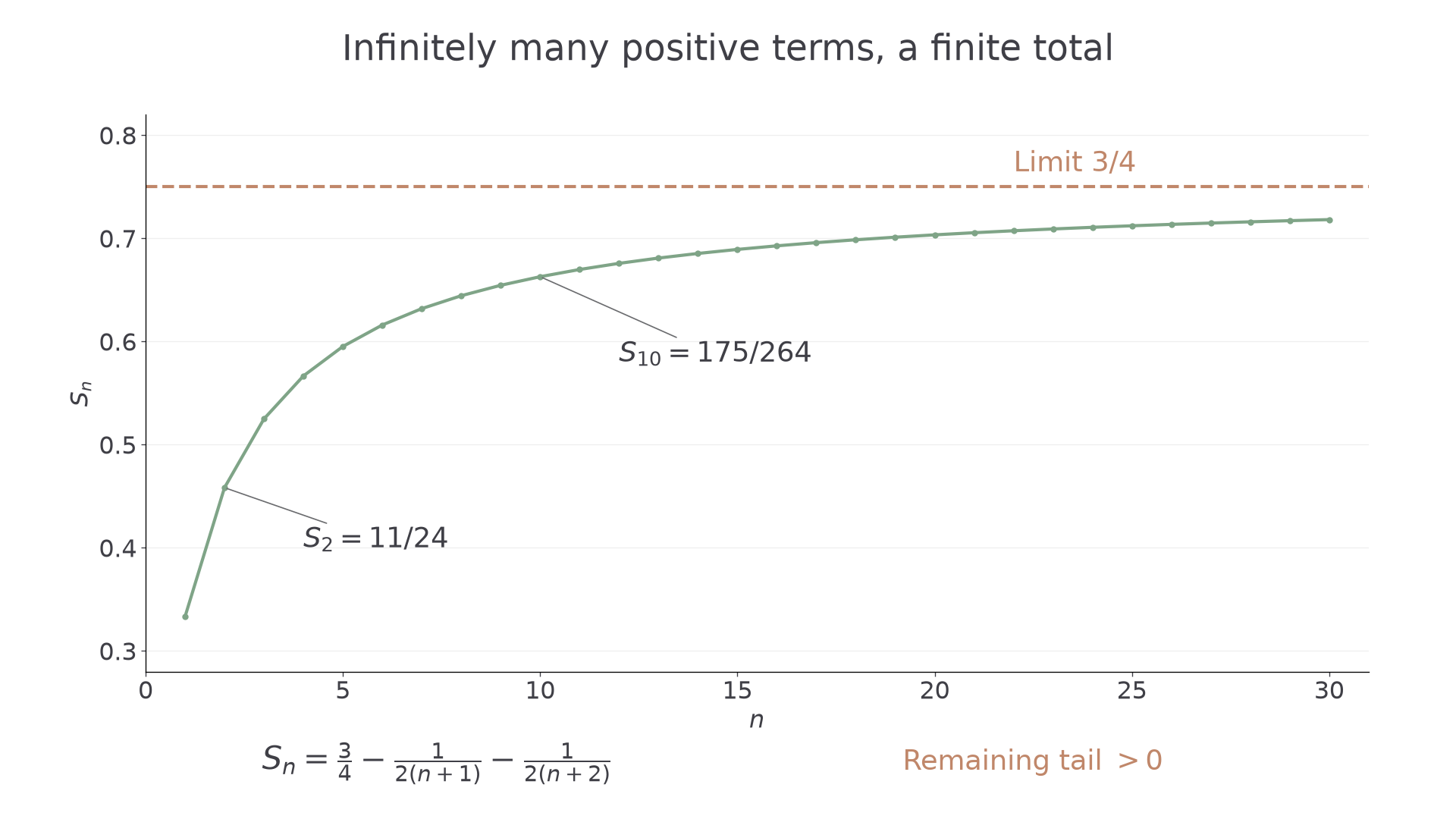
[DIAGRAM: asset_name: Partial sums approaching three quarters; asset_slug: rational_series_limit; caption: The opening rational series approaches three quarters from below; description: A graph shows the finite sums of 1 over r times r+2 for indices 1 to n, for n from 1 to 30. Sage points rise towards the horizontal clay line at 0.75. Labels at n=2 and n=10 give 11/24 and 175/264, and a note identifies the positive remaining tail.]
You already know
An infinite series converges when its finite partial sums have a finite limit. Establish before taking ; do not split the infinite series into two divergent infinite sums.
The partial-fraction identities and resulting rational sums are not printed in the formula booklet. Their limits follow from the finite expressions you derive.
Worked example 5: a shifted adjacent pair
Question. Find .
Plan. Decompose, telescope the finite sum and let the final reciprocal vanish.
Why this step? The first positive fraction is , because the first factor is , not .
Answer. .
Check. The first term is , and all terms are positive; the total is larger, as it must be.
Change only the second factor from to . Both the coefficient and the boundary count change because the gap has widened.
Worked example 6: a wider gap to infinity
Question. Find .
Plan. Use coefficient and retain two fractions at each finite boundary before taking the limit.
Why this step? Taking the limit only after keeping both final fractions prevents an incomplete cancellation argument.
Answer. .
Check. Each denominator is larger than , so its total should be below the previous total ; is.
The opening sum is therefore : its finite sum from the previous section has two tail fractions that vanish. Infinitely many positive terms fit inside the remaining gap, however many terms you have already added.
Watch out
Wrong: cancel two infinite harmonic sums separately and write “infinity minus infinity”. Right: cancel inside , where all sums are finite, and then take one limit.
The last question changes both shifts while keeping the same gap-based decision.
Quick Recap
- Decompose the rational summand to expose a difference.
- The spacing between factors determines the coefficient and boundary count.
- Keep the actual lower index when writing the initial survivors.
- Take the limit of the complete finite expression to obtain a sum to infinity.
The opening non-geometric rational series has exact sum .