Mw6, Mw7 - Energy conservation and the work-energy principle
Energy methods link the beginning and end of a motion without finding every intermediate acceleration. In Mw6 you identify when mechanical energy is conserved; in Mw7 you include the work of driving and resistive forces when it is not. The main habit is to account for each energy transfer exactly once.
When mechanical energy is conserved
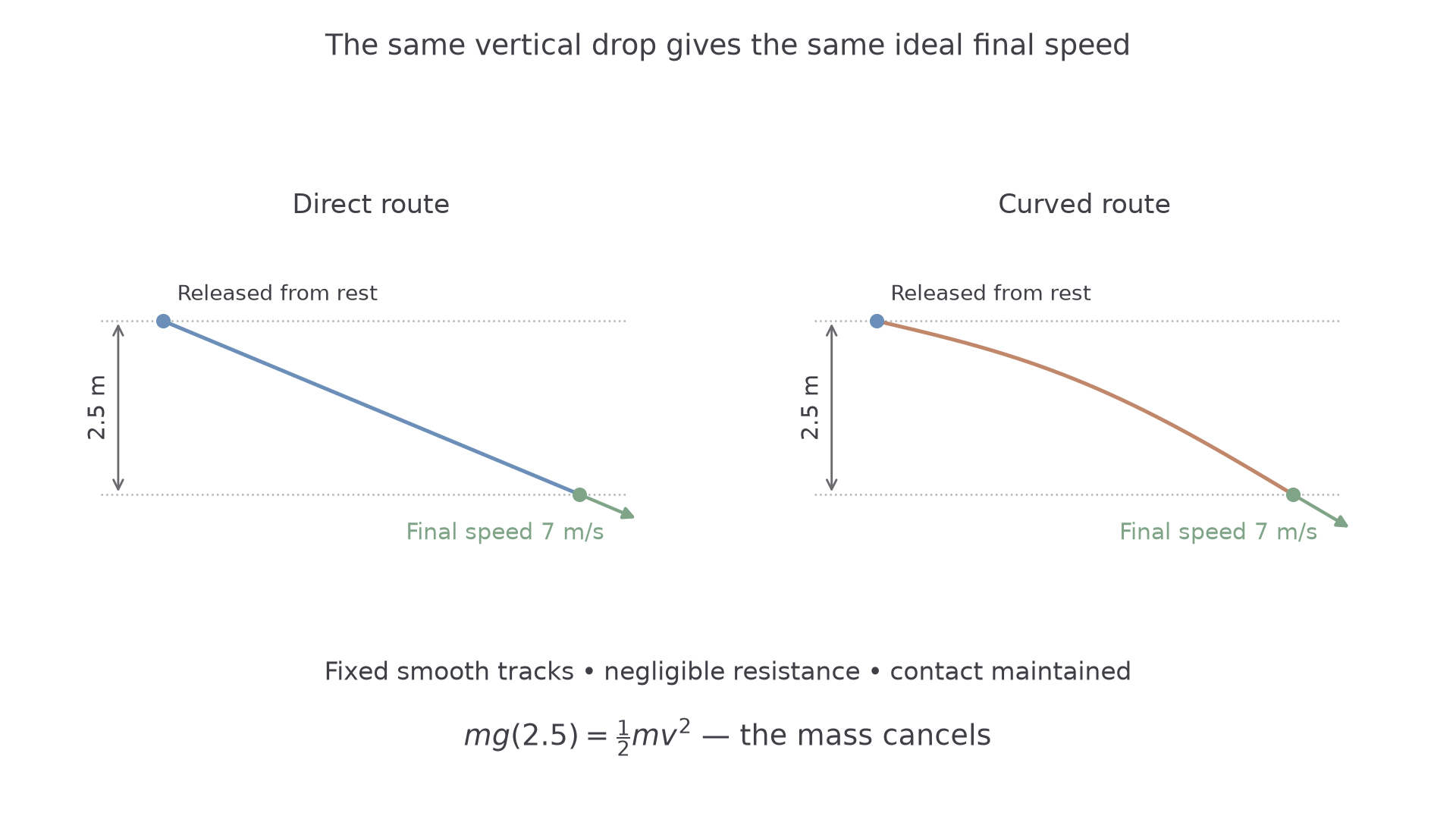
Two smooth slides start at the same height and finish lower. One is direct and the other winds around. Which gives a particle released from rest the greater final speed?
Provided each track is fixed, the particle stays in contact and resistance is negligible, neither wins. Gravity does the same work for the same vertical drop, and each normal contact force acts perpendicular to the motion. Energy connects the endpoints even when the acceleration changes along a curved route.
You already know
, , and the work done by gravity is . A force perpendicular to the displacement does zero work. Use .
Mechanical energy is conserved when conservative forces account for the energy transfer and no external driving or dissipative work changes the mechanical total. A smooth surface can still exert a force: what matters here is that its normal force does no work.
Conservation of mechanical energy
When gravity is the only force doing work:
Equivalently,
This requires negligible dissipative work and no additional energy input.
Not in the formula booklet: learn it.
Choose a convenient zero height, often the final point. The difference in potential energy will be the same whichever reference you choose.
[DIAGRAM: asset_name: Different smooth routes with the same vertical drop; asset_slug: smooth_routes_energy; caption: A shared vertical drop gives the same final speed when the particle starts with the same speed and resistance is absent; description: Two schematic smooth tracks connect points at a common starting height to a common finishing height 2.5 m lower. One route is direct and the other curved. Both have a blue particle released from rest at the top and a sage final arrow labelled speed 7 m per second. A vertical height marker is separate from the path lengths. A side note says fixed smooth track, negligible resistance and contact maintained.]
Worked example 1: release from rest on a smooth track
Question. A particle is released from rest on a fixed smooth track. It descends through a vertical height of . Neglect resistance and assume contact is maintained. Use energy to find its final speed.
Plan. Set the final height to zero and equate the lost gravitational potential energy to the gained kinetic energy.
Why this step? The normal force does no work, so the route's shape does not enter the endpoint energy equation. The mass cancels from both energy terms.
Answer. The final speed is , for either slide in the opening question.
Check. Per kilogram, the lost potential energy is , equal to .
The next example changes only the initial speed. Its initial kinetic energy must now remain in the equation.
Worked example 2: an initial speed is already present
Question. A particle starts at on the same fixed smooth track and descends through . With the same assumptions, use energy to find its final speed.
Plan. Add the initial kinetic energy to the gravitational potential energy released.
Why this step? The descent adds energy to motion that already exists. Dropping the term would model a release from rest instead.
Answer. .
Check. The final speed exceeds both and the rest-release result, as the extra initial energy requires.
This gives a useful mathematical surprise: in the ideal gravity-only model, neither mass nor route shape affects the final speed for given initial speed and vertical drop. They can affect the motion and travel time, but not this endpoint energy result.
Watch out
Wrong: conserve merely because the surface is smooth. A separate resistive force or a motor can still change mechanical energy. Right: list which forces do work and check the model's assumptions before choosing conservation.
Change the initial speed once more, retaining the same height drop.
Maximum height and motion at the endpoint
Choose endpoints where you know the relevant speed, and distinguish being momentarily highest from being completely at rest.
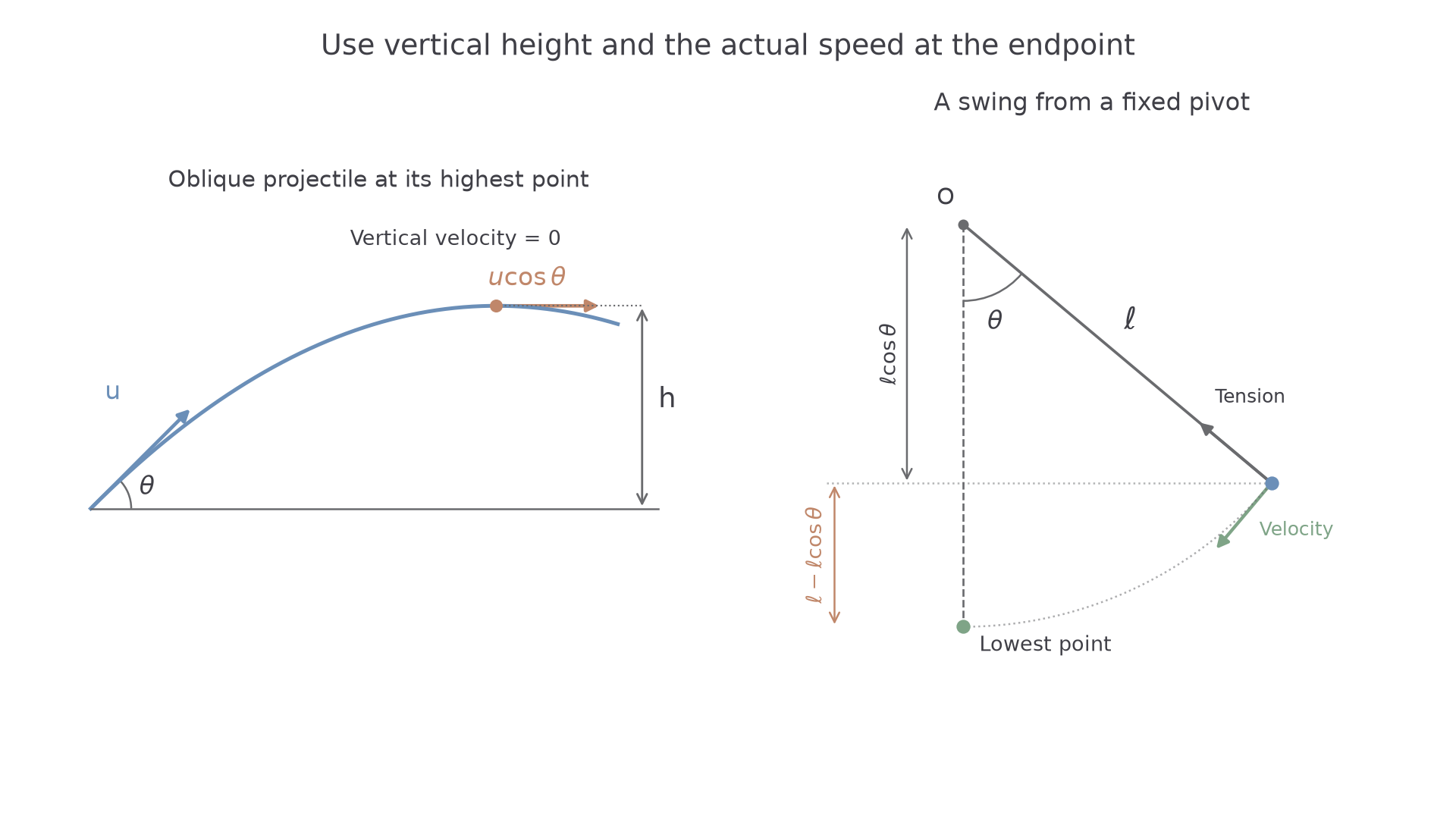
A vertically projected particle is at rest at its highest point. An oblique projectile still has horizontal velocity there: only its vertical component has become zero. Energy must include that surviving motion.
Energy for an ideal projectile
With no air resistance, and initial height chosen as zero:
At maximum height of a projectile launched at angle to the horizontal, the remaining speed is . Substitution gives
This follows from conservation and constant horizontal velocity; derive it when using an energy method.
Not in the formula booklet: learn it.
For other constrained motions, use the geometry to find the vertical height change. A light inextensible rope of length , fixed at its upper end, gives a vertical drop from an angle to the downward vertical to its lowest point. The tension is perpendicular to the motion and does no work.
[DIAGRAM: asset_name: Heights for a projectile and a swing; asset_slug: projectile_and_swing_heights; caption: A projectile retains horizontal speed at the top; a swing loses height ell minus ell cos theta; description: The left panel shows a projectile launched at angle theta, its highest point marked with a horizontal velocity u cos theta and zero vertical velocity, and a vertical height marker h. The right panel shows a rope of length ell from a fixed pivot, once at angle theta to the downward vertical and once vertically down. The vertical projection ell cos theta and the remaining drop ell minus ell cos theta are labelled. Tension at the inclined position points towards the pivot and the velocity arrow is perpendicular to the rope.]
Worked example 3: a vertical launch
Question. A particle is projected vertically upwards at . Neglect air resistance. Use energy to find its maximum height above the launch point.
Plan. Use zero final speed at the top and transfer all the initial kinetic energy to gravitational potential energy.
Why this step? For a vertical launch, there is no horizontal motion left at the top. All of the initial kinetic energy can become potential energy.
Answer. .
Check. Per kilogram, the initial kinetic energy is , equal to .
The next example changes only the launch direction, keeping the same initial speed. Some kinetic energy now survives at the top.
Worked example 4: an oblique launch
Question. A particle is projected at , at above the horizontal. Neglect air resistance. Use energy to find its maximum height above the launch point.
Plan. Retain the horizontal speed in the final kinetic energy.
Why this step? A highest point has zero vertical velocity, not necessarily zero speed. Omitting the horizontal kinetic energy would incorrectly give the vertical-launch height.
Answer. .
Check. The initial vertical speed is , whose kinetic energy per kilogram is , exactly the potential-energy gain per kilogram.
The same endpoint reasoning works for a swing: identify the starting and finishing heights, then include whatever speeds are actually present at those points.
Watch out
Wrong: put at the highest point of every projectile. Right: retain unless the launch is vertical. The energy that becomes GPE comes from the vertical motion.
The next launch changes only the angle again.
Continue this lesson.
You’re previewing NovaLearn without an account. Create a free account to read the rest.
Create free account